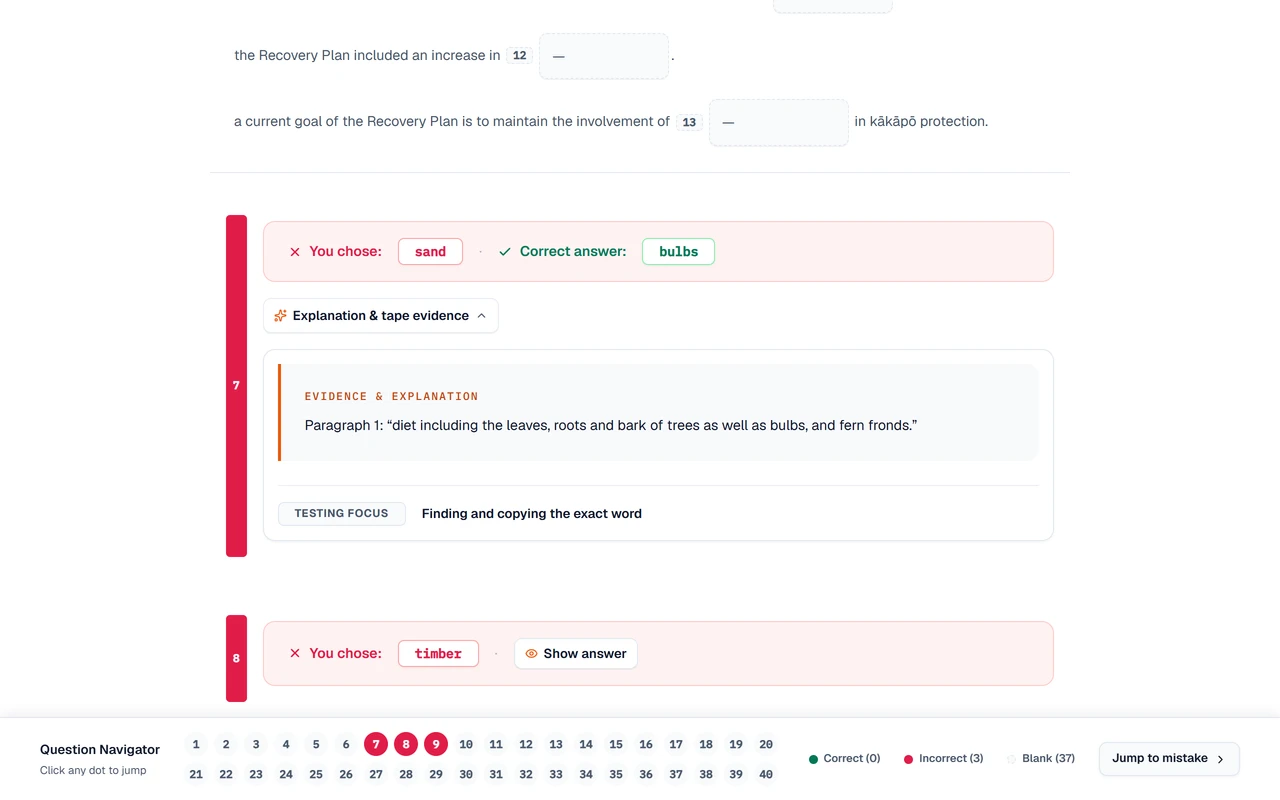
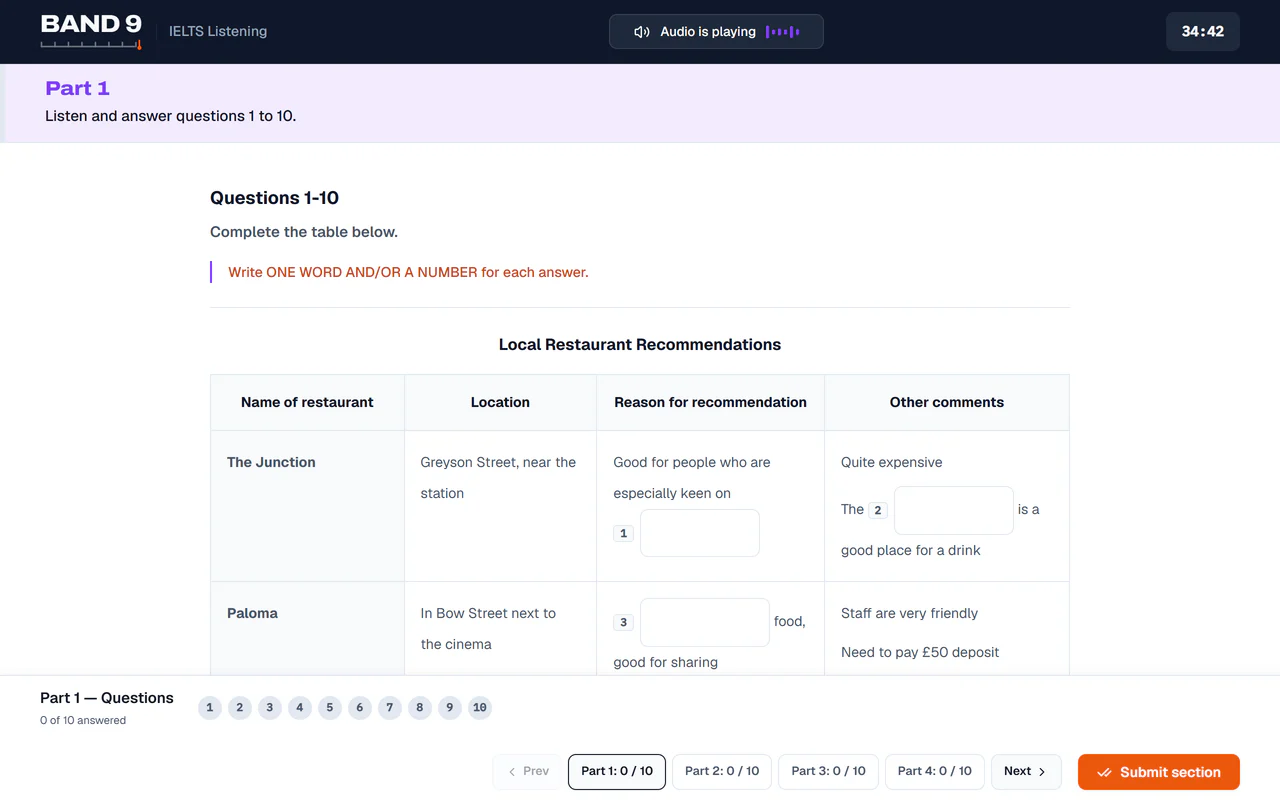
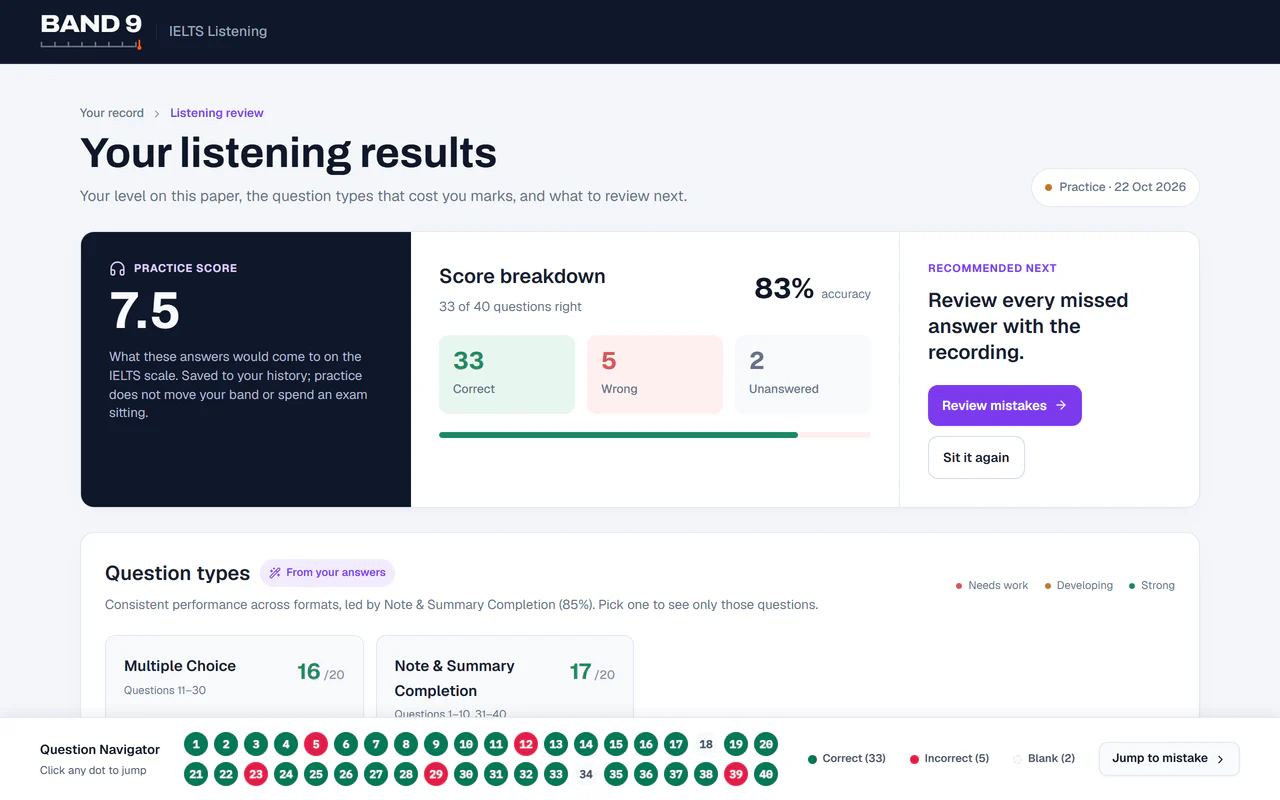
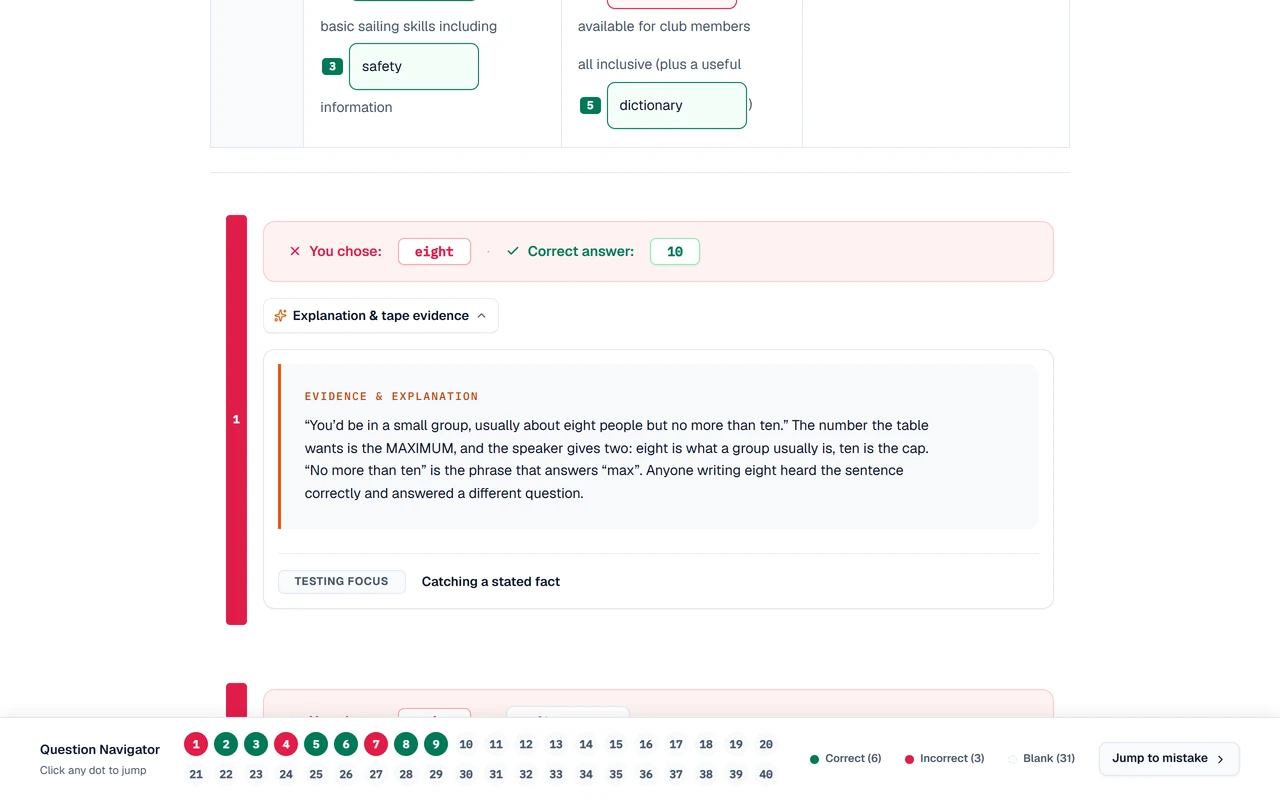
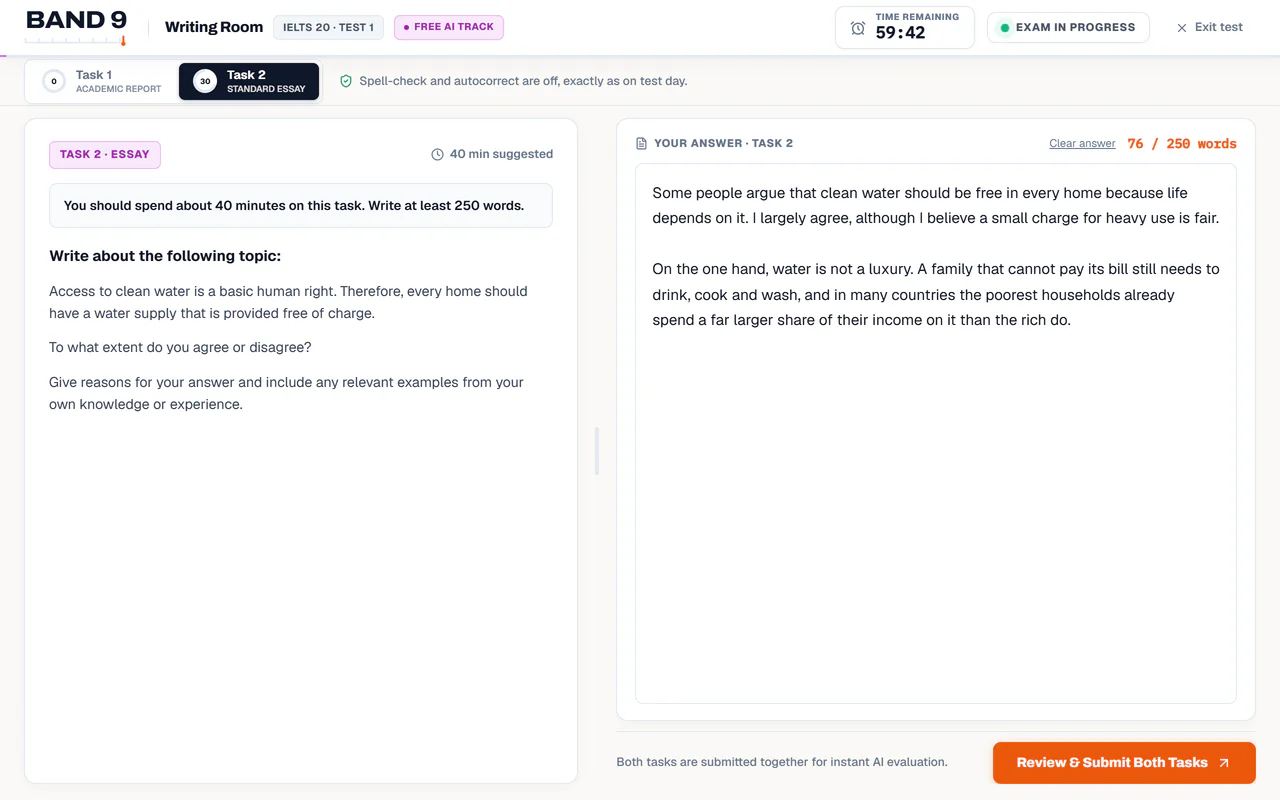
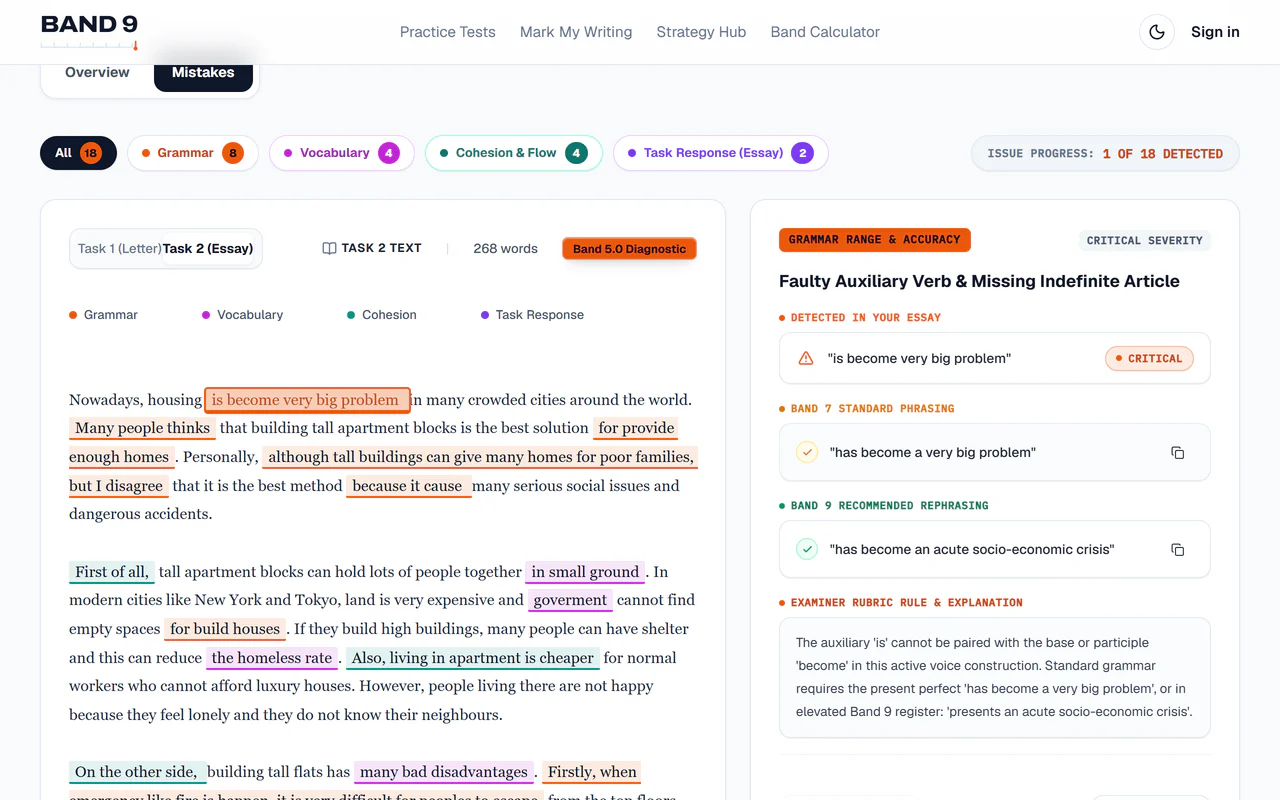
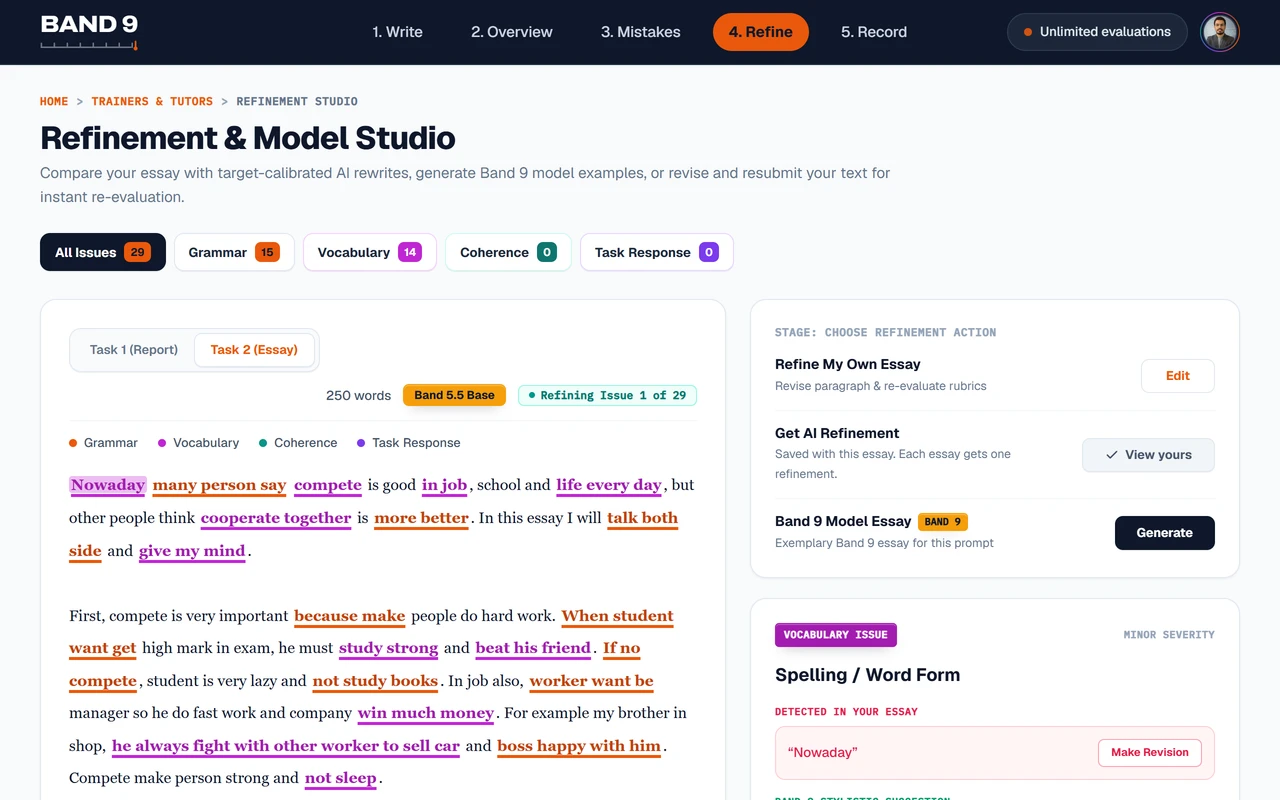
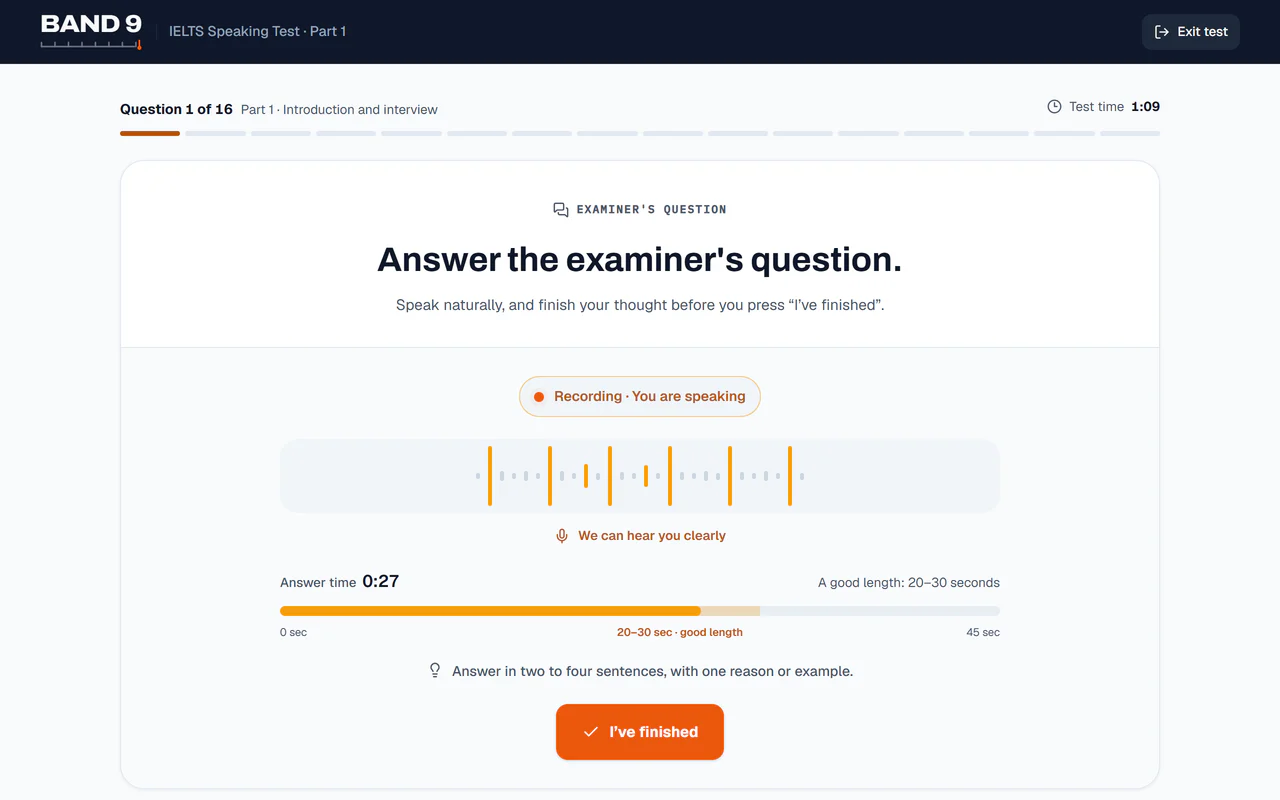
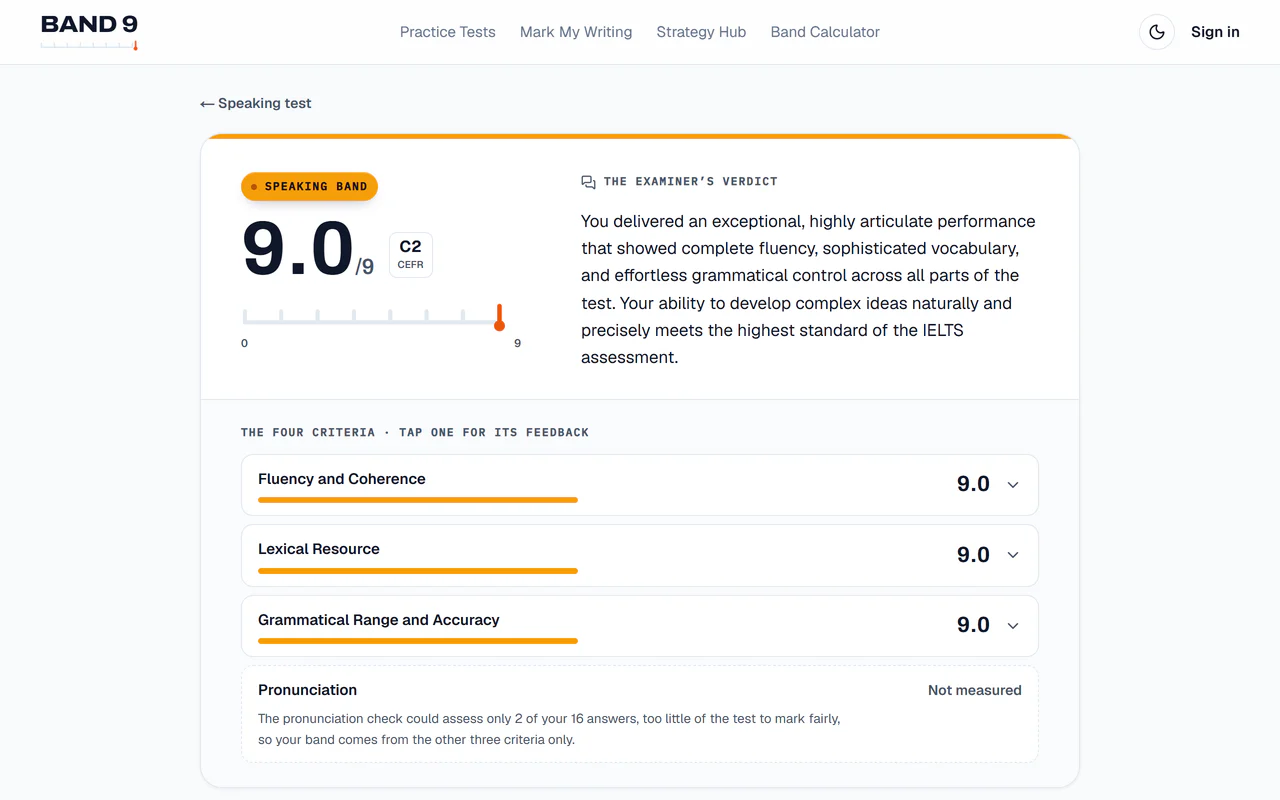
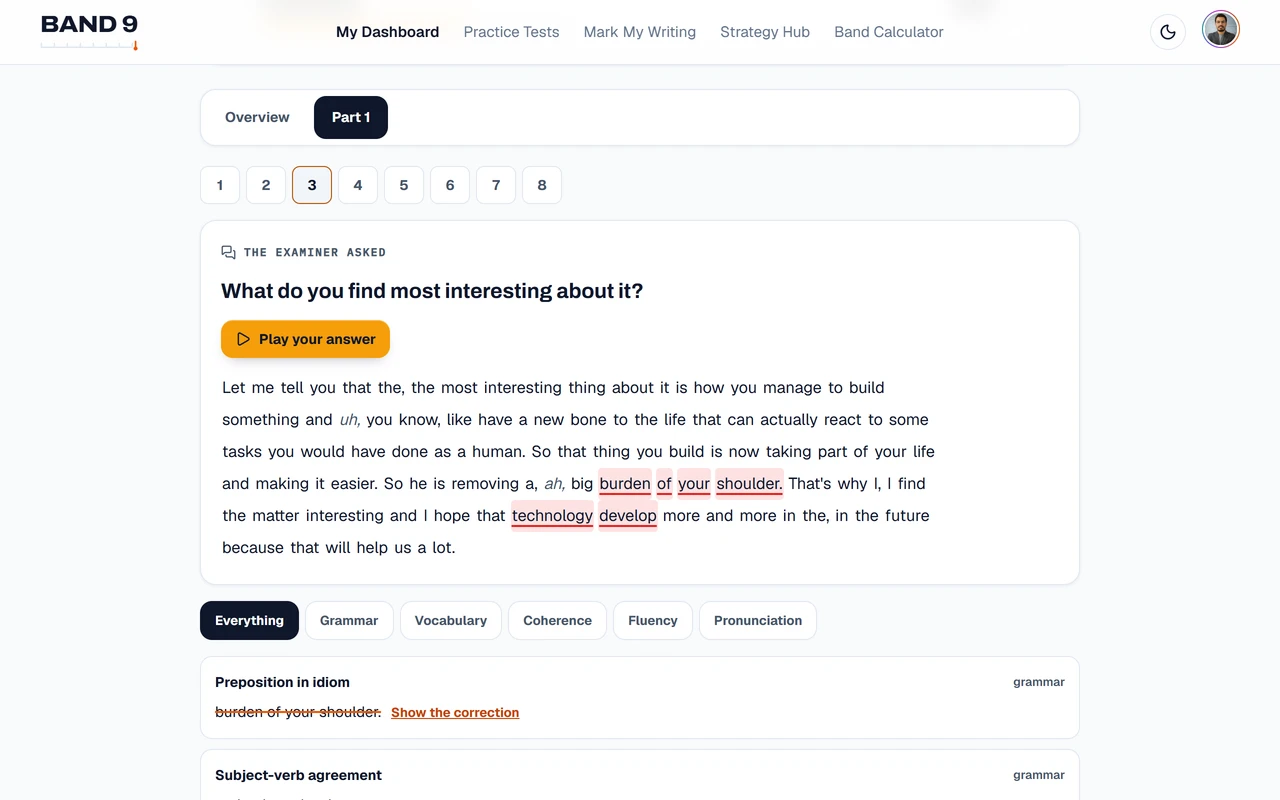
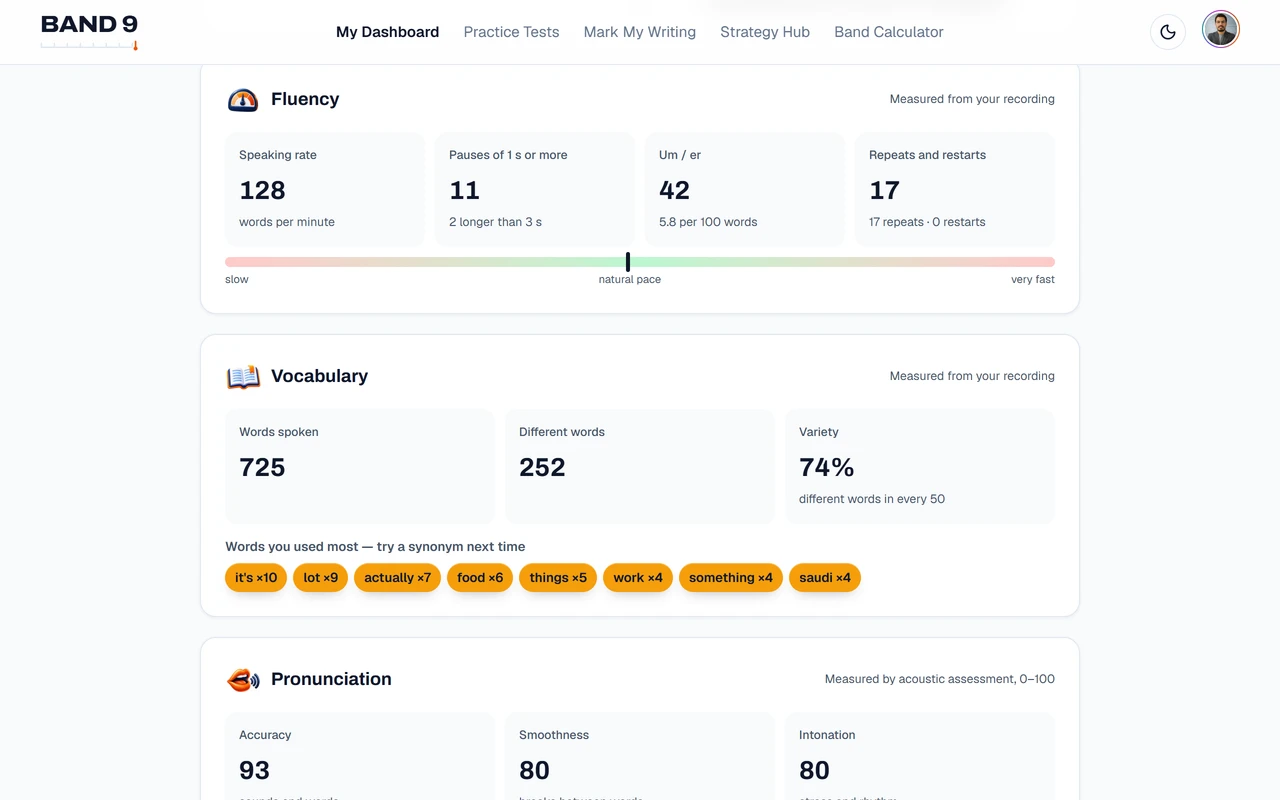
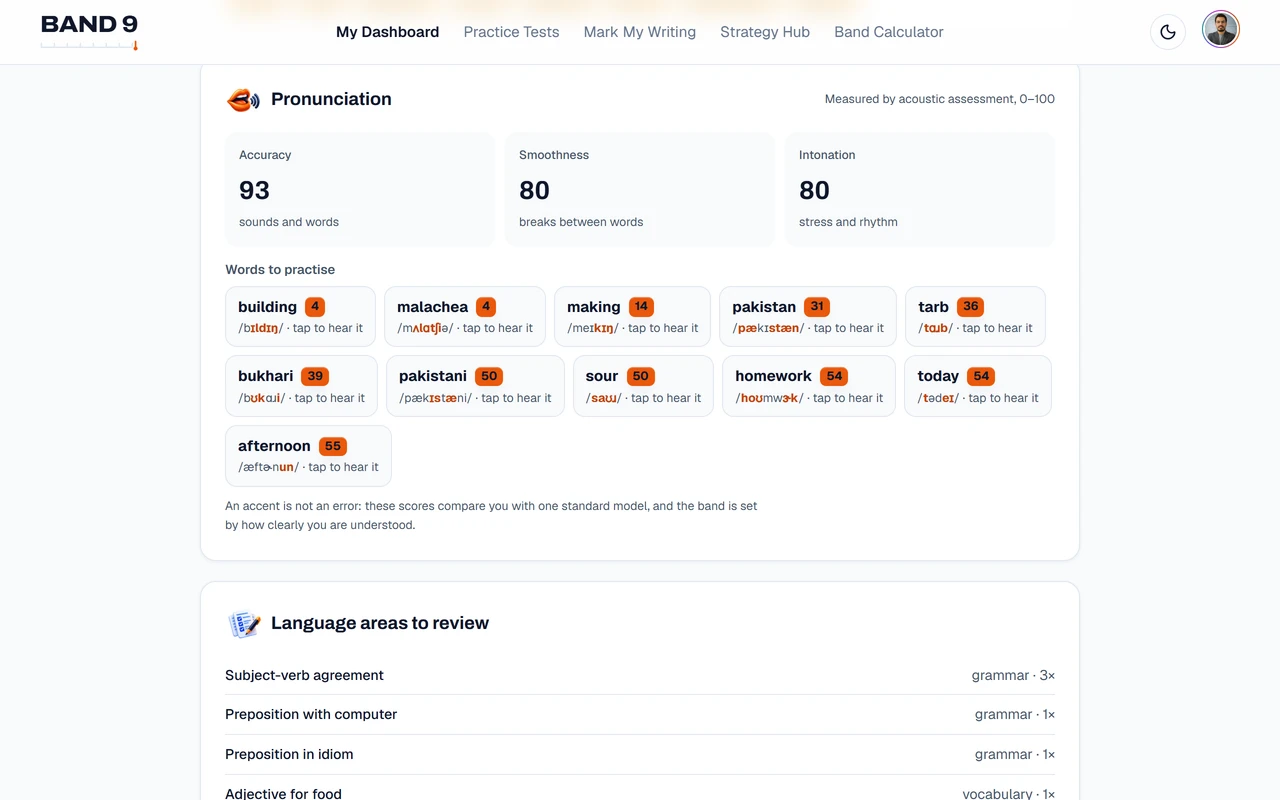
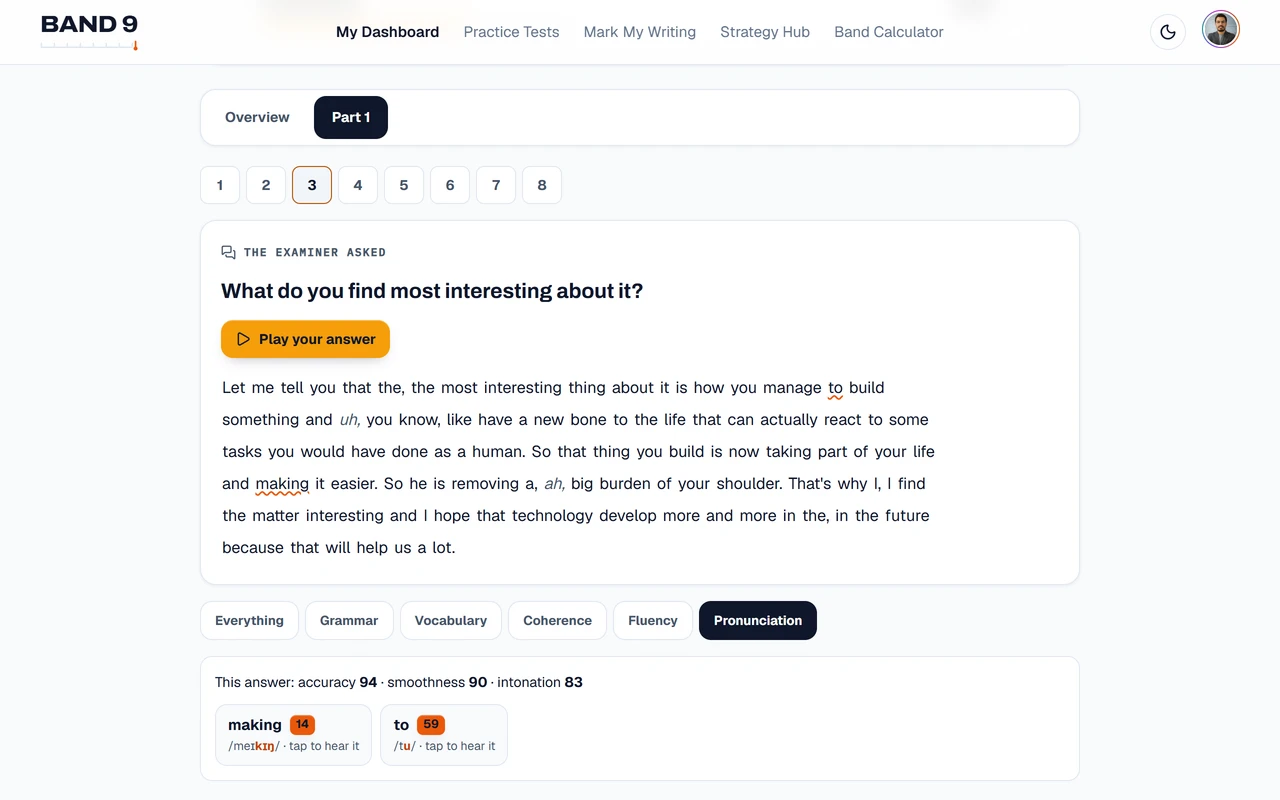
Line-by-line annotations against the four official IELTS assessment criteria, with your own sentences quoted back to you.
Sample feedback report — Writing Task 2
Writing Task 2 — technology and society
Technology has become an indispensable catalyst1 for progress in almost every field of modern life. However, the rapid pace of change also causes many damages to2 traditional communities that cannot adapt quickly enough. Furthermore, people who grow up with these tools often lose older skills.3
In conclusion, the benefits of technology outweighs4 the drawbacks for most people. Governments should invest in training. Workers need new skills. Companies should also help.5
1Band 8 lexical item
Precise and natural. This is the level of collocation that separates a 7 from an 8 in Lexical Resource — keep doing this.
2Lexical Resource — costing you the band
Unnatural collocation. “Damages” is countable here only in a legal sense. Write “causes significant disruption to”.
3Grammatical Range — simple structure
Two simple clauses where a complex conditional would show range: “If children grow up with these tools, they risk losing skills their parents took for granted.”
4Grammatical Accuracy — subject-verb agreement
“Benefits” is plural, so the verb must be “outweigh”, not “outweighs”. Subject-verb errors cost accuracy marks even when the meaning is clear.
5Grammatical Range — three simple sentences in a row
Three short declaratives where one complex sentence would show range: “Governments and companies alike should invest in retraining programmes so that workers can acquire the skills a shifting economy demands.”
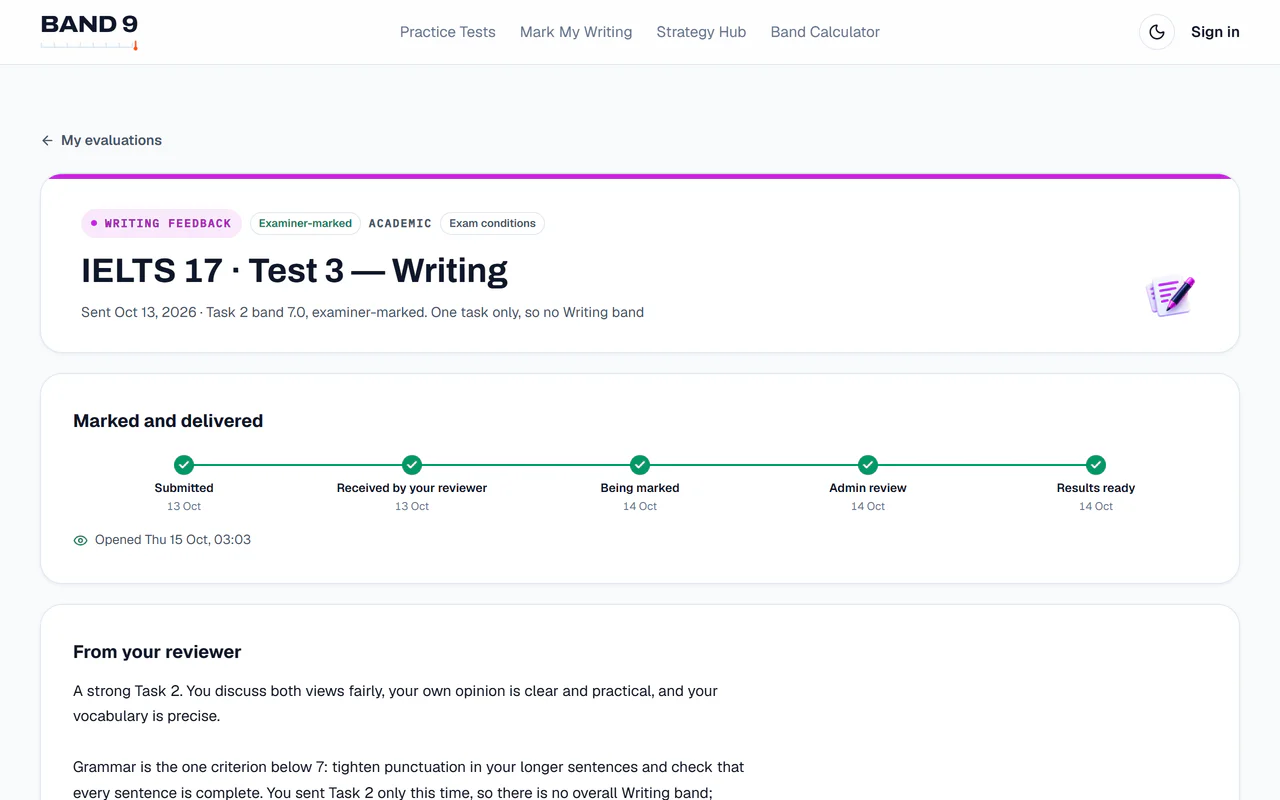
Marked by an IELTS examiner
6.5overall band
Task Response7.0
Holding · Clear position, fully developed
Coherence & Cohesion6.0
Weakest · Underdeveloped links between paragraphs
Lexical Resource7.0
Holding · Wide vocabulary, minor collocation slips
Grammatical Range & Accuracy6.0
Weakest · Frequent simple sentences
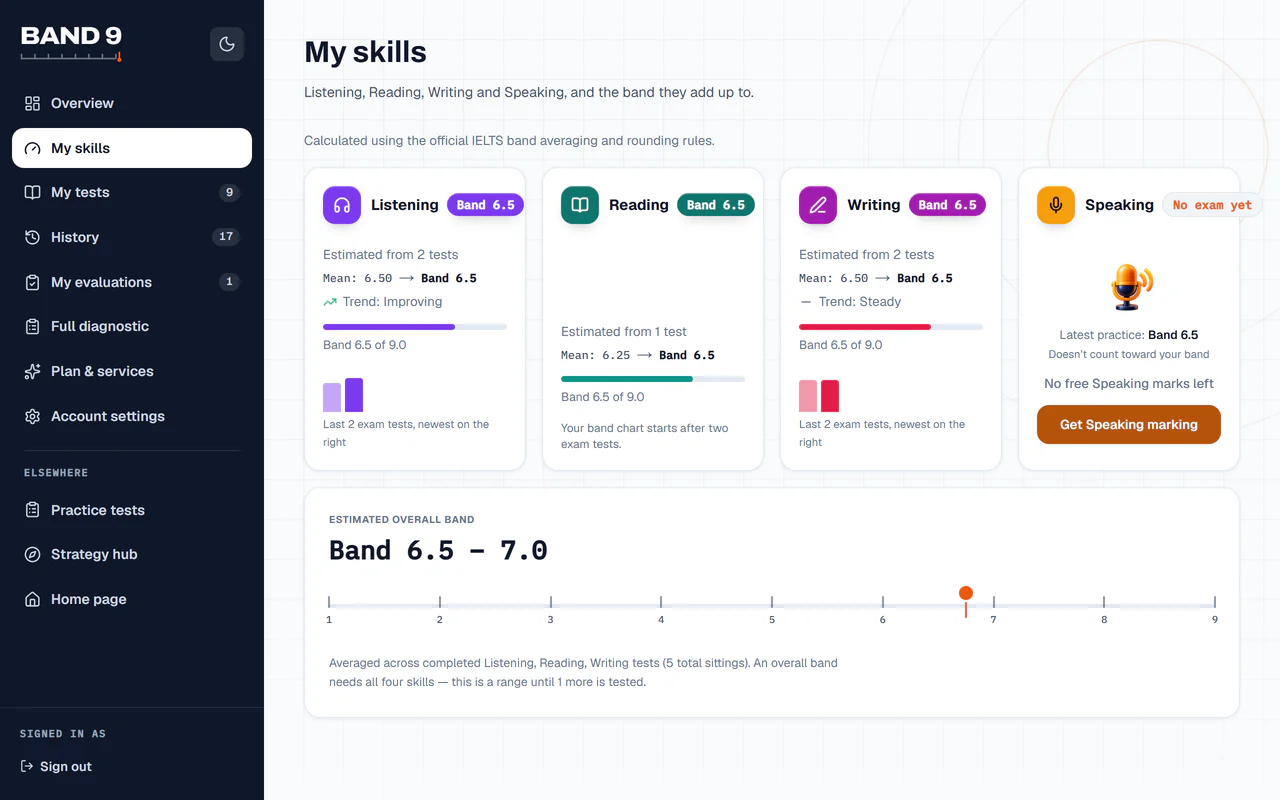
Bands run 0–9. Writing is the average of the four criteria, rounded to the nearest half band.
Evaluated against official IELTS criteria with line-by-line sentence corrections and guaranteed turnaround.
The errors shown, such as subject-verb disagreement, unnatural collocations and overreliance on simple sentences, are among the most recurring weaknesses in IELTS writing worldwide.
From our students
What students say about Band 9
In their own words, from Egypt, Sudan, Tunisia and the Philippines.
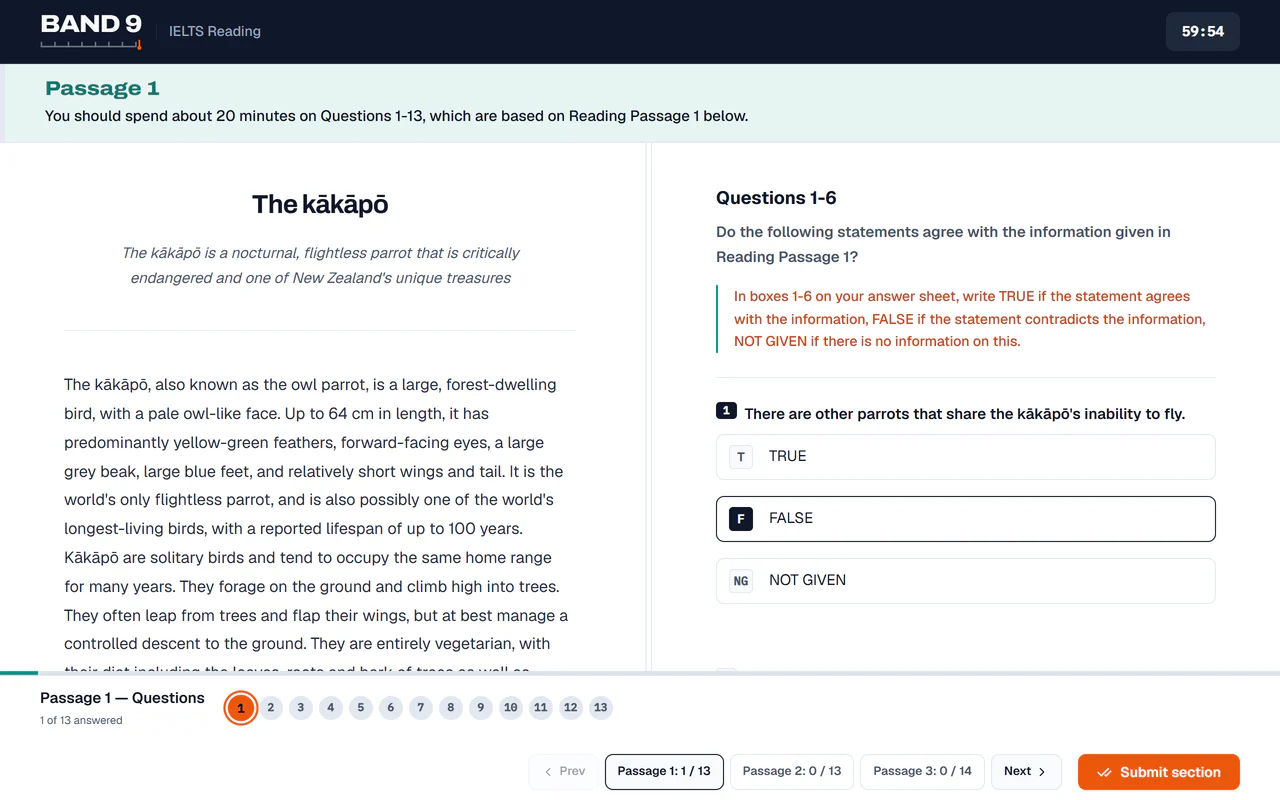
اللي عجبني في Band9 إنك بتتدرب على الامتحانات الرسمية نفسها، مش مجرد أسئلة وخلاص. بعمل الـtest كأنه امتحان حقيقي، وبعدين بشوف نتيجتي وأعرف مستوايا فين.
TranslatedWhat I like about Band9 is that you practice on the actual official exams, not just questions that look like them. I sit the test like the real exam, then see my result and know where my level is.
Ahmed BaghdadiEgypt
Band 6.0 → 7.0
الموقع وفر عليا وقت كبير جدًا. بدل ما أفضل أدور على امتحانات ومواد من أماكن مختلفة، كل حاجة تقريبًا بقت قدامي في مكان واحد، خصوصًا الـmock tests والـpractice.
TranslatedThe site saved me a huge amount of time. Instead of hunting for exams and materials in different places, almost everything is in one place, especially the mock tests and practice.
Ahmed DewidarEgypt
Band 6.0 → 7.0
أكتر حاجة استفدت منها هي إن الاختبارات timed وبتديك إحساس الامتحان الحقيقي. وكمان موضوع الـwriting والـmodel answers خلاني أراجع أخطائي بطريقة أحسن.
TranslatedWhat helped me most is that the tests are timed and feel like the real exam. And the Writing feedback and model answers let me review my mistakes much better.
Mahmoud HusseinEgypt
والله Band9 فادني شديد، خصوصًا في موضوع التمرين على الامتحانات الرسمية. بقيت أتعامل مع الـtest كأنو امتحان حقيقي وأعرف مستواي وين بالضبط.
TranslatedHonestly, Band9 helped me a lot, especially practicing on official exams. I started treating the test like the real exam and knowing exactly where my level is.
Mohamed KamalSudan
Band 6.0 → 6.5
الحاجة العجبتني إنو الموقع ما مجرد نصائح IELTS، عندك امتحانات كاملة ومصادر للمراجعة والـlistening transcripts والـvocabulary. الموضوع خلاني أنظم مذاكرتي أحسن.
TranslatedWhat I liked is that it isn’t just IELTS tips: you get full exams, revision resources, Listening transcripts and vocabulary. It helped me organise my studying better.
Ahmed AbdelrahimSudan
بصراحة Band9 عجبني برشا، خاصة خاطر التمارين مبنية على الامتحانات الرسمية الحقيقية. تنجم تعمل الـmock test في الوقت متاعو وتشوف مستواك وين، وهذا يعاون برشا باش تعرف على شنوة يلزمك تركز أكثر.
TranslatedHonestly, I really liked Band9, especially because the practice is built on real official exams. You can sit the mock test in its real time and see where your level is, and that helps a lot to know what you need to focus on.
Youssef ElfahemTunisia
What I really like about Band9 is that it feels much closer to the real IELTS experience. The timed official practice tests helped me understand where I actually stand, instead of just practising random questions.
Jeffry CadeliniaPhilippines
Free tool
IELTS band calculator
Turn your scores into bands and see your overall, for Academic or General Training.
Enter your scores
Raw scores out of 40 for Listening and Reading, then your Writing and Speaking bands.
Choose the package that fits your preparation. One-time or recurring — built around how IELTS actually marks you.
Start here
Expert Exam Evaluation
$25one-time
Our most thorough assessment. A focused evaluation across all four skills, with your Writing and Speaking read by an IELTS examiner. You get feedback on what is holding your band back, and a plan to fix it.
About 1 to 1½ hours across all 4 IELTS skills, depending on your module
Detailed strengths & weaknesses feedback
Personalized study roadmap with actionable milestones
Which practice papers to work through next
Curated book list with exact topic guidance
An estimated band score report
AI Practice Plan
AI marking for your Writing and Speaking every week, with full mock tests marked in all four skills. Listening and Reading practice is free for everyone.
6 Writing tests marked a week (Task 1 + Task 2)
6 AI rewrites of your essays a week
5 Speaking tests marked a week, Pronunciation included
Listening & Reading free and unlimited
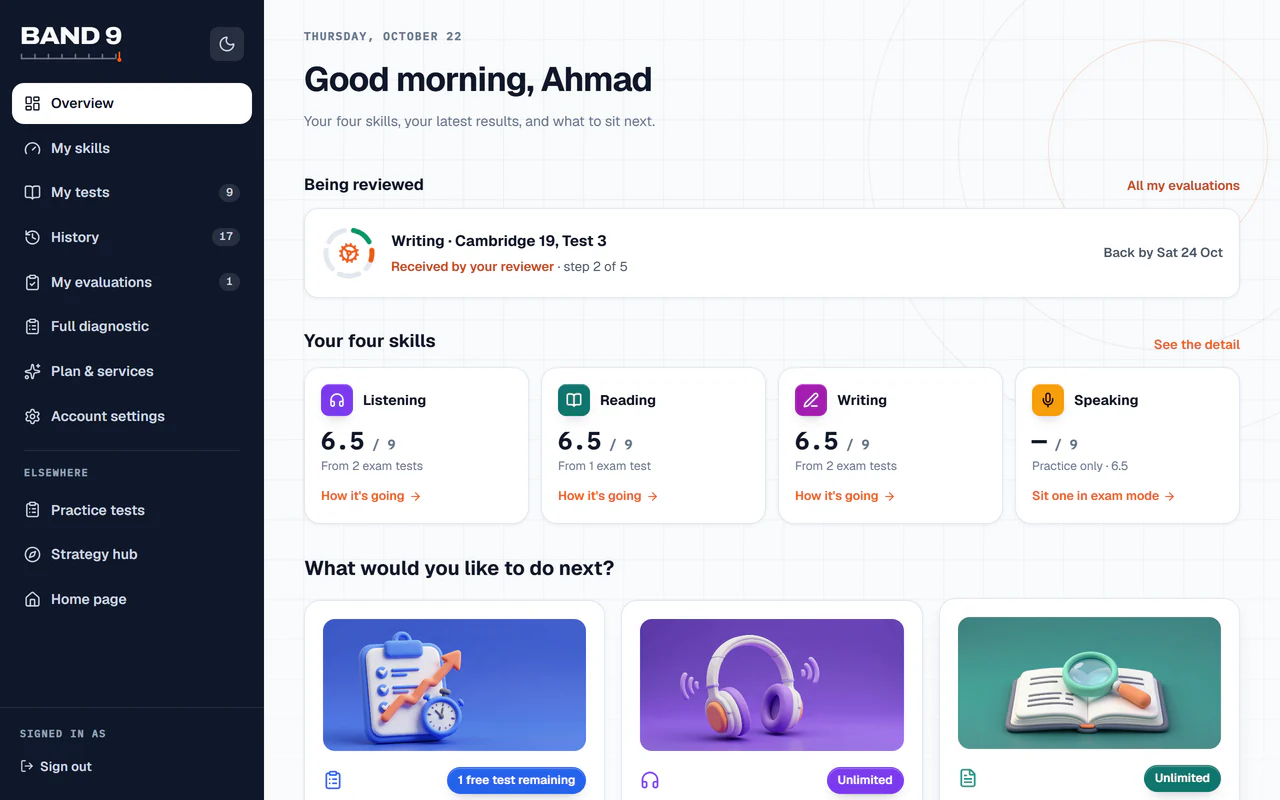
Progress tracking dashboard
Expert Writing Evaluation
Bundle — 3 full exams17% off
$55$66(Task 1 + Task 2)
Individual:Task 1 $10|Task 2 $12
Get professional IELTS examiner feedback on your writing with band score breakdown.
Something else? Write to hello@band9.uk and a person answers.
Is Band 9 free?
The diagnostic is free, and so are Listening and Reading in every book, as often as you like. You also get one free AI mark for a Writing task and one for a Speaking test, so you can see the feedback before you pay for anything.
Are these real IELTS papers?
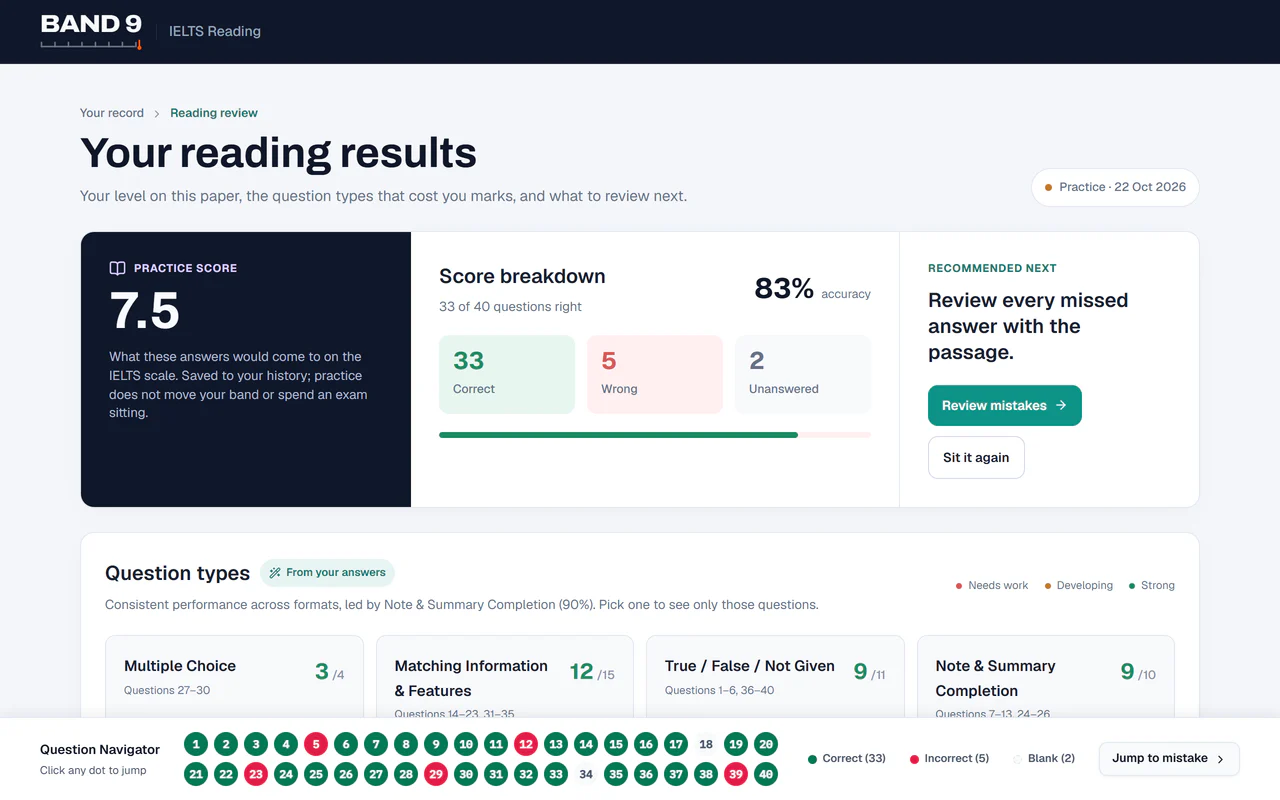
Yes. The practice tests follow the published Cambridge IELTS books, timed like the exam. Listening and Reading are marked on the official band tables, so a full paper gives you a band, not a percentage.
Who marks my Writing and Speaking?
You choose. AI marking scores your work against the four official criteria and quotes your own sentences back to you. For the most reliable band, an IELTS examiner can mark your Writing, or take you through a live Speaking test.
Do you cover Academic and General Training?
Both. Pick your module when you start, and the diagnostic, the Reading papers and the band tables all follow it.
Which books have Speaking?
Writing is marked in every book. Speaking is marked in IELTS 6 to 21 and Official Practice 1 and 2, on all four criteria including pronunciation.
Do I need to install anything?
No. Everything runs in your browser. A computer is closest to the real computer-delivered test; Speaking needs a microphone, and Listening works best with headphones.
Know your band before exam day does.
Thirty minutes, free, no signup. You leave with your band range and the skill to fix first.