50 Academic Collocations Essential for Getting a Band 7.5+
Elevate your Academic Writing Task 2 and Reading comprehension with high-yield collocations categorized by essay function and argument development.


Collocations demonstrate natural control of lexical features required for Band 7+ Lexical Resource.
Why Collocations are Crucial for a High Band Score
Many candidates focus on learning individual words, believing that a wide vocabulary alone will secure a high band score in IELTS Writing Task 2. While a broad vocabulary is important, it's only one piece of the puzzle. To truly impress the examiner and achieve a Band 7.5 or higher, you need to demonstrate a natural and sophisticated control of lexical features, which includes the correct use of collocations.
Collocations are words that frequently go together. For example, we say 'heavy rain', not 'strong rain'. Using words in unnatural combinations, even if the individual words are correct, can signal to the examiner that your lexical resource is limited or that you are translating directly from your native language. This can prevent you from achieving a higher band score, even if your grammar and ideas are strong.
The IELTS Writing Task 2 band descriptors for Lexical Resource at Band 9 state: "uses a wide range of vocabulary with very natural and sophisticated control of lexical features". Correct collocation use is a key indicator of this "natural and sophisticated control".
This article will introduce you to 50 essential academic collocations, categorised by their function in an essay. Mastering these will not only improve your Writing Task 2 score but also enhance your Reading comprehension, as these are common pairings in academic texts.
The Collocation Matrix: Organising Academic Phrases
Academic essays often require you to perform specific functions: discussing causes and effects, evaluating arguments, proposing policies, or contrasting ideas. By categorising collocations based on these functions, you can more easily recall and apply them in your writing.
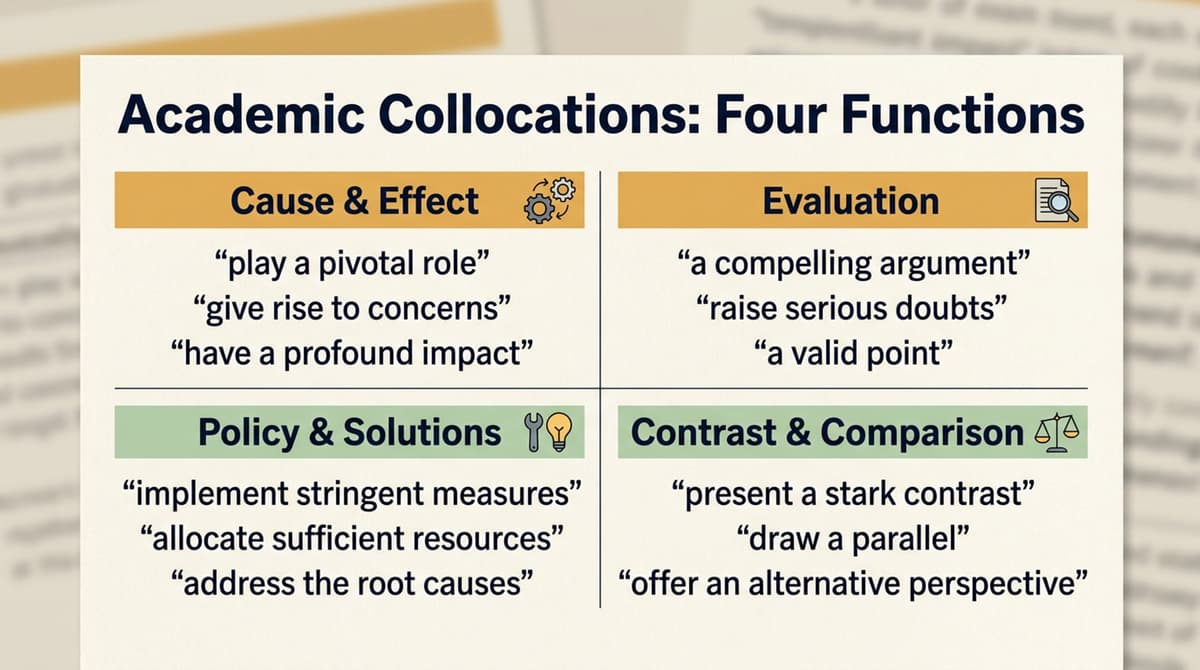
Cause & Effect
These collocations are vital for explaining relationships between phenomena and developing arguments logically.
- Exert a significant influenceParents exert a significant influence on their children's eating habits.
- Play a pivotal roleTeachers play a pivotal role in shaping a child's attitude to learning.
- Lead to adverse consequencesCutting public transport funding could lead to adverse consequences for low-income workers.
- Give rise to concernsThe rapid spread of misinformation online has given rise to concerns about public trust.
- Trigger a chain reactionA rise in fuel prices can trigger a chain reaction across the entire economy.
- Have a profound impactRemote working has had a profound impact on city-centre businesses.
- Contribute to the emergenceCheap air travel contributed to the emergence of mass tourism.
- Result in widespread implicationsA ban on private cars would result in widespread implications for urban planning.
- Foster economic growthInvestment in infrastructure can foster economic growth in rural regions.
- Drive social changeYoung people often drive social change through online campaigns.
- Pose a serious threatPlastic waste poses a serious threat to marine life.
- Underpin the argumentSeveral long-term studies underpin the argument that exercise improves concentration.
Evaluation
When you need to assess the importance, validity, or implications of an idea, these collocations will be invaluable.
- Hold a firm beliefMany educators hold a firm belief that creativity should be taught in schools.
- Reach a consensusExperts have yet to reach a consensus on the ideal school starting age.
- Draw a conclusionIt is too early to draw a conclusion about the long-term effects of social media.
- Provide compelling evidenceRecent research provides compelling evidence that green spaces reduce stress.
- Offer a nuanced perspectiveA balanced essay should offer a nuanced perspective rather than a one-sided view.
- Merit careful considerationThe financial cost of free university education merits careful consideration.
- Warrant further investigationThe link between screen time and sleep quality warrants further investigation.
- Present a strong caseSupporters of a four-day week present a strong case based on productivity data.
- Highlight key issuesThe report highlights key issues such as housing costs and youth unemployment.
- Emphasise the importanceDoctors constantly emphasise the importance of a balanced diet.
- Acknowledge the limitationsIt is important to acknowledge the limitations of online learning for practical subjects.
- Formulate a hypothesisScientists formulate a hypothesis before designing an experiment to test it.
Policy & Solutions
Many Task 2 essays require you to discuss solutions or policy implications. These collocations will help you articulate your ideas effectively.
- Implement stringent measuresGovernments must implement stringent measures to reduce air pollution in cities.
- Allocate sufficient resourcesHospitals cannot cope unless authorities allocate sufficient resources to them.
- Formulate effective strategiesSchools need to formulate effective strategies to tackle bullying.
- Address the root causesRather than punishing crime, society should address the root causes, such as poverty.
- Promote sustainable developmentTax incentives can promote sustainable development in the construction industry.
- Enforce strict regulationsAuthorities should enforce strict regulations on the disposal of industrial waste.
- Initiate public awareness campaignsHealth ministries often initiate public awareness campaigns about the dangers of smoking.
- Bridge the gapFree online courses could help bridge the gap between rich and poor students.
- Mitigate the risksCareful planning can mitigate the risks of building in flood-prone areas.
- Facilitate international cooperationClimate summits aim to facilitate international cooperation on reducing emissions.
- Devise innovative solutionsEngineers are working to devise innovative solutions to urban water shortages.
- Adopt a proactive approachEmployers should adopt a proactive approach to staff mental health.
Contrast & Comparison
When comparing different viewpoints or presenting counter-arguments, these collocations will add sophistication to your writing.
- Present a stark contrastLife in the capital presents a stark contrast to life in the surrounding villages.
- Exhibit a clear divergenceSpending habits exhibit a clear divergence between older and younger consumers.
- Highlight a fundamental differenceThe two surveys highlight a fundamental difference in attitudes towards work.
- Offer an alternative perspectiveCritics of standardised testing offer an alternative perspective on how to measure ability.
- Draw a parallelSome historians draw a parallel between the internet and the invention of printing.
- Conversely, it can be arguedConversely, it can be argued that tourism damages the very places it celebrates.
- In sharp oppositionIn sharp opposition to this view, many economists believe tariffs harm growth.
- By the same tokenStudents need rest to perform well; by the same token, employees need regular breaks.
- Distinguish betweenIt is essential to distinguish between reliable news and opinion.
- Reconcile conflicting viewsGood policy must reconcile conflicting views on economic growth and conservation.
- Underscore the disparityThese figures underscore the disparity between urban and rural incomes.
- Acknowledge the nuancesA strong answer will acknowledge the nuances of the debate rather than oversimplify it.
General Academic Collocations
These collocations are versatile and can be used across various essay topics to enhance academic tone.
- Conduct researchUniversities conduct research that often benefits the wider community.
- Analyse dataCompanies analyse data from customers to predict buying trends.
- Provide insightsLongitudinal studies provide insights into how habits change over a lifetime.
- Establish credibilityCiting reliable sources helps a writer establish credibility.
- Generate debateProposals to raise the retirement age always generate debate.
- Formulate an argumentBefore writing, it is wise to formulate an argument and plan the supporting points.
- Address the issueLocal councils have been slow to address the issue of homelessness.
- Explore the implicationsThis essay will explore the implications of an ageing population.
- Examine the evidenceBefore banning homework, policymakers should examine the evidence carefully.
- Support the claimSeveral studies support the claim that bilingual children are better at multitasking.
- Challenge the assumptionNew findings challenge the assumption that older people cannot learn new technology.
- Arrive at a conclusionAfter weighing both sides, I arrive at the conclusion that the benefits outweigh the costs.
- Demonstrate proficiencyCandidates must demonstrate proficiency in English to study at a British university.
- Achieve objectivesWithout clear targets, organisations rarely achieve their objectives.
Avoiding the Examiner Trap: Unnatural Combinations
Candidate Assumption (Band 6.0)
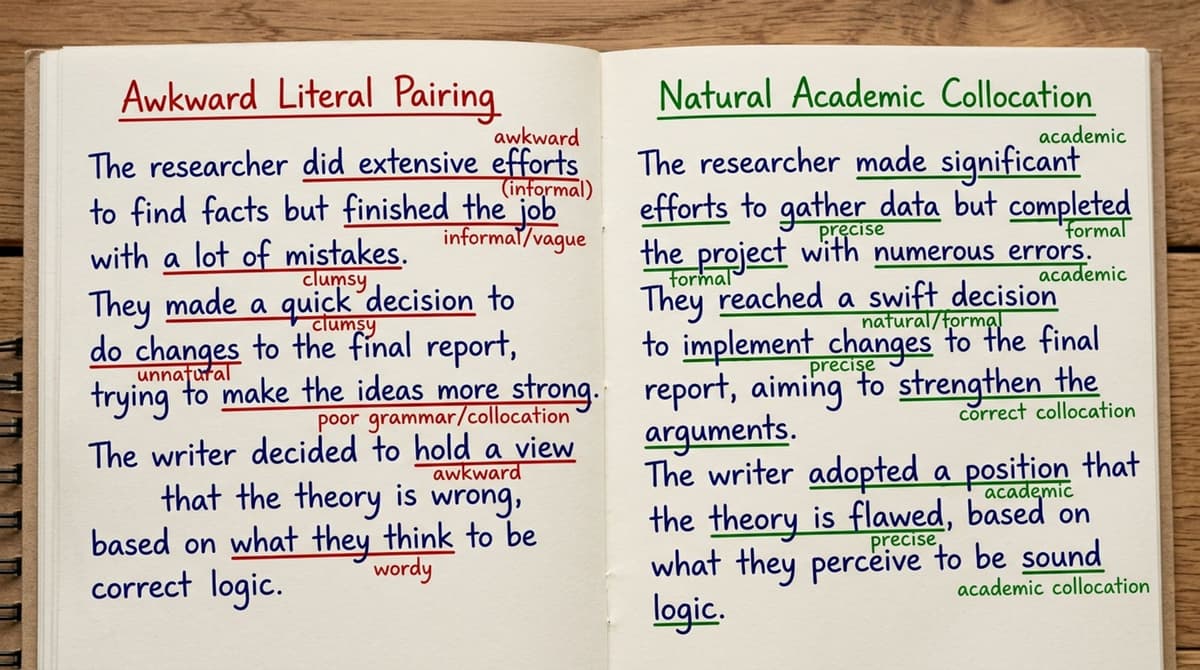
Candidates often assume that if they know the meaning of individual words, they can combine them freely. This leads to phrases like "make a damage" or "grow an awareness", which are grammatically understandable but sound unnatural to a native speaker and an examiner.
Band 9 Reality
Examiners are looking for "natural and sophisticated control of lexical features". This means using words in combinations that are common and idiomatic in academic English, such as "cause extensive damage" or "raise awareness". These precise collocations demonstrate a higher level of lexical proficiency.
The key is to learn collocations as single units of meaning, rather than individual words. When you encounter a new word, always try to learn its common collocations. This practice will significantly improve the naturalness and accuracy of your writing.
Integrating Collocations into Your Writing
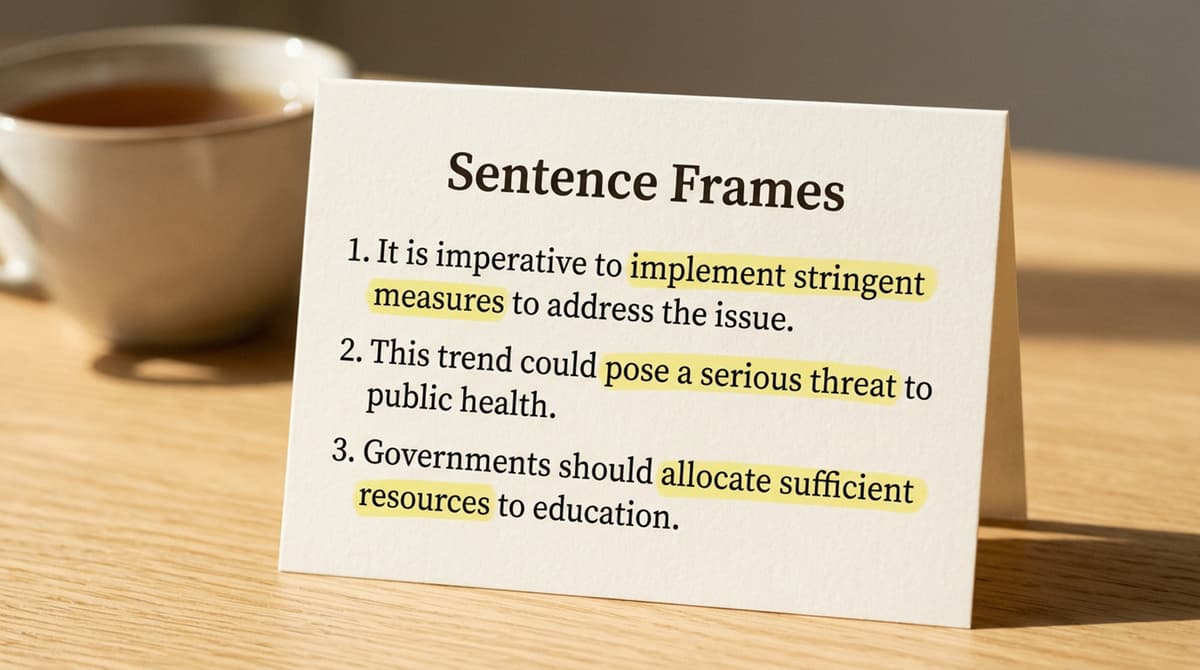
Simply memorising collocations is not enough; you need to practice integrating them into complex sentences. Here's a simple framework to help you:
Sentence Frame: It is [adjective] to [verb collocation] in order to [purpose/result].
Example: It is imperative to implement stringent measures in order to address the root causes of environmental degradation.
Another approach is to use collocations to introduce or conclude paragraphs, or to link ideas within a paragraph:
- Introducing an argument: Many scholars hold a firm belief that...
- Discussing consequences: Such policies often lead to adverse consequences for vulnerable populations.
- Proposing solutions: Therefore, governments must formulate effective strategies to foster economic growth.
Regular practice with these sentence frames will help you internalise the collocations and use them naturally under exam conditions.
Checklist for Mastering Academic Collocations
To ensure you are effectively using collocations for a higher band score, follow this checklist:
- Learn collocations in context: Don't just memorise lists. See how they are used in academic articles or model essays.
- Categorise them by function: Use the matrix approach (Cause & Effect, Evaluation, Policy, Contrast) to make them easier to recall.
- Practice active recall: Regularly test yourself by trying to complete collocations (e.g., "exert a..." -> "exert a significant influence").
- Integrate into sentences: Use sentence frames and practice writing full sentences with your target collocations.
- Review and revise: After writing an essay, specifically check your collocation usage. Are there any unnatural combinations? Can you replace simple words with more sophisticated collocations?
- Read widely: The more you read academic texts, the more you will naturally encounter and absorb correct collocations.
By systematically working through these steps and focusing on the 50 collocations provided, you will significantly enhance your lexical resource and move closer to achieving a Band 7.5+ in IELTS Writing Task 2.

Check yourself
5 questions · about 4 minutes · every answer explained
Was this strategy guide helpful?
Tell us if it helped. It shapes what we write next.
Band 9 Team
Written by the team that builds Band 9.
Candidate Discussion (0)
Join the conversation
Sign in to ask our examiners questions and participate in strategy discussions.