Mastering Complex Sentences: Relative Clauses Demystified
Grammatical Range and Accuracy requires flexible complex structures. Master defining and non-defining relative clauses with zero punctuation slips.


Band 8+ Grammatical Range requires a wide variety of complex structures produced with high accuracy.
On this page
- 01Why Complex Sentences Matter for Band 9 Writing
- 02Defining vs. Non-Defining Relative Clauses: The Core Distinction
- 03The Punctuation Trap: Comma Splices and Run-on Sentences
- 04Practice: Combining Simple Sentences into Complex Ones
- 05Advanced Considerations and Common Pitfalls
- 06Checklist for Mastering Relative Clauses
Why Complex Sentences Matter for Band 9 Writing
In IELTS Writing, achieving a high score for Grammatical Range and Accuracy means demonstrating control over a variety of complex sentence structures. Simple and compound sentences alone will not allow you to reach the higher bands. The band descriptors for Grammatical Range and Accuracy reward candidates who can use a "wide range of complex structures with full flexibility and accuracy" at Band 9, and "a variety of complex structures" at Band 7.
One of the most effective ways to introduce complexity and sophistication into your writing is through the accurate use of relative clauses. These clauses allow you to combine information, add detail, and express relationships between ideas more precisely. However, many candidates struggle with their correct formation and, crucially, their punctuation.
Incorrect punctuation, especially with commas, can change the meaning of your sentence or create grammatical errors like comma splices, which can significantly lower your score for Grammatical Range and Accuracy.
Defining vs. Non-Defining Relative Clauses: The Core Distinction
The fundamental difference between defining and non-defining relative clauses lies in whether the information they provide is essential to understanding the noun they modify. This distinction dictates whether you use commas.
Defining Relative Clauses (No Commas)
A defining relative clause provides information that is essential to identify the noun it modifies. Without this clause, the meaning of the sentence would be unclear or ambiguous. Because the information is essential, it is not separated by commas.
- Relative pronouns commonly used: who, whom, whose, which, that.
- That can often replace which or who in defining clauses.
- The relative pronoun can sometimes be omitted if it is the object of the clause.
Example: The student who scored highest received a scholarship.
Here, "who scored highest" is essential. If we remove it, we are left with "The student received a scholarship," which doesn't tell us *which* student. No commas are used.
Non-Defining Relative Clauses (With Commas)
A non-defining relative clause provides additional, non-essential information about the noun it modifies. The sentence would still make sense and the noun would still be clearly identified even if this clause were removed. Because the information is supplementary, it is set off by commas.
- Relative pronouns commonly used: who, whom, whose, which.
- That cannot be used in non-defining clauses.
- The relative pronoun cannot be omitted.
Example: My brother, who lives in London, is visiting next week.
Here, "who lives in London" provides extra information about "my brother." We already know who "my brother" is. The sentence "My brother is visiting next week" is complete and clear without the clause. Therefore, commas are used to set it apart.
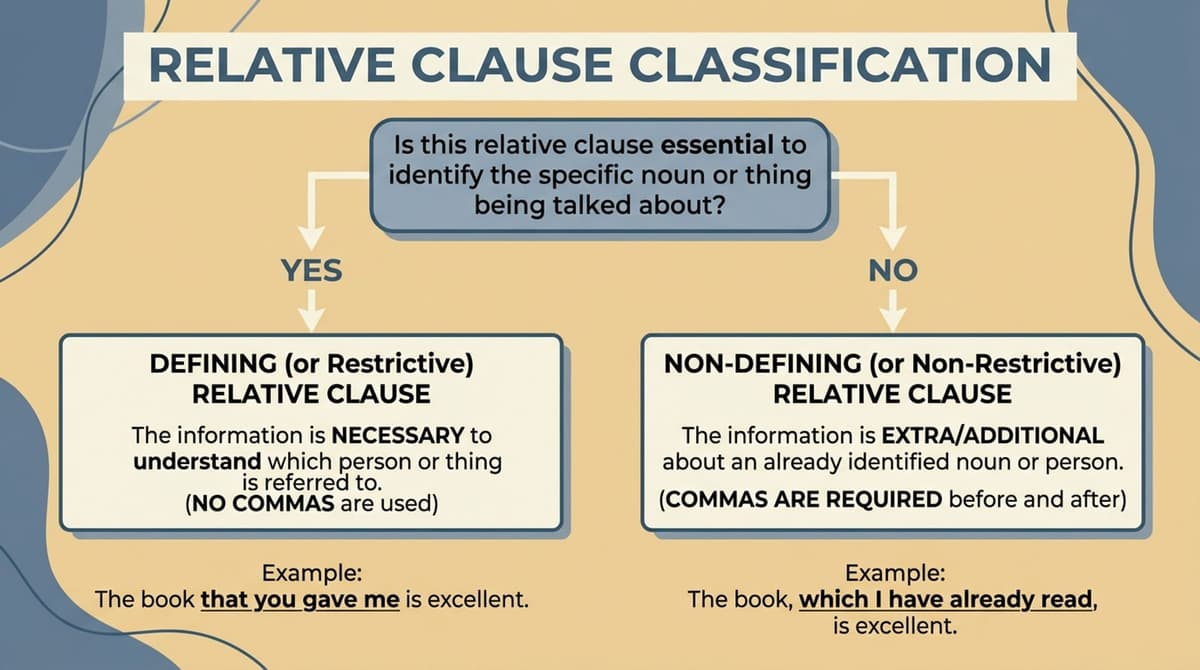
The Relative Clause Decision Tree
Figure 1 illustrates a simple decision-making process for determining whether a relative clause is defining or non-defining. This flowchart can help you quickly assess the role of the information you want to add and apply the correct punctuation.
Ask yourself: "Is this information absolutely necessary to identify the noun I'm talking about?" If the answer is yes, it's a defining clause, and no commas are needed. If the answer is no, and the noun is already clearly identified, then it's a non-defining clause, and you must use commas.
The Punctuation Trap: Comma Splices and Run-on Sentences
A common error among IELTS candidates is the comma splice, where two independent clauses are incorrectly joined by only a comma. While this is a general grammar error, it often appears when candidates attempt to create complex sentences without fully understanding relative clause punctuation.
Candidate Error (Band 5.0)
The government introduced new policies, they aimed to reduce unemployment.
This is a comma splice. Two complete sentences are joined only by a comma, indicating a lack of control over sentence structure.
Band 9 Solution
The government introduced new policies, which aimed to reduce unemployment.
By using a non-defining relative clause, the second part of the sentence correctly modifies "new policies" and provides additional information, creating a grammatically correct complex sentence.
Another related error is the run-on sentence, where two or more independent clauses are joined without any punctuation or with incorrect punctuation. Both comma splices and run-on sentences demonstrate a lack of control over sentence boundaries, which limits your score for Grammatical Range and Accuracy.
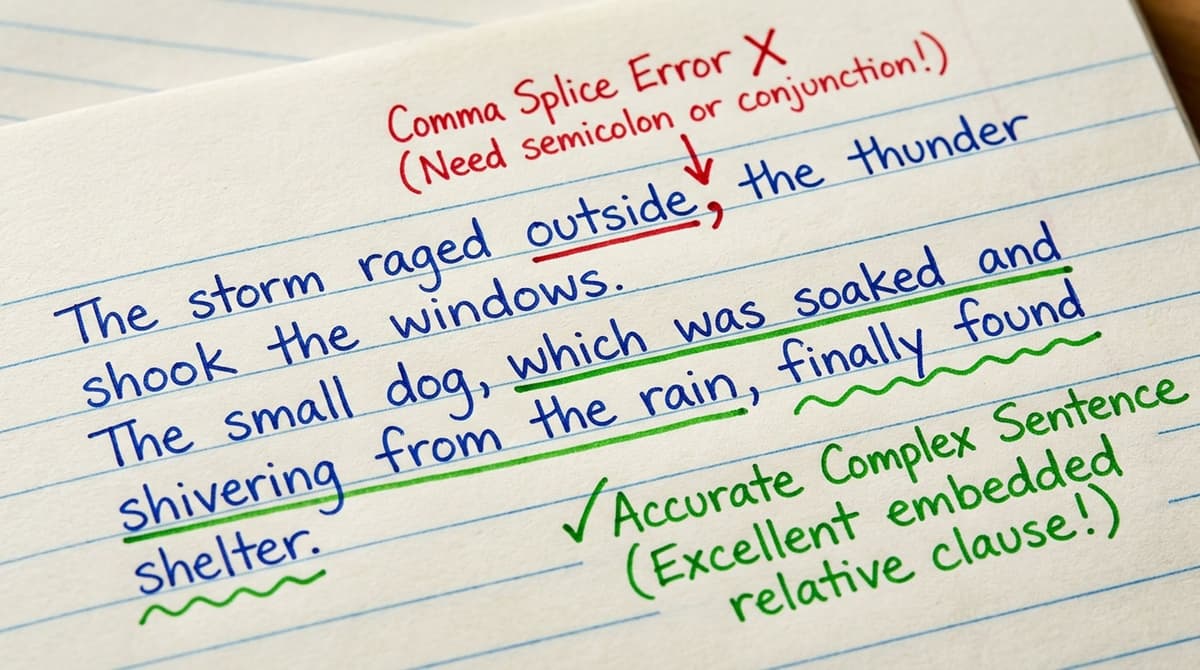
Avoiding the Comma Splice
Figure 2 visually highlights the difference between a common comma splice error and a correctly constructed sentence using a relative clause. The key takeaway is that a comma alone cannot join two independent clauses. When you want to add supplementary information about a noun, a non-defining relative clause, correctly punctuated with commas, is the appropriate structure.
Remember, a comma splice indicates that you are not fully in control of complex sentence structures, which can cap your Grammatical Range and Accuracy score at Band 5 or 6.
Practice: Combining Simple Sentences into Complex Ones
A highly effective way to improve your use of relative clauses is to practice combining simple sentences. This exercise forces you to think about the relationship between ideas and how to express them concisely and accurately.
The Sentence Synthesis Protocol:
- Identify two simple sentences that share a common noun or pronoun.
- Decide if the information in the second sentence is essential or non-essential to the first.
- Choose the appropriate relative pronoun (who, whom, whose, which, that).
- Combine the sentences, applying correct punctuation (commas for non-defining, no commas for defining).
Let's apply this protocol:
Original Sentences:
- Many people are concerned about climate change.
- Climate change poses a significant threat to future generations.
Step 1: Common noun is "climate change."
Step 2: The second sentence provides essential information about *what kind* of climate change we are concerned about. It defines the threat. So, it will be a defining clause.
Step 3: Use which or that for an inanimate object.
Step 4: Many people are concerned about climate change that poses a significant threat to future generations. (No commas)
Another example:
Original Sentences:
- Elena Smith is a leading expert in renewable energy.
- Elena Smith recently published a groundbreaking study.
Step 1: Common noun is "Elena Smith."
Step 2: "Elena Smith" is already clearly identified. The second sentence adds extra information about him. So, it will be a non-defining clause.
Step 3: Use who for a person.
Step 4: Elena Smith, who recently published a groundbreaking study, is a leading expert in renewable energy. (Commas used)
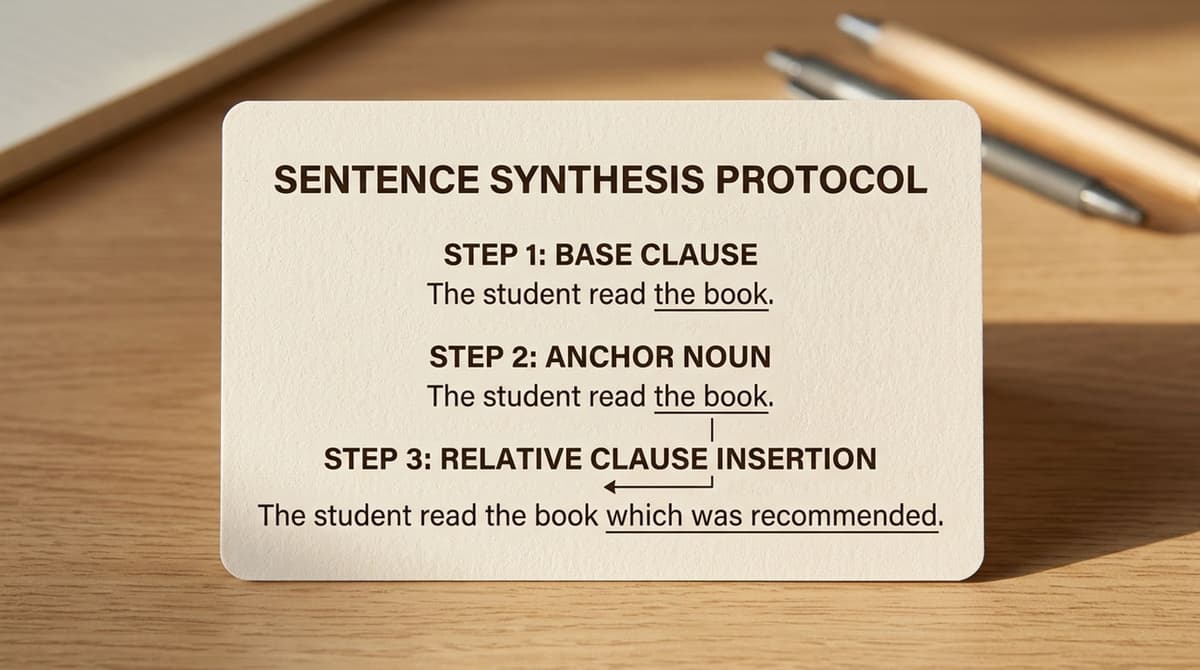
Your Sentence Synthesis Workbench
Figure 3 visualises the process of combining simple sentences into complex ones using relative clauses. Think of it as a workbench where you carefully select the right tools (relative pronouns) and apply the correct techniques (punctuation) to craft sophisticated sentences.
Regular practice with this protocol will not only improve your grammatical accuracy but also enhance your ability to express complex ideas clearly and concisely, which is crucial for both Writing Task 1 and Task 2.
Advanced Considerations and Common Pitfalls
Relative Adverbs: Where, When, Why
Beyond relative pronouns, you can also use relative adverbs to introduce relative clauses, adding further complexity and precision:
- Where (for places): The city where I grew up has changed dramatically.
- When (for times): There was a time when people relied solely on letters.
- Why (for reasons): I understand the reason why you are concerned.
Prepositions in Relative Clauses
Sometimes, a preposition is part of the relative clause. It can either precede the relative pronoun or appear at the end of the clause.
- Formal: The issue about which we are debating is complex.
- Informal (more common in speech, but acceptable in writing): The issue which we are debating about is complex.
For IELTS Writing, maintaining a slightly more formal tone is generally advisable, so placing the preposition before the relative pronoun can demonstrate greater grammatical control.
Avoiding Ambiguity
Incorrect placement of a relative clause can lead to ambiguity. Ensure the clause is placed as close as possible to the noun it modifies.
Ambiguous: I saw a dog in the park that was wearing a red collar. (Was the park wearing a collar?)
Clear: I saw a dog that was wearing a red collar in the park.
Checklist for Mastering Relative Clauses
Before submitting your IELTS Writing, use this checklist to review your use of relative clauses:
- Have I used a variety of sentence structures, including complex sentences with relative clauses?
- Is the information in my relative clause essential (defining) or non-essential (non-defining)?
- Have I used commas correctly for non-defining relative clauses? (e.g., My car, which is old, needs repairs.)
- Have I avoided commas for defining relative clauses? (e.g., The car that is parked outside is mine.)
- Have I avoided using that in non-defining relative clauses?
- Are my relative pronouns (who, which, whose, whom) used correctly for people and things?
- Have I checked for and corrected any comma splices or run-on sentences?
- Is the relative clause placed correctly to avoid ambiguity?
By diligently applying these rules and practicing regularly, you will significantly enhance your grammatical range and accuracy, moving closer to a Band 9 in IELTS Writing.

Check yourself
5 questions · about 4 minutes · every answer explained
Was this strategy guide helpful?
Tell us if it helped. It shapes what we write next.
Band 9 Team
Written by the team that builds Band 9.
Candidate Discussion (0)
Join the conversation
Sign in to ask our examiners questions and participate in strategy discussions.