The Ultimate 30-Day IELTS Study Plan: How to Secure a Band 8.0+
A structured four-week preparation roadmap for self-studiers. Master diagnostic pacing, targeted error analysis, and peak exam-day stamina.


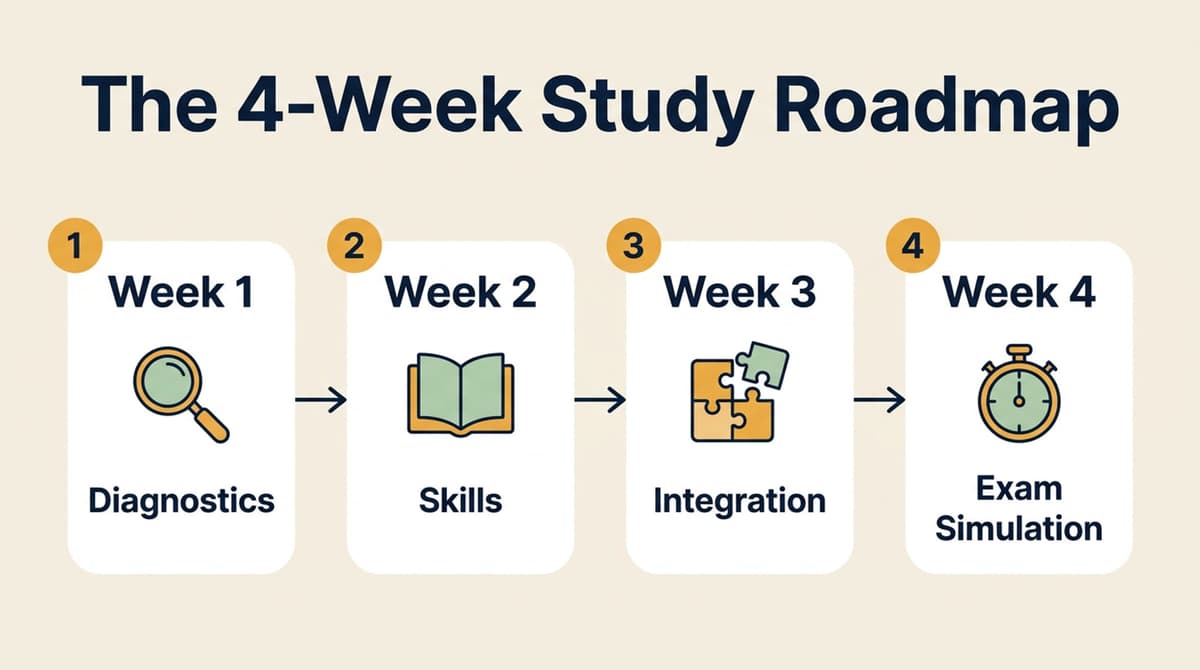
A diagnostic four-week schedule separates deliberate practice from aimless mock test repetition.
Introduction: Beyond Blind Mock Testing
Many candidates approach IELTS preparation by repeatedly taking full mock tests, hoping that sheer volume will lead to improvement. This strategy, which we call 'Blind Mock Testing', often locks scores at Band 6.5. Without a structured approach to identify and address specific weaknesses, candidates find themselves repeating the same errors, leading to frustration and stagnation.
This 30-day study plan is designed to move you beyond this common trap. It provides a structured, four-week roadmap focusing on diagnostic pacing, targeted error analysis, and building the stamina required for a Band 8.0+.
The goal is not just to practice, but to practice smart. Every study session should have a clear objective: to identify a weakness, understand its root cause, and implement a strategy to overcome it.
Week 1: Diagnostic Pacing and Foundational Skills
The first week is dedicated to understanding your current level and identifying your core strengths and weaknesses across all four modules: Listening, Reading, Writing, and Speaking. This isn't about achieving a high score immediately, but about gathering data.
Day 1-3: Initial Diagnostics
Begin with a full, timed mock test. Treat this as a diagnostic tool, not a performance assessment. Pay close attention to where you struggle with timing, question types, or specific content areas. Do not just mark answers right or wrong; note why you made a mistake.
Day 4-7: Targeted Skill Building
Based on your diagnostic results, dedicate time to foundational skills. For Reading, this might mean practicing skimming and scanning. For Listening, focus on identifying keywords and predicting information. For Writing, review essay structures and common grammatical patterns. For Speaking, practice expanding on answers and using a wider range of vocabulary.
Candidate Assumption (Band 6.0)
"I'll just do another practice test tomorrow. Eventually, I'll get better."
Band 9 Reality
"My diagnostic showed I struggle with True/False/Not Given questions in Reading. This week, I will dedicate 30 minutes daily to understanding the difference between FALSE and NOT GIVEN, using specific examples."
Week 2: Error Analysis and Remediation
This week is crucial for moving beyond simply identifying errors to understanding their root causes and implementing targeted solutions. This is where you transform mistakes into learning opportunities.
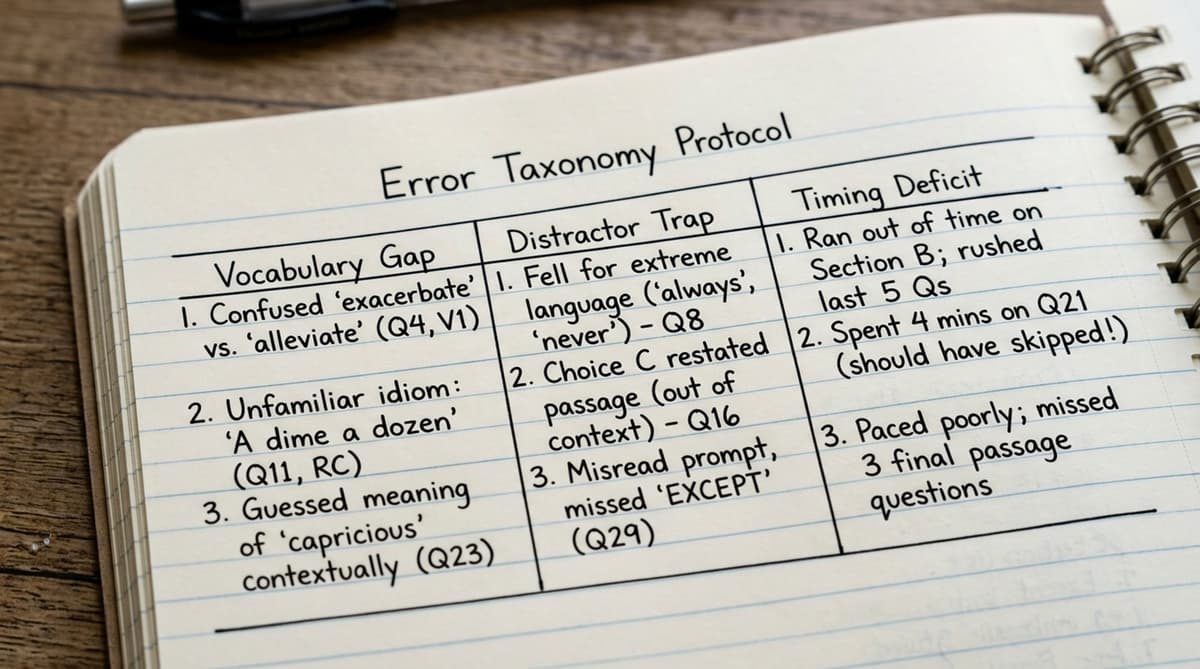
The Error Taxonomy Protocol
Categorise your errors using a simple framework:
- Vocabulary Gap: You didn't understand a key word or phrase.
- Distractor Trap: You were misled by an option that seemed correct but wasn't.
- Timing Deficit: You ran out of time or rushed, leading to careless mistakes.
- Structural/Grammatical: For Writing/Speaking, issues with sentence structure, tense, or agreement.
- Task Misinterpretation: You didn't fully understand what the question was asking.
For each error, ask yourself: Why did I make this mistake? Was it a lack of vocabulary? A misunderstanding of the question type? Poor time management?
Targeted Remediation
Once you've categorised your errors, dedicate specific study time to address them. If it's a vocabulary gap, learn the new words and their synonyms. If it's a distractor trap, practice identifying common distractor patterns. If it's timing, practice specific sections under strict time limits.
Week 3: Integration and Advanced Strategies
Having addressed individual weaknesses, Week 3 focuses on integrating these improvements into your overall test-taking strategy. This is about refining your approach and building confidence.
Module-Specific Integration
- Reading: Practice applying skimming, scanning, and detailed reading techniques in combination. Focus on managing your time across all three passages.
- Listening: Work on predicting answers while listening, and simultaneously noting down keywords. Practice different accents and speeds.
- Writing: Practice writing full Task 1 and Task 2 responses, focusing on coherence, cohesion, and using a wide range of vocabulary and grammatical structures. Ensure your ideas are "fully extended and well supported".
- Speaking: Engage in simulated Part 1, 2, and 3 conversations. Focus on developing topics fully and appropriately, and speaking "fluently with only occasional repetition or self-correction".
Developing a Personalised Strategy
By now, you should have a clearer understanding of which question types or sections require more of your attention. Develop a personalised strategy for each module. For example, in Reading, decide whether you tackle True/False/Not Given questions first or last.
Week 4: Exam Simulation and Stamina Building
The final week is about consolidating your learning, building stamina, and fine-tuning your exam-day approach. This is where you simulate exam conditions to minimise surprises on the actual test day.
Full Mock Tests Under Exam Conditions
Take at least two full mock tests this week, replicating exam conditions as closely as possible. This means no breaks, strict timing, and using official answer sheets if available. The goal is to build mental and physical stamina for the 2 hours and 45 minutes of the test.
Review and Refine
After each mock test, conduct a thorough review. Identify any remaining weak areas, but also acknowledge your improvements. Focus on minor adjustments to your strategy rather than trying to overhaul your approach at this late stage.
Your daily study allocation should be balanced. A good rule of thumb is 45 minutes for focused input (reading, listening practice), 45 minutes for production (writing, speaking practice), and 30 minutes for error logging and review.

The Day Before the Exam
Avoid intense study. Instead, review your error log, familiarise yourself with key vocabulary, and ensure you have all necessary documents ready. Get a good night's sleep.
Exam Day
Arrive early, stay calm, and trust your preparation. Remember the strategies you've practiced, and manage your time effectively.
Checklist for a Band 8.0+ Study Plan
- Did you complete an initial diagnostic test to identify weaknesses?
- Are you categorising your errors (e.g., vocabulary gap, distractor trap, timing deficit)?
- Are you dedicating specific study time to address each type of error?
- Are you practicing all four modules, integrating skills as you progress?
- Are you taking full, timed mock tests under exam conditions in the final week?
- Are you reviewing your mistakes and refining your strategy after each practice session?
- Are you maintaining a consistent daily study schedule?
By following this structured 30-day plan, you will move beyond the pitfalls of 'Blind Mock Testing' and build a robust foundation for achieving a Band 8.0+ in your IELTS exam. Good luck!

Check yourself
4 questions · about 3 minutes · every answer explained
Was this strategy guide helpful?
Tell us if it helped. It shapes what we write next.
Band 9 Team
Written by the team that builds Band 9.
Candidate Discussion (0)
Join the conversation
Sign in to ask our examiners questions and participate in strategy discussions.