Band 9.0 Vocabulary Lists for Common Speaking Topics
High-yield, topic-specific collocation sets for Hometown, Work, Technology, Leisure, and Environment — with natural model phrases and lexical chunking.


Band 9 Lexical Resource rewards topic-anchored collocations deployed in natural conversational chunks.
Introduction: Beyond Single Words
Achieving a Band 9 in IELTS Speaking requires more than just knowing many individual words. The Band 9 descriptor for Lexical Resource states: uses a wide range of vocabulary with very natural and sophisticated control of lexical features
. This natural and sophisticated control
comes from using collocations and lexical chunks – groups of words that frequently go together.
Many candidates make the mistake of memorising long lists of disconnected words. While a broad vocabulary is important, using these words out of context or incorrectly can sound unnatural and hinder your score. Instead, focus on learning vocabulary in topic-specific sets, understanding how words combine to form natural-sounding phrases.
Memorising single, isolated words without understanding their common collocations or how they fit into natural phrases. This often leads to awkward or incorrect usage, making your speech sound less fluent and natural.
This article will guide you through building high-yield collocation sets for five common IELTS Speaking topics: Hometown, Work/Study, Technology, Leisure, and Environment. We will show you how to learn these as lexical chunks and integrate them into natural spoken answers.
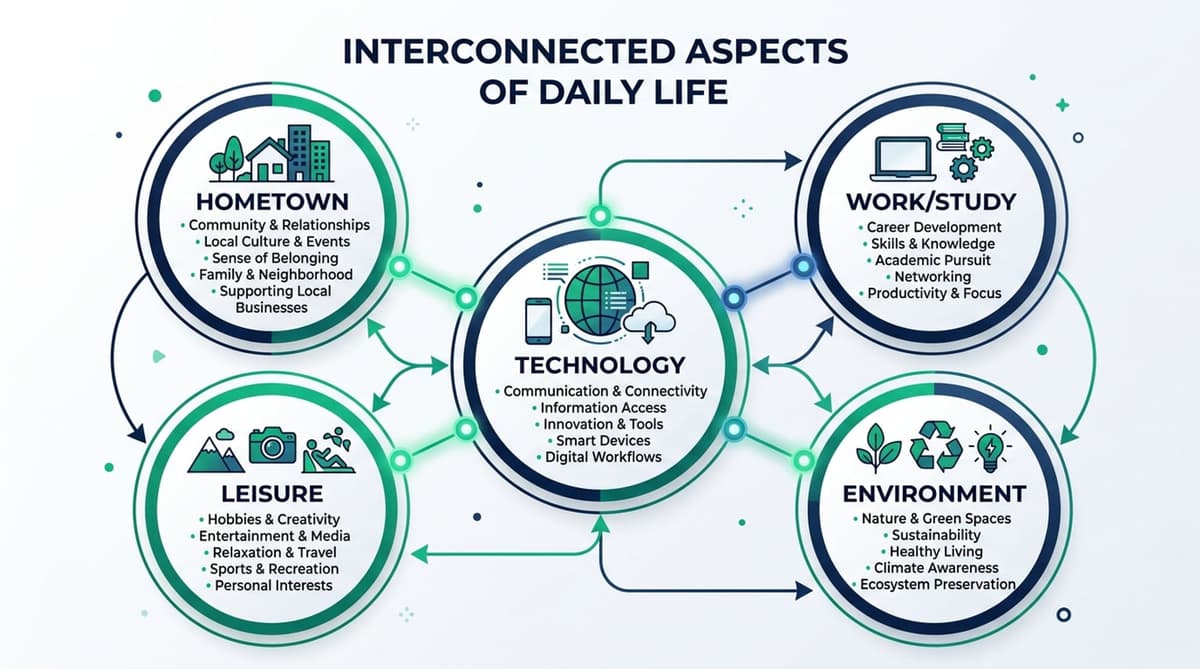
The Five Core Topic Spheres
The IELTS Speaking test frequently covers a range of common topics. While the specific questions vary, they often revolve around these five core areas, as illustrated in Figure 1. By preparing topic-specific vocabulary for these spheres, you can ensure you have the linguistic tools to respond effectively to a wide array of questions.
Focusing on these areas allows you to build a robust vocabulary foundation that is both relevant and versatile.
Learning Vocabulary as Lexical Chunks
A lexical chunk is a group of words that are commonly found together. These can be collocations (words that frequently co-occur), idioms, phrasal verbs, or fixed expressions. Learning vocabulary in chunks helps you speak more fluently because you retrieve and produce these groups of words as single units, rather than assembling them word by word.
Learn vocabulary in context, focusing on collocations and lexical chunks. This improves both your Lexical Resource and Fluency and Coherence scores by enabling more natural and effortless speech.
Consider the difference between saying "I have a strong feeling for my city" and "I have a strong attachment to my city." Both convey a similar meaning, but the latter uses a more natural and common collocation. This is the essence of lexical chunking.
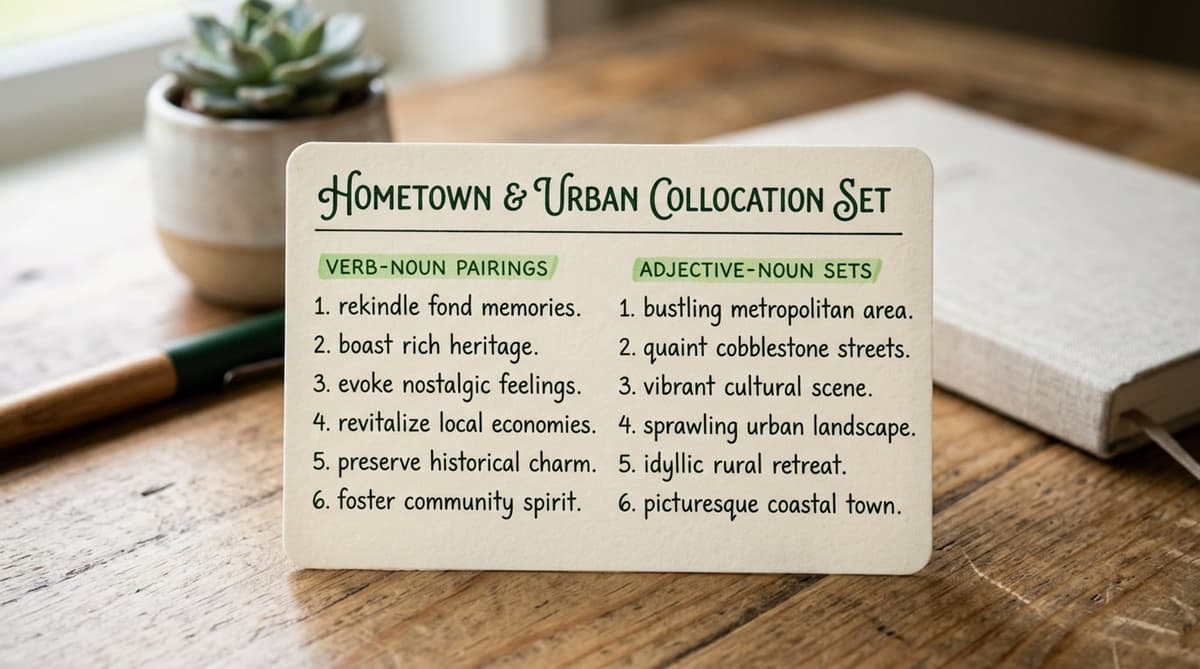
The Lexical Chunking Model
Figure 2 illustrates a study card approach to lexical chunking. Instead of listing single words, you group collocations around a central topic. For example, under 'Hometown', you might list phrases like 'bustling city', 'close-knit community', 'local amenities', and 'sense of belonging'. This method helps you visualise and remember how words naturally combine.
When you encounter a new word, always try to find its common partners. Is it a verb that takes a specific noun? An adjective that describes certain types of things? A noun that is often followed by a particular preposition?
Topic-Specific Collocation Sets and Model Phrases
Here are high-yield collocation sets for the five core topics, along with natural model phrases to demonstrate their use in spoken answers.
1. Hometown
Questions about your hometown are very common in Part 1. Be ready to describe its characteristics, what you like or dislike, and what has changed.
Key Collocations:
- bustling city / quiet townI grew up in a bustling city, but these days I'd honestly prefer a quiet town.
- close-knit communityIt's a close-knit community, so everyone on my street knows each other by name.
- local amenities (e.g., shops, parks, libraries)
- sense of belongingGoing back home always gives me a real sense of belonging.
- historical landmarksThe old town is full of historical landmarks, like the castle and the clock tower.
- vibrant nightlifeThe city centre has a vibrant nightlife, so it's busy until well after midnight.
- traffic congestionThe one downside is the traffic congestion during the morning rush hour.
- green spacesI wish there were more green spaces where families could relax at weekends.
Model Phrases:
- "I grew up in a bustling city with a truly vibrant nightlife."
- "What I appreciate most is the close-knit community and the strong sense of belonging."
- "The city offers excellent local amenities, from parks to libraries."
2. Work/Study
You might be asked about your current job, your studies, future career plans, or the importance of education.
Key Collocations:
- demanding job / rewarding careerNursing is a demanding job, but it's also a really rewarding career.
- career prospectsI chose engineering mainly because the career prospects are so good.
- professional developmentMy company pays for courses, which really helps my professional development.
- acquire new skillsI took a part-time job at university to acquire new skills.
- academic pursuitsThese days most of my time goes on academic pursuits, so I rarely go out.
- heavy workloadI have quite a heavy workload at the moment because two colleagues are on leave.
- job satisfactionFor me, job satisfaction matters far more than a high salary.
- team collaborationMy role involves a lot of team collaboration, so communication is key.
Model Phrases:
- "I find my current role to be quite a demanding job, but it offers great career prospects."
- "My university course focuses on academic pursuits that will help me acquire new skills."
- "Professional development is crucial for job satisfaction in my field."
3. Technology
This topic often covers the impact of technology on daily life, communication, education, or work.
Key Collocations:
- technological advancementsTechnological advancements have completely changed the way we shop.
- digital nativeAs a digital native, I can't really imagine life without the internet.
- online platformsI mostly learn new things through online platforms rather than books.
- information overloadWith so many news apps, it's easy to suffer from information overload.
- privacy concernsI have some privacy concerns about apps that track my location.
- cutting-edge innovationMy phone isn't exactly cutting-edge innovation, but it does everything I need.
- virtual realityI tried virtual reality at a museum once and it felt incredibly real.
- social media addictionI deleted a few apps because I was worried about social media addiction.
Model Phrases:
- "Technological advancements have transformed how we communicate."
- "As a digital native, I'm comfortable using various online platforms."
- "One major drawback is the potential for information overload and privacy concerns."
4. Leisure
Expect questions about your hobbies, free time activities, relaxation, or the importance of leisure.
Key Collocations:
- pursue a hobbyI finally had the time to pursue a hobby I'd always wanted to try: painting.
- unwind and relaxAfter a long week, I like to unwind and relax with a good film.
- recreational activitiesOur local park offers lots of recreational activities, from tennis to cycling.
- quality timeSunday is when I spend quality time with my family.
- stress reliefRunning is my main form of stress relief.
- active lifestyleI try to keep an active lifestyle by walking to work every day.
- cultural enrichmentTravelling abroad was a great source of cultural enrichment for me.
- personal fulfilmentVolunteering gives me a sense of personal fulfilment that my job doesn't.
Model Phrases:
- "In my free time, I love to pursue a hobby like painting to unwind and relax."
- "Engaging in recreational activities is essential for stress relief."
- "Spending quality time with family brings me immense personal fulfilment."
5. Environment
This topic often involves discussing environmental problems, conservation efforts, or personal responsibility.
Key Collocations:
- environmental degradationRapid building in my area has caused serious environmental degradation.
- climate changeSummers are noticeably hotter now, and I think climate change is the reason.
- sustainable developmentOur city is trying to encourage sustainable development, like energy-efficient housing.
- carbon footprintI cycle to work to reduce my carbon footprint.
- renewable energyMore and more homes near me have solar panels for renewable energy.
- conservation effortsLocal conservation efforts have helped bring rare birds back to the lake.
- ecological balanceOverfishing can upset the ecological balance of the whole coastline.
- waste managementBetter waste management would make a huge difference to our streets.
Model Phrases:
- "One of the biggest challenges we face is environmental degradation due to climate change."
- "Governments are promoting sustainable development and renewable energy sources."
- "Individuals can reduce their carbon footprint through better waste management."
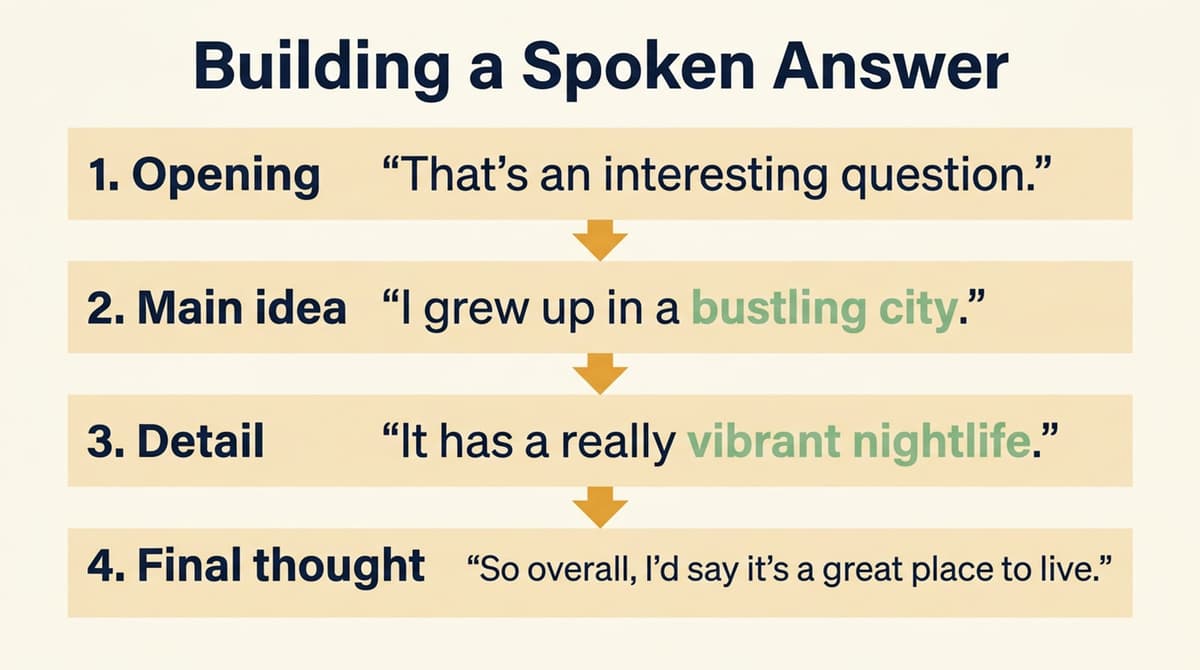
Embedding Collocations into Complete Answers
Figure 3 illustrates how to structure your spoken responses to naturally embed these high-yield collocations. Start with an opening phrase, introduce your main idea, support it with details using your learned chunks, and conclude with a brief thought.
This structured approach helps you maintain coherence and fluency while showcasing your rich lexical resource. Practice integrating these chunks into full sentences and longer responses, rather than just reciting them in isolation.
How to Practise and Store Lexical Chunks
Effective practice is key to making these collocations a natural part of your spoken English.
- Create your own study cards: Similar to Figure 2, make cards for each topic. On one side, write the topic; on the other, list 5-7 key collocations and a short example sentence for each.
- Active recall: Don't just read the lists. Cover the collocations and try to recall them when you see the topic. Then, try to form a sentence using each one.
- Record yourself: Practice answering common IELTS Speaking questions using your new collocations. Listen back to identify areas where you can improve naturalness or fluency.
- Contextual learning: When you read or listen to English, pay attention to how words are used together. Note down any interesting collocations you encounter.
- Use a collocation dictionary: Online tools can help you find common collocations for any given word.
Focus on quality over quantity. It's better to master a smaller set of high-frequency, natural collocations than to vaguely know many obscure ones.
Checklist for Band 9 Vocabulary in Speaking
- Do I use a wide range of topic-specific vocabulary?
- Do I use collocations and lexical chunks naturally and accurately?
- Is my vocabulary varied, avoiding repetition of simple words?
- Can I convey precise meanings using appropriate word choices?
- Do I self-correct only rarely, indicating good control of my vocabulary?
By consistently applying these strategies and focusing on learning vocabulary in meaningful chunks, you will significantly enhance your Lexical Resource score and contribute to overall fluency and coherence in your IELTS Speaking test.

Check yourself
4 questions · about 3 minutes · every answer explained
Was this strategy guide helpful?
Tell us if it helped. It shapes what we write next.
Band 9 Team
Written by the team that builds Band 9.
Candidate Discussion (0)
Join the conversation
Sign in to ask our examiners questions and participate in strategy discussions.