Breaking the Speaking Band 6.5 Plateau: Pragmatic Collocations vs The 'Big Word' Fallacy
Why reciting 'plethora' and 'myriad' guarantees a lower score — and how native pragmatic discourse markers unlock Band 8.5 in Fluency and Lexical Resource.

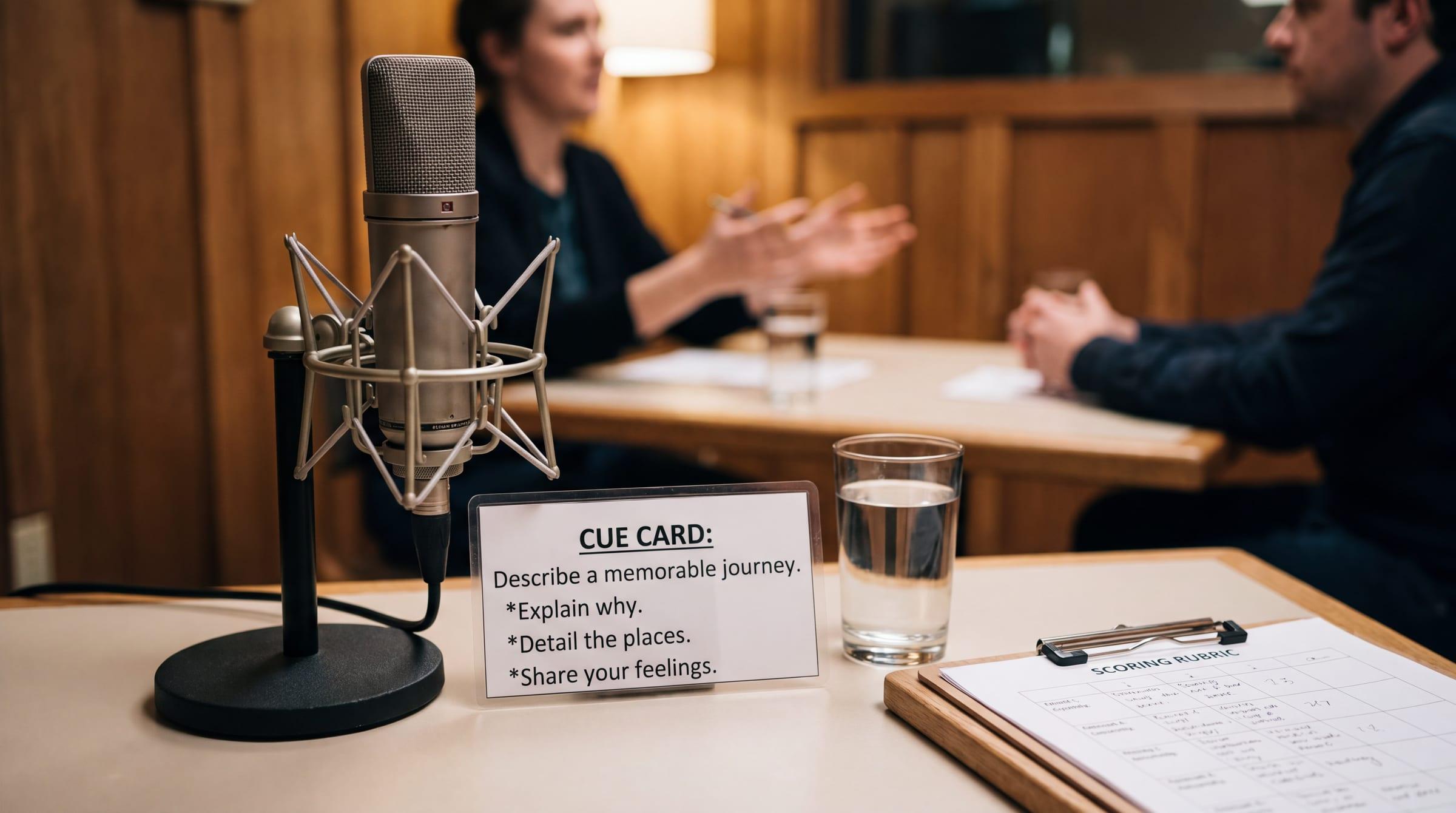
Examiners evaluate spontaneous pragmatic communication, not recited speeches.
A recurring pattern in IELTS Speaking is the persistent Band 6.5 ceiling that many intelligent, diligent students encounter, particularly in Speaking Part 2 long turns and Part 3 abstract discussions. They often possess a solid grammatical foundation and can communicate ideas clearly, yet they consistently fall short of the coveted Band 7 or 8. The primary culprit? A fundamental misunderstanding of what constitutes 'advanced vocabulary' in the context of authentic, spontaneous spoken English.
This masterclass will dismantle the 'big word' fallacy – the misguided belief that peppering your speech with obscure, academic-sounding words like 'plethora,' 'myriad,' or 'ubiquitous' will automatically elevate your score. On the contrary, this approach often leads to unnatural register clashes, hesitation, and a lack of precision, which examiners instantly penalize. Instead, we will focus on the true hallmarks of Band 9 lexical proficiency: pragmatic collocations and native-like discourse markers.
The IELTS Speaking test is not a vocabulary quiz. It's an assessment of your ability to communicate effectively and naturally in English. Forcing 'big words' often disrupts fluency and coherence, making your speech sound rehearsed and inauthentic. Examiners are trained to detect this immediately.
The Band 6.5 Trap: The 'Big Word' Fallacy
Let's be unequivocally clear: memorizing lists of rare SAT/GRE words and attempting to force them into casual conversation is a guaranteed path to a lower score. Why? Because spoken English, even at an advanced level, prioritizes naturalness, appropriacy, and precision over sheer lexical rarity. The Band 7 and Band 8 descriptors for Lexical Resource explicitly mention 'uses some less common and idiomatic vocabulary and shows some awareness of style and collocation' (Band 7) and 'uses a wide vocabulary resource readily and flexibly to convey precise meaning' (Band 8). The key phrases here are 'awareness of style and collocation' and 'readily and flexibly to convey precise meaning'.
Candidate Assumption (Band 6.0): "To get a high score, I need to use complex, academic words like 'ameliorate,' 'concomitant,' or 'eschew' in every sentence."
Example: "The plethora of technological advancements has ameliorated our daily lives, though some concomitant issues persist."
Examiner Reality: "High scores come from using a wide range of vocabulary naturally, precisely, and appropriately for the context, with a strong command of collocations and idiomatic expressions."
Example: "Technology has significantly improved our daily lives, making things much easier in many respects, though it's not without its drawbacks."
Notice the difference. The Band 9 example uses common words but combines them in natural, idiomatic phrases ('significantly improved,' 'making things much easier,' 'not without its drawbacks'). This demonstrates a sophisticated understanding of how words combine, which is far more impressive than simply dropping in a rare synonym.
The Power of Pragmatic Collocations
A collocation is simply a natural pairing of words. For example, we say 'heavy rain', not 'strong rain'. We 'make a decision', not 'do a decision'. These are fundamental building blocks of native-like fluency. Pragmatic collocations take this a step further: they are word combinations that are not just grammatically correct, but also contextually appropriate and natural-sounding in spoken discourse.
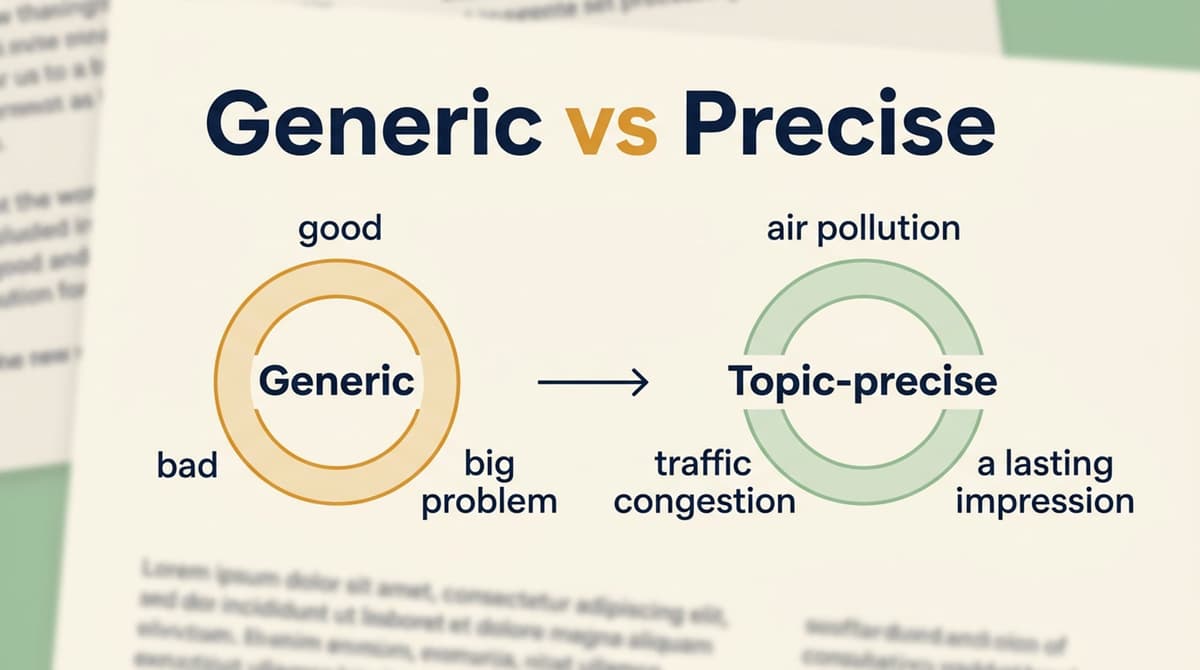
Figure 1: The Topic-Sphere Framework
Imagine your vocabulary as a series of concentric spheres. The outermost sphere contains generic, high-frequency words that are always safe but rarely impressive (e.g., 'good,' 'bad,' 'important'). The innermost sphere holds highly specific, precise collocations relevant to particular topics.
- Generic Vocabulary (Band 6.0): Words like 'many,' 'a lot of,' 'very good,' 'big problem.' These are functional but lack precision and sophistication.
- Topic-Related Vocabulary (Band 7.0): Words directly related to the topic, but perhaps not in their most natural collocations. E.g., for 'environment,' using 'pollution,' 'deforestation.'
- Precision Collocations (Band 8.0+): Natural, idiomatic pairings that demonstrate a deep understanding of the language. E.g., for 'environment,' using 'irreversible damage,' 'carbon footprint,' 'sustainable development,' 'pressing issue.'
Your goal is to move from the outer sphere to the inner sphere, not by replacing common words with rare ones, but by combining common words in uncommon, yet natural, ways.
For instance, when discussing 'environmental issues':
- Band 6.0: "There are many problems with the environment, like bad air."
- Band 9.0: "Climate change is arguably the most pressing issue of our time, leading to catastrophic consequences such as extreme weather events and irreversible damage to ecosystems."
The Band 9 example uses 'pressing issue,' 'catastrophic consequences,' 'extreme weather events,' 'irreversible damage' – all highly natural and precise collocations. These are not 'big words' in isolation, but their combination elevates the lexical quality significantly.
Discourse Markers: The Glue of Fluency and Coherence
Beyond collocations, pragmatic discourse markers are crucial for achieving high scores in Fluency and Coherence. These are words or phrases that organize your thoughts, signal your intentions, and make your speech flow naturally. They are the 'lubricant' of conversation.
For Band 8 in Fluency and Coherence, the descriptors ask that you 'speak fluently with only occasional repetition or self-correction' and 'develop topics coherently and appropriately'; Band 9 adds 'fully appropriate cohesive features'. Pragmatic discourse markers are central to this.
Consider the difference:
- Band 6.0: "I think technology is good. It helps people. Also, it has some bad things. For example, privacy." (Choppy, repetitive, lacks natural flow).
- Band 9.0: "Well, to be perfectly honest with you, I'd say technology is a double-edged sword. On the one hand, it undoubtedly streamlines many aspects of our lives, making communication effortless, for instance. However, having said that, it also presents a whole host of challenges, not least of which is the pervasive issue of data privacy."
The Band 9 example uses a range of pragmatic discourse markers ('Well, to be perfectly honest with you,' 'On the one hand,' 'for instance,' 'However, having said that,' 'not least of which is') that signal opinion, introduce examples, contrast ideas, and add emphasis. These are not 'big words,' but they are highly sophisticated in their function and impact.
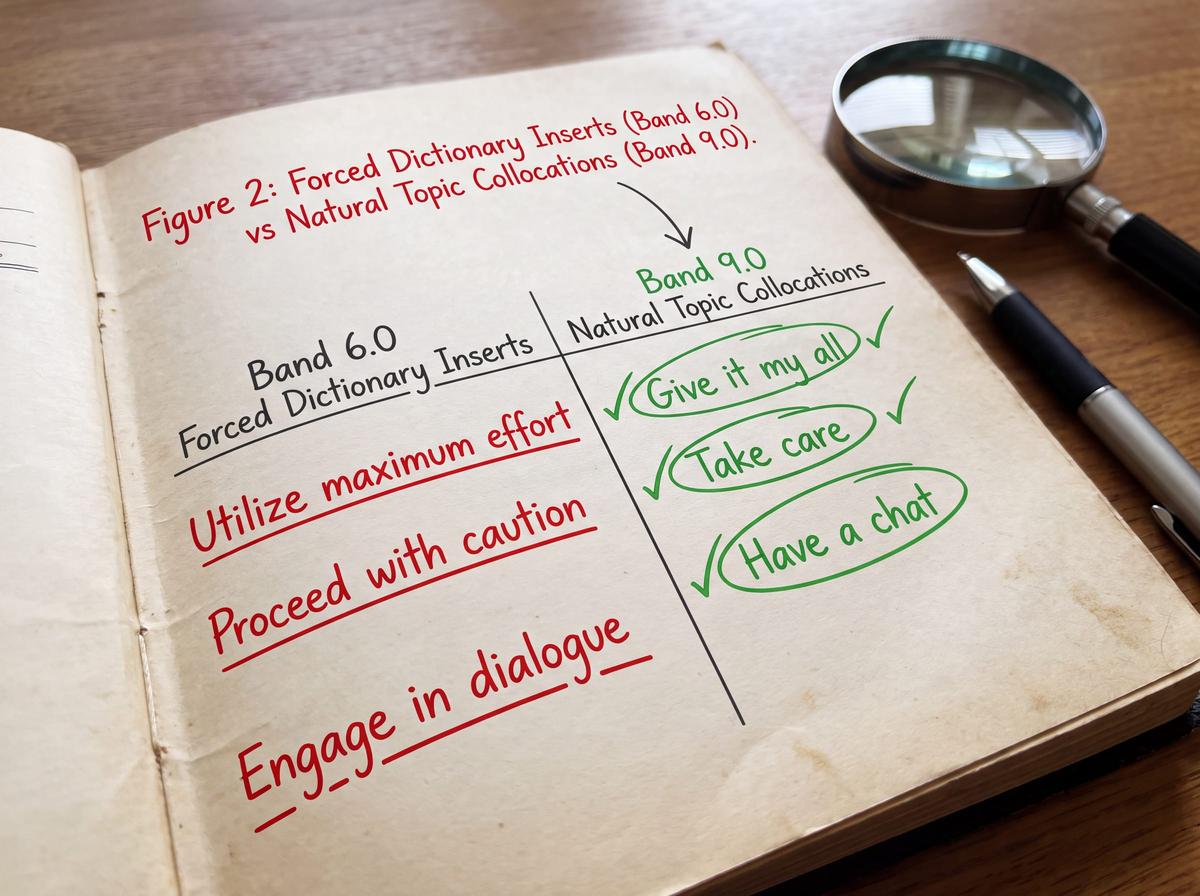
Figure 2: Forced Dictionary Inserts (Band 6.0) vs Natural Topic Collocations (Band 9.0)
This diagram illustrates the critical distinction between memorized, out-of-context vocabulary and organically integrated lexical items.
- Forced Dictionary Inserts (Band 6.0): Represented by jagged, disconnected pieces. These are words or idioms learned in isolation and then awkwardly inserted into speech, often resulting in misuse, inappropriacy, or hesitation as the candidate searches for a place to use them. E.g., using 'it's raining cats and dogs' when describing a light drizzle.
- Natural Topic Collocations (Band 9.0): Represented by smoothly interlocking gears. These are lexical items that fit seamlessly into the context, demonstrating an intuitive grasp of how words combine. They enhance meaning and flow, rather than disrupting it. E.g., for 'weather,' using 'torrential downpour,' 'blustery winds,' 'scorching heat.'
The key is to learn vocabulary in context and as chunks, not as isolated words.
Mastering Speaking Part 2: The Extended Turn
Part 2 requires you to speak for 1-2 minutes on a given topic. This is where many candidates falter, either by running out of things to say or by resorting to generic, repetitive language. The solution lies in a structured approach that leverages pragmatic collocations and discourse markers.
The PREP Method for Part 2
I recommend the PREP method for structuring your Part 2 response. This ensures you cover the topic comprehensively and naturally extend your discourse.

Figure 3: The PREP Method
This framework provides a robust structure for extended speaking, ensuring both coherence and lexical depth.
- P - Point: State your main idea or answer the cue card directly. Use a strong opening phrase.
- R - Reason: Explain why you hold this view or why this event/person is significant. Provide justification.
- E - Example: Illustrate your point with a specific, personal anecdote or a general example. This adds credibility and detail.
- P - Perspective: Broaden the discussion. What are the implications? How does it affect you/others? What did you learn? This is where you can introduce more abstract ideas and sophisticated language.
Each stage offers opportunities to deploy pragmatic collocations and discourse markers.
Let's apply this to a common Part 2 cue card:
Describe a time you helped someone. You should say: who you helped, what you did, why you helped them, and how you felt about it.
P - Point: "Okay, so I'd like to talk about a time I was able to lend a hand to a friend of mine who was really going through a tough patch." (Uses 'lend a hand,' 'going through a tough patch' – natural collocations).
R - Reason: "Essentially, the reason I felt compelled to step in was that she was facing immense pressure with her final university project, and to make matters worse, she'd fallen ill. It was a classic case of being overwhelmed." (Uses 'felt compelled to step in,' 'immense pressure,' 'to make matters worse,' 'classic case of being overwhelmed').
E - Example: "So, what I actually did was offer to proofread her entire dissertation. I spent a good few evenings meticulously going through it, checking for grammatical errors and ensuring the arguments were coherent. It was a small gesture, but it seemed to lift a huge weight off her shoulders." (Uses 'meticulously going through it,' 'grammatical errors,' 'ensuring the arguments were coherent,' 'lift a huge weight off her shoulders').
P - Perspective: "Looking back, it was incredibly rewarding. It really reinforced my belief that even small acts of kindness can make a profound difference. More broadly speaking, it taught me the importance of community and mutual support, especially when people are under considerable strain." (Uses 'incredibly rewarding,' 'reinforced my belief,' 'profound difference,' 'more broadly speaking,' 'mutual support,' 'under considerable strain').
This structured approach ensures you hit all aspects of the cue card while naturally integrating advanced lexical items and discourse markers.
Elevating Speaking Part 3: Abstract Discussion
Part 3 demands abstract thinking, the ability to discuss broader issues, and to express nuanced opinions. This is where the 'big word' fallacy is most tempting and most damaging. Instead, focus on syntactic complexity and sophisticated discourse management.
Strategies for Band 9 in Part 3
- Acknowledge Complexity: Start by acknowledging that the question is multifaceted. "That's a really insightful question, and it's certainly not straightforward to answer." or "It's a complex issue with various contributing factors."
- Present Both Sides: Use contrasting discourse markers. "On the one hand... however, on the flip side..." or "While it's true that... one must also consider..."On the one hand, working from home saves time; on the flip side, it can feel quite isolating.
- Express Nuance: Avoid definitive statements. Use hedging language. "It tends to be the case that...", "It could be argued that...", "There's a strong argument to be made for..."It tends to be the case that older people prefer to shop in person.
- Provide Examples/Elaborate: Don't just state an opinion; explain it. "To illustrate my point...", "What I mean by that is...", "This is particularly evident when we consider..."Public transport here is poor. To illustrate my point, the last bus leaves at nine.
- Conclude/Summarize: Offer a brief summary or a final thought. "So, all things considered...", "Ultimately, it boils down to..."So, all things considered, I'd say the benefits outweigh the drawbacks.
Let's consider a Part 3 question:
Do you think technology has made people more or less connected?
Band 6.0 Response: "I think technology makes people more connected because they can talk online. But also, it makes them less connected because they don't meet in person. So, it's both." (Lacks depth, uses simple vocabulary and sentence structures).
Band 9.0 Response: "That's a particularly pertinent question, and I'd argue it's a nuanced situation rather than a clear-cut 'more' or 'less' scenario. On the one hand, technology has undeniably fostered unprecedented levels of connectivity. We can maintain close ties with friends and family across continents, and social media platforms, for all their flaws, do facilitate a sense of global community. However, having said that, there's a compelling argument to be made that it has also led to a certain degree of superficiality in our interactions. People might have hundreds of online 'friends,' but they often lack deep, meaningful face-to-face connections. So, ultimately, while the sheer volume of connections has increased, the quality, in many instances, has arguably diminished."
This Band 9 response uses:
- 'particularly pertinent question,' 'nuanced situation,' 'clear-cut scenario' (pragmatic collocations for acknowledging complexity).
- 'undeniably fostered unprecedented levels of connectivity,' 'maintain close ties,' 'facilitate a sense of global community' (sophisticated collocations for 'more connected').
- 'compelling argument to be made,' 'certain degree of superficiality,' 'deep, meaningful face-to-face connections,' 'sheer volume of connections,' 'quality... has arguably diminished' (advanced collocations for 'less connected' and expressing nuance).
- Discourse markers: 'On the one hand,' 'However, having said that,' 'So, ultimately,' 'in many instances,' 'arguably'.
Many candidates believe that using a complex grammatical structure (e.g., a conditional or passive voice) is enough for a high score. While important, grammatical range without lexical precision and naturalness will still limit your score. A Band 9 response integrates both seamlessly.
Actionable Steps for Band 9 Lexical Resource and Fluency
- Stop Memorizing Isolated Words: Immediately cease memorizing lists of rare, academic words. This is counterproductive.
- Focus on Collocations: When you learn a new word, always learn it with its common partners. Use a collocation dictionary (e.g., Oxford Collocations Dictionary) or a corpus (e.g., COCA) to see how words naturally combine. For example, don't just learn 'challenge'; learn 'face a challenge,' 'overcome a challenge,' 'a daunting challenge,' 'a significant challenge.'
- Learn Discourse Markers in Context: Pay attention to how native speakers link ideas, express opinions, and manage conversations. Watch interviews, documentaries, and podcasts. Note down phrases like 'Having said that,' 'By the same token,' 'It goes without saying that,' 'To a certain extent,' 'I'm inclined to believe that.'
- Practice Thematic Vocabulary Chunks: Instead of individual words, create 'lexical sets' around common IELTS topics. For 'education,' think: 'holistic development,' 'critical thinking skills,' 'rote learning,' 'curriculum reform,' 'lifelong learning.'
- Record Yourself: Regularly record your responses to Part 2 and Part 3 questions. Listen back critically. Do you sound natural? Are you hesitating to find words? Are your 'big words' fitting in or sticking out?
- Seek Feedback from a Qualified Examiner: An experienced IELTS examiner can pinpoint exactly where your lexical choices are falling short and provide targeted advice.
The journey from Band 6.5 to Band 8.5+ in Speaking is not about acquiring a larger dictionary; it's about mastering the art of natural, precise, and appropriate communication. By focusing on pragmatic collocations and sophisticated discourse markers, you will not only impress the examiner but also genuinely enhance your ability to express complex ideas with native-like fluency and coherence. This is the true path to a Band 9.

Check yourself
3 questions · about 2 minutes · every answer explained
Was this strategy guide helpful?
Tell us if it helped. It shapes what we write next.
Band 9 Team
Written by the team that builds Band 9.
Candidate Discussion (0)
Join the conversation
Sign in to ask our examiners questions and participate in strategy discussions.