Decoding Section 3 & 4 Listening Distractor Traps: The Dialogue Pivot Architecture
Why so many high-scoring candidates fall for the 'instant answer' trap in university tutorials — and how to track speaker consensus in real time.


Listening Section 3 tests dialogue tracking and speaker resolution, not isolated keyword catching.
On this page
- 01The Anatomy of the 'Instant Answer' Trap
- 02The Dialogue Pivot Architecture: A 3-Phase Framework
- 03The Examiner's Pivot Vocabulary: Your Real-Time Tracker
- 04The 30-Second Question Scan Protocol: Pre-empting the Pivot
- 05Practical Application: Two Test-Style Scenarios
- 06Mastering the Art of Active Listening
Securing a Band 8.5 or 9.0 in IELTS Listening requires mastering the dialogue architecture of the test. Today, the Band 9 editorial team tackles a pervasive and insidious barrier that routinely prevents otherwise proficient candidates from achieving the coveted 8.5+ in the Listening module: the 'instant answer' trap in Sections 3 and 4.
This is not a guide to generic listening tips. This is a deep dive into the Dialogue Pivot Architecture – the deliberate linguistic mechanisms examiners embed to test your capacity for real-time information qualification, a skill absolutely critical for academic success and, by extension, a Band 9 score.
The difference between a Band 7.0 (30-31 correct out of 40) and a Band 8.5 (37-38) in Listening often hinges not on whether you hear the correct information, but whether you correctly identify the final, agreed-upon, or qualified information. Many candidates correctly identify a keyword or initial suggestion, but fail to track the subsequent dialogue pivot that renders their initial choice incorrect.
Let us be unequivocally clear: the IELTS Listening test, particularly in its academic sections, is not merely a test of lexical recognition. It is a sophisticated assessment of your ability to process complex, multi-layered discourse, identify speaker intent, track evolving arguments, and discern consensus or definitive statements amidst discussion and qualification. This is precisely why so many high-scoring candidates (those consistently scoring 7.0-7.5) falter when confronted with the nuanced dynamics of university tutorials (Section 3) and academic lectures (Section 4).
The Anatomy of the 'Instant Answer' Trap
Consider a typical Section 3 scenario: two students, perhaps a tutor, discussing a project. An option in your question paper might perfectly match an initial suggestion made by one student. Your brain, eager for a quick win, flags this. However, the conversation continues. The other student might disagree, the tutor might offer a counter-point, or the first student might self-correct. The 'instant answer' trap is sprung when you commit to that initial, seemingly correct piece of information without waiting for the dialogue to conclude its natural progression.
Candidate Assumption (Band 6.0)
"If I hear a keyword from the options, that's the answer. The test is about speed and matching."
Band 9 Examiner Reality
"The test assesses your ability to follow a dynamic discussion, identify qualified information, and discern final consensus or definitive statements. Initial mentions are often distractors."
This phenomenon is particularly prevalent in multiple-choice questions and summary completion where options are designed to reflect stages of a discussion, not necessarily its conclusion. In Section 4, a lecturer might present a theory, then immediately qualify it with 'However, recent research suggests...' or 'While this was once believed, we now understand...'. The initial statement, though factually presented, becomes a distractor if you fail to register the subsequent pivot.
The Dialogue Pivot Architecture: A 3-Phase Framework
To overcome this, you must internalise the Framework of the Dialogue Pivot. It operates in three distinct phases:
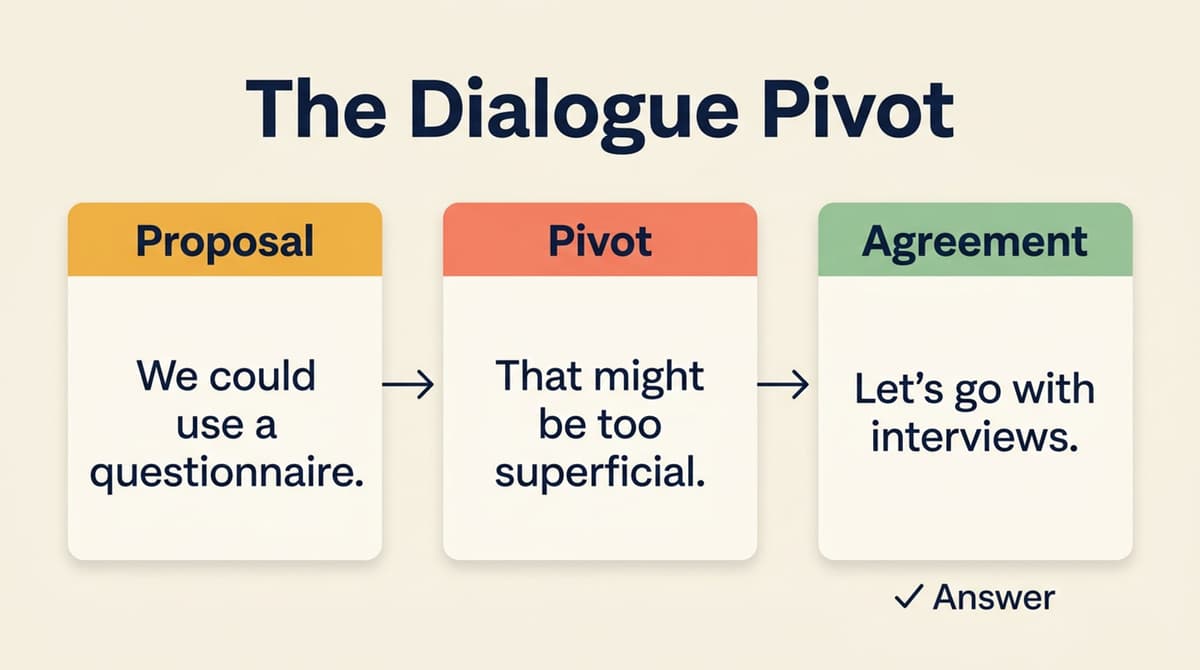
Phase 1: Proposal/Initial Statement
A speaker introduces an idea, a fact, or a suggestion. This is where most candidates commit their error by latching onto keywords.
- Example (Section 3): Student A: "I was thinking for the methodology, we could just use a simple questionnaire."
Phase 2: Qualification/Contradiction/Elaboration
Another speaker (or the same speaker) immediately modifies, challenges, or expands upon the initial statement. This is the pivot point.
- Example: Student B: "Hmm, a questionnaire might be too superficial for this topic. What about some in-depth interviews instead?"
- Example (Section 4): Lecturer: "Early theories posited that the primary driver was solar radiation. However, subsequent data revealed a more complex interplay..."
Phase 3: Agreement/Consensus/Definitive Statement
The discussion concludes with a mutually agreed-upon point, a definitive decision, or the lecturer's final, qualified statement. This is the answer.
- Example: Student A: "You're right, interviews would give us richer data. Let's go with that then."
- Example: Lecturer: "...thus, it is now understood that both solar radiation and atmospheric composition contribute significantly."
Never select an answer until the dialogue or monologue segment pertaining to that question has demonstrably concluded. Wait for the final word on the topic.
The Examiner's Pivot Vocabulary: Your Real-Time Tracker
Examiners are masters of linguistic misdirection. They employ a specific lexicon of signposting language to signal a pivot. Your task is to recognise these immediately. These are not mere conjunctions; they are cognitive triggers designed to shift your attention and re-evaluate prior information.
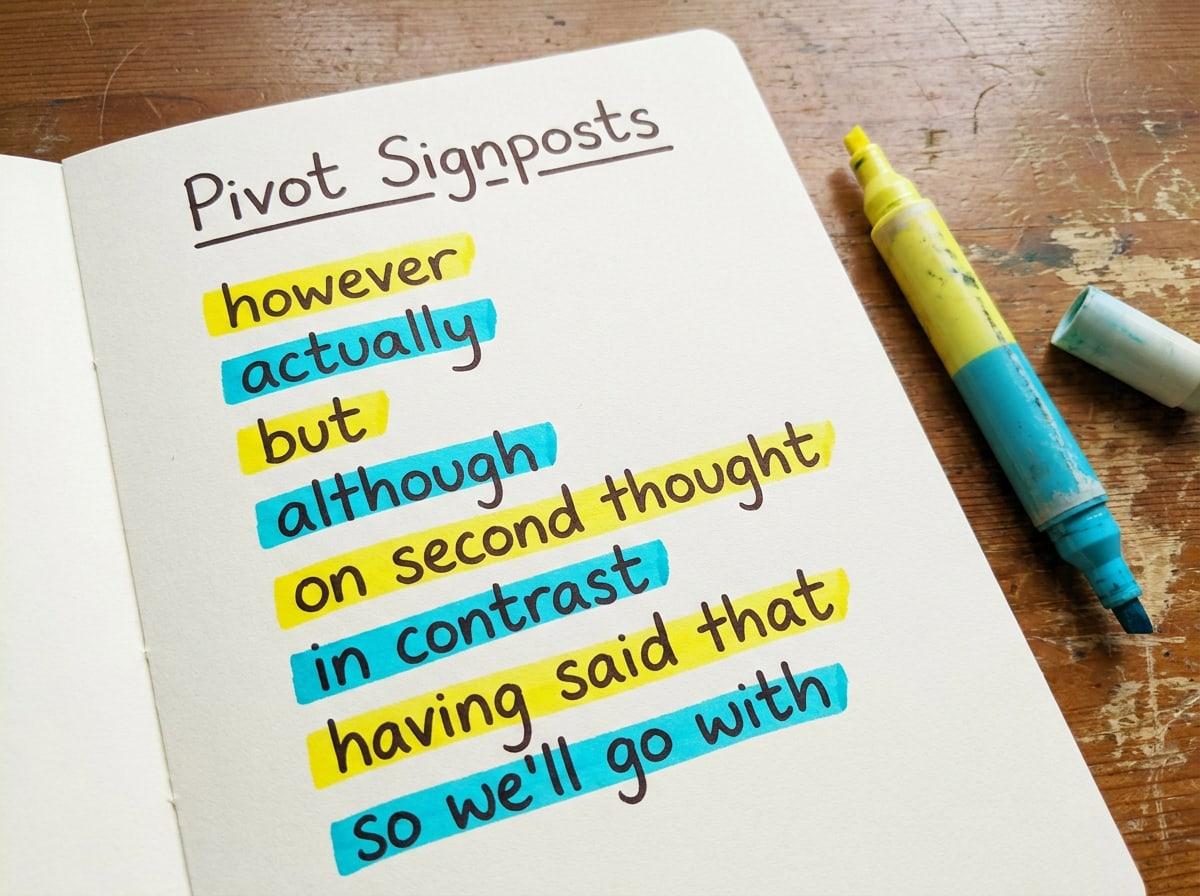
High-Frequency Reversal Signposts:
- Contradiction/Correction: "Actually...", "On second thought...", "I've changed my mind...", "That's not quite right...", "However...", "But then again...", "Conversely...", "In contrast..."‘Let's meet on Tuesday. Actually, Wednesday suits everyone better.’ The answer is Wednesday, not Tuesday.
- Qualification/Refinement: "Having said that...", "Although...", "While that's true...", "Perhaps a better approach would be...", "It's more accurate to say..."‘The survey went well. Having said that, the sample was rather small.’ The speaker's real point is the weakness.
- Agreement/Consensus (often after a pivot): "So, we'll go with...", "That settles it then.", "Yes, that makes more sense.", "Ultimately, the decision is..."‘Interviews would give us richer data.’ ‘True. So, we'll go with interviews.’ This confirms the final choice.
- Rejection/Dismissal: "No, I don't think so.", "We can rule out...", "That's not really feasible."‘What about a field trip?’ ‘We can rule out that idea; it's too expensive.’ Cross that option out.
Syntactic Patterns to Watch For:
- Initial suggestion + immediate counter-suggestion: "We could do X, but Y would be better."
- Statement + qualification clause: "X is important, though Y is arguably more critical."
- Question + re-evaluation: "What about X? Actually, Y seems more appropriate."
Do not confuse elaboration with pivot. Sometimes speakers simply add more detail without changing the core idea. A true pivot fundamentally alters or rejects the preceding information.
The 30-Second Question Scan Protocol: Pre-empting the Pivot
Your preparation time before each section is gold. Most candidates use it to merely read the questions. Band 9 candidates do something far more strategic: they pre-empt the pivot.
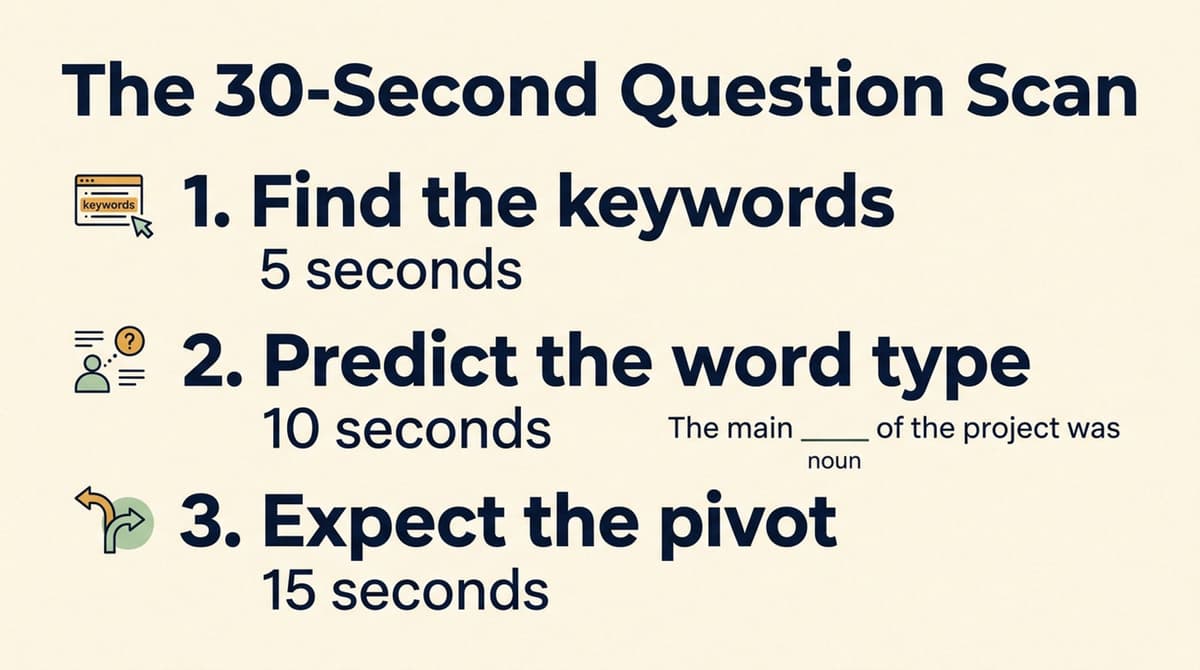
Step 1: Identify Question Type & Keywords (5 seconds)
Quickly determine if it's multiple choice, gap-fill, matching, etc. Circle or underline the core keywords in the question stem and options.
Step 2: Predict Grammatical Word Class (10 seconds)
For gap-fills, what kind of word is missing? A noun? An adjective? A verb? This narrows down possibilities and helps you filter noise.
- Example: "The main _______ of the project was..." (Predict: Noun)
Step 3: Anticipate Potential Pivots & Distractors (15 seconds)
This is the critical step. Look at the options for multiple-choice questions. Are there options that are very similar but subtly different? These are prime candidates for a pivot. For example, if options are 'interviews' and 'questionnaires', you know the discussion might involve a choice between these two. Mentally prepare for a speaker to suggest one, then pivot to the other.
- Strategy: If you see options A, B, C, and D, and A is mentioned first, do not immediately mark it. Keep B, C, and D active in your mind as potential pivots.
Your pre-reading is not just about understanding the questions; it's about predicting the examiner's strategy for misdirection. Anticipate the pivot before you even hear the audio.
Practical Application: Two Test-Style Scenarios
Let's apply this to two scenarios written in the style of the test.
Scenario 1: Section 3 - Project Discussion (Multiple Choice)
Question: What did the students finally decide was the most effective method for data collection?
A. Online surveys
B. Face-to-face interviews
C. Focus groups
D. Observation studies
Audio Excerpt:
Student A: "So, for our data collection, I was thinking we could just put together some online surveys. They're quick and easy to distribute."
Student B: "That's true, but I'm worried about the depth of information we'd get. Actually, I think face-to-face interviews would give us much richer qualitative data, even if they take longer."
Student A: "You've got a point. We really need to understand the nuances of people's experiences. Yes, let's definitely go with the interviews then. We can always supplement with a smaller survey later if needed, but the core should be interviews."
Analysis:
1. Initial mention: Student A suggests 'online surveys' (Option A). A Band 7 candidate might mark this immediately.
2. Pivot: Student B uses "Actually" and introduces 'face-to-face interviews' (Option B), highlighting its benefits.
3. Agreement/Final Decision: Student A explicitly agrees: "Yes, let's definitely go with the interviews then." The subsequent mention of a 'smaller survey later' is a distractor; the core decision is 'interviews'.
Correct Answer: B. Face-to-face interviews.
Scenario 2: Section 4 - Lecture (Summary Completion)
Question: The primary cause of the decline in bee populations was initially thought to be _______.
Audio Excerpt:
Lecturer: "For many years, the scientific community largely attributed the dramatic decline in global bee populations to habitat loss, specifically the reduction of flowering plants in agricultural areas. This was a widely accepted theory, and indeed, habitat destruction plays a significant role. However, more recent and comprehensive studies have revealed that the primary driver is actually a complex interaction of factors, with pesticide use, particularly neonicotinoids, emerging as the most critical single element. So, while habitat loss is a contributing factor, it is no longer considered the primary cause."
Analysis:
1. Initial thought/distractor: The lecturer states, "initially thought to be habitat loss." A Band 7 candidate might write 'habitat loss'.
2. Pivot: The lecturer uses "However" and explicitly states that 'habitat loss' is "no longer considered the primary cause." The new primary cause is 'pesticide use'.
3. What the question asks: The question asks what it was *initially thought* to be. The lecturer explicitly states this. The subsequent information about pesticide use is a pivot away from the *initial thought*, but the question specifically targets the initial belief.
Correct Answer: Habitat loss.
In Section 4, the lecturer often presents historical or superseded theories before presenting the current, accepted understanding. The question stem will dictate whether you need the old theory or the new one. Read carefully!
Mastering the Art of Active Listening
To consistently achieve Band 9, you must cultivate active listening – a dynamic process of prediction, verification, and qualification. It's not about passively absorbing sound; it's about engaging with the audio as if you are part of the conversation, anticipating shifts, and holding information in a temporary mental buffer until its final status is confirmed.
Your Actionable Checklist for Band 9:
- Pre-read with purpose: Identify keywords, predict word classes, and, crucially, anticipate potential points of contention or qualification between options.
- Listen for pivot markers: Train your ear to immediately flag words like 'however', 'but', 'actually', 'on second thought', 'conversely', 'while that's true', 'ultimately'.
- Buffer, don't commit: When you hear an initial match, hold it in your mind. Do not write it down or select it immediately. Wait for the dialogue to progress.
- Track speaker consensus: In Section 3, pay close attention to whether all speakers agree on a point, or if one speaker's suggestion is ultimately adopted. The final agreement is the answer.
- Identify definitive statements: In Section 4, distinguish between a lecturer presenting a historical view and then correcting it, versus presenting a definitive, current understanding.
The IELTS Listening test is a finely tuned instrument designed to assess your ability to navigate the complexities of academic discourse. By understanding and actively countering the Dialogue Pivot Architecture, you will not merely hear the words; you will comprehend the intent, qualify the information, and confidently secure your Band 9.

Check yourself
3 questions · about 2 minutes · every answer explained
Was this strategy guide helpful?
Tell us if it helped. It shapes what we write next.
Band 9 Team
Written by the team that builds Band 9.
Candidate Discussion (0)
Join the conversation
Sign in to ask our examiners questions and participate in strategy discussions.