Overcoming the Multiple Choice Trap in Section 3
Options are scrambled, paraphrased, and multi-layered. Learn real-time option elimination, paraphrase spotting, and how to conquer 'choose TWO letters' questions.


Multiple-choice questions test your ability to recognise spoken paraphrases and eliminate distractors in real time.
The Section 3 Multiple Choice Challenge
IELTS Listening Section 3 often presents the most challenging multiple-choice questions. Unlike earlier sections, you'll typically hear two or three speakers discussing an academic topic, such as a student and a tutor, or two students collaborating on a project. The language is more complex, and the questions are designed to test your ability to follow nuanced arguments and identify specific details within a broader discussion.
Many candidates find these questions difficult because the options are rarely presented in a straightforward manner. You'll encounter options that are spoken out of order, paraphrased extensively, or require you to select multiple correct answers from a longer list. This article will equip you with the strategies to overcome these common traps and improve your score in Section 3 multiple-choice tasks.
In Section 3, expect academic discussions. The speakers will often express opinions, agree or disagree, and elaborate on complex ideas. Your task is to pinpoint the specific information requested by the question, even when it's hidden within a longer conversation.
The Scrambled Order Trap: Eliminating Options in Real Time
One of the most common traps in Section 3 multiple-choice questions is the 'scrambled order' of options. You might read options A, B, and C in your question booklet, but the speakers could mention option C first, then A, and finally B. If you're listening for the options to be spoken in the order they appear on the page, you'll quickly become confused and miss the correct answer.
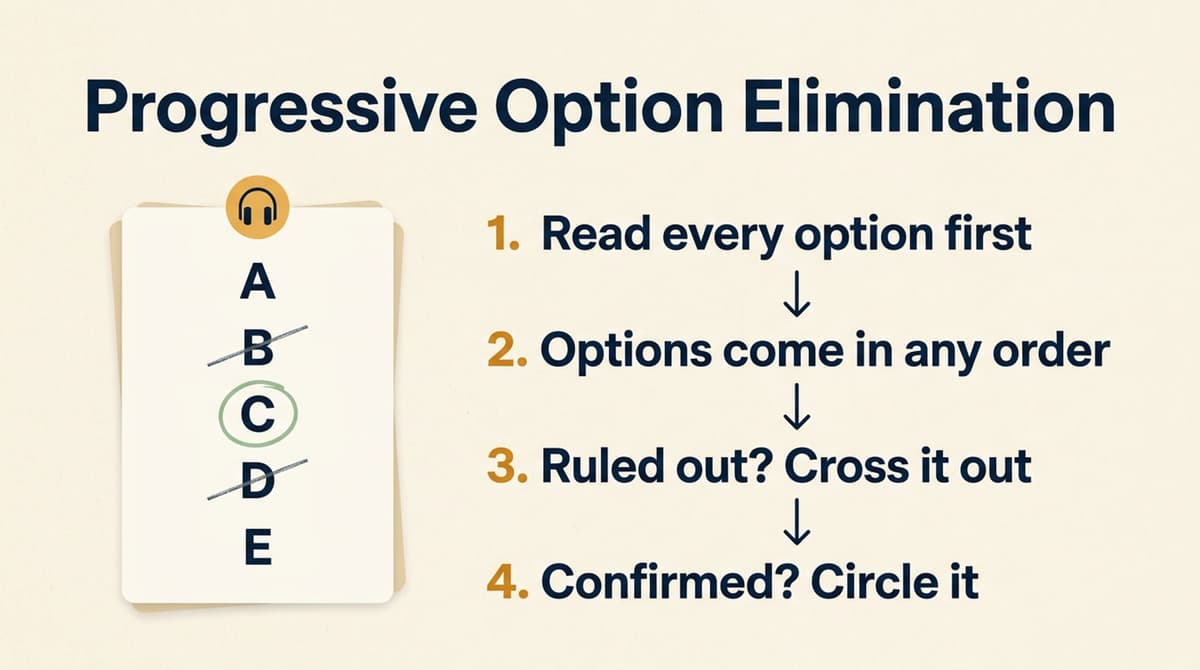
The key to overcoming this is to adopt a strategy of real-time option elimination. As soon as an option is mentioned, evaluate it against the question. If it's clearly incorrect, cross it out immediately. If it's a potential answer, keep it in mind but don't commit until you've heard the entire discussion related to the question.
How to Practice Real-Time Elimination
Before the recording starts, read the question and all its options carefully. Underline keywords in the question and in each option. This pre-reading helps you anticipate what to listen for. As the speakers discuss the topic, listen for any mention of the ideas presented in the options. When an idea is mentioned, quickly check if it matches the question's requirement. If it doesn't, cross it out. This systematic approach prevents you from being overwhelmed by the scrambled order.
Candidate Assumption (Band 6.0)
I will hear the options in the order A, B, C. I'll wait for the speaker to say option A, then option B, then option C, and then choose the correct one.
Band 9 Reality
The options will be discussed in a random order. I must listen for the content of each option, evaluate it as it's spoken, and eliminate incorrect options immediately, regardless of the order.
The Paraphrase Trap: Beyond Exact Keywords
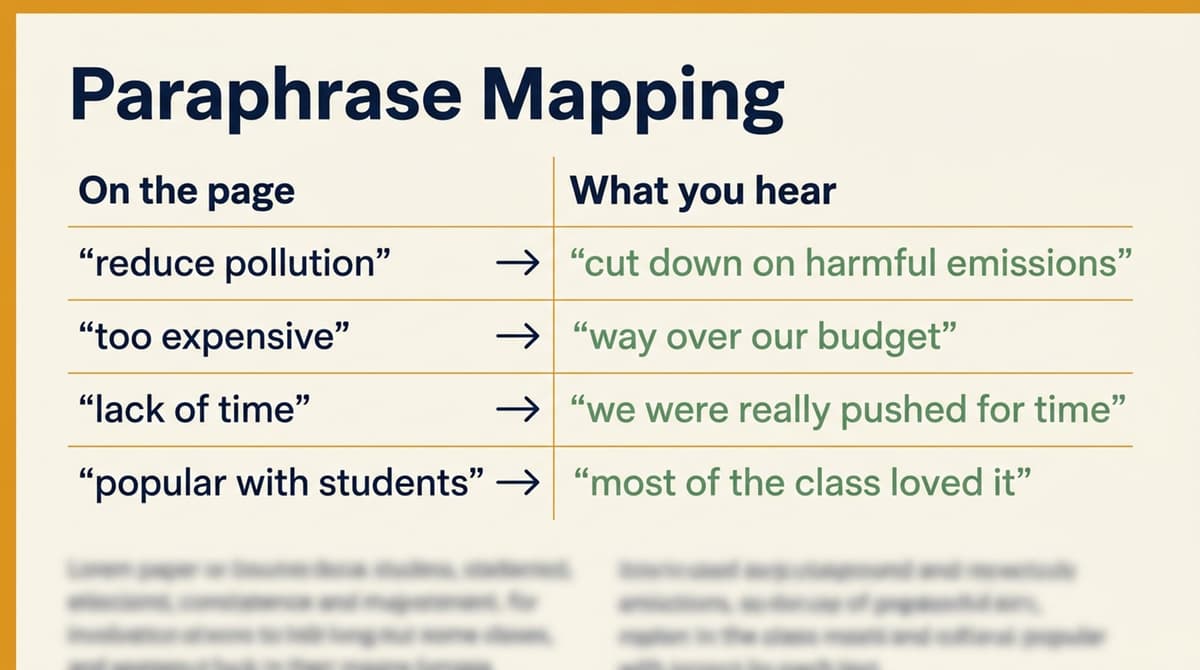
Another significant challenge in Section 3 multiple-choice is the extensive use of paraphrasing. You will rarely hear the exact words from the options spoken in the recording. Instead, the speakers will use synonyms, rephrased sentences, and different grammatical structures to convey the same meaning.
Listening for exact keywords is a common Examiner Trap. While keywords can help you locate the relevant part of the discussion, you must then listen for the *meaning* of what is being said and match it to the *meaning* of the options, not just the words.
Developing Paraphrase Spotting Skills
To improve your ability to spot paraphrases, expand your vocabulary, focusing on synonyms and antonyms. When you pre-read the options, think of alternative ways the same idea could be expressed. For example, if an option says 'reduce pollution', you might hear 'minimise environmental impact' or 'cut down on harmful emissions'.
Practice is crucial here. Use authentic IELTS practice materials and actively identify how options are paraphrased in the audio. After checking your answers, go back and listen to the sections where you struggled, specifically noting the paraphrased language.
When pre-reading, highlight keywords in the question and options. Then, for each keyword, brainstorm 2-3 synonyms or related phrases. This prepares your ear for the paraphrases you are likely to hear.
Mastering 'Choose TWO Letters' Questions
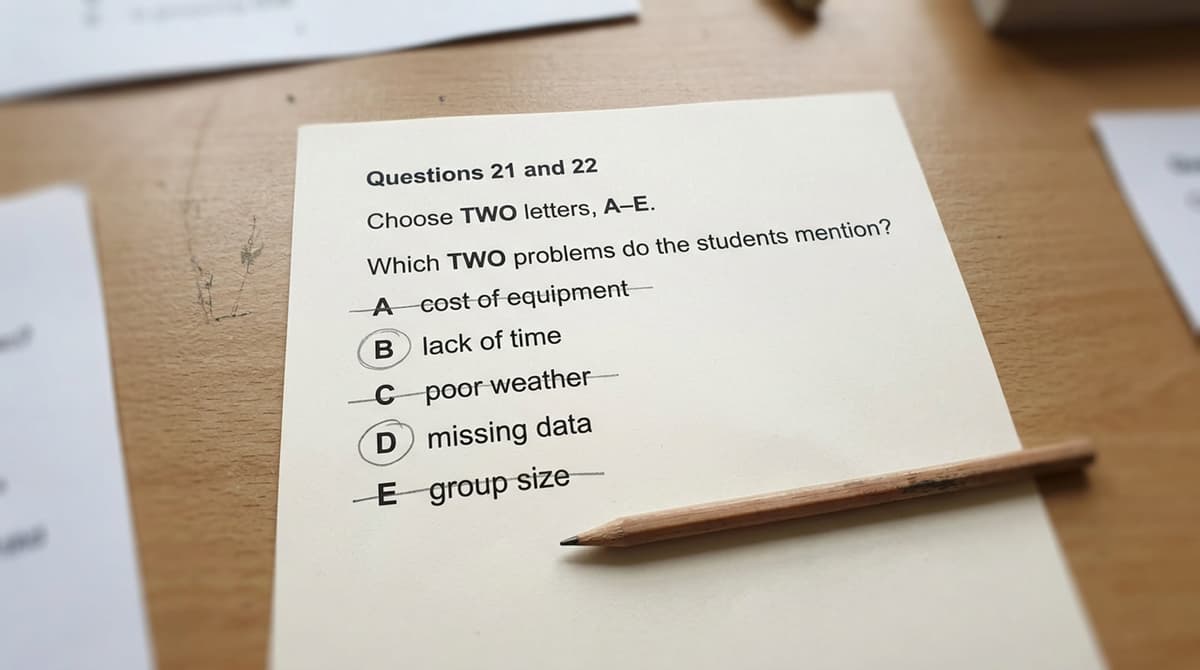
Section 3 often includes 'choose TWO letters' questions, where you need to select two correct answers from a list of five or more options. These questions combine the challenges of scrambled order and paraphrasing with the added complexity of managing multiple potential answers.
The strategy for these questions is an extension of real-time elimination, but with a crucial difference: you are looking for two correct options, not just one. This means you might initially identify three or four plausible options before the speakers provide enough detail to narrow it down to the final two.
A Step-by-Step Approach for Multi-Select
- Pre-read all options: Understand the core idea of each of the five options.
- Listen and mark: As each option is mentioned or alluded to, make a quick note (e.g., a tick for 'possibly correct', a cross for 'definitely incorrect').
- Listen for confirmation/rejection: The speakers will often discuss an option, then either confirm it as relevant to the question or dismiss it. Listen for phrases like 'that's a good point', 'I agree', 'however', 'on the other hand', which signal agreement or disagreement.
- Final selection: Once the discussion related to the question concludes, review your marked options and select the two that are most clearly supported by the audio. Don't be afraid to change your initial markings as more information is revealed.
For 'choose TWO letters' questions, do not commit to an answer until the entire relevant segment of the audio has finished. Speakers often introduce an idea only to contradict or refine it later in the conversation.
Practice and Review: The Path to Success
Consistent practice is the most effective way to master Section 3 multiple-choice questions. When you practice, don't just check your answers. Engage in a detailed review process:
- Transcribe difficult sections: For questions you got wrong, transcribe the relevant part of the audio. This helps you see exactly how the paraphrasing works and how the options were scrambled.
- Identify distractors: Understand why the incorrect options were mentioned. Often, they contain keywords from the audio but don't answer the specific question, or they represent an idea that was discussed but ultimately rejected.
- Time yourself: Practice pre-reading the questions and options within the allocated time. This is crucial for developing the speed and efficiency needed on test day.
By systematically applying these strategies – real-time elimination, active paraphrase spotting, and a structured approach to multi-select questions – you will significantly improve your performance in IELTS Listening Section 3. Remember, the goal is to understand the meaning, not just to match words.
Checklist for Section 3 Multiple Choice
- Did I pre-read the question and all options, underlining keywords?
- Did I anticipate possible paraphrases for key terms?
- Did I eliminate options in real-time as they were clearly contradicted or irrelevant?
- For 'choose TWO' questions, did I wait until the end of the discussion before making my final selections?
- Did I focus on the overall meaning conveyed by the speakers, rather than just isolated words?

Check yourself
4 questions · about 3 minutes · every answer explained
Was this strategy guide helpful?
Tell us if it helped. It shapes what we write next.
Band 9 Team
Written by the team that builds Band 9.
Candidate Discussion (0)
Join the conversation
Sign in to ask our examiners questions and participate in strategy discussions.