Matching Headings in Academic Reading: Why Scanning for Keywords Guarantees a Band 6.5
Discover the 'Theme vs Detail' dichotomy and the 3-step Paragraph Core Synthesis protocol that eliminates distractor headings forever.


Matching Headings tests your grasp of the paragraph's controlling idea, not surface vocabulary.
On this page
- 01The Fatal Flaw: Why Keyword Scanning is a Band 6.5 Trap
- 02The 'Theme vs Detail' Dichotomy: Your Band 9 Filter
- 03The 3-Step Paragraph Core Synthesis Protocol
- 04The Strategic Advantage: Doing Headings First
- 05Advanced Strategies for Complex Texts
- 06Time Management for Matching Headings
- 07Conclusion: From Keyword Scanning to Cognitive Synthesis
Matching Headings is widely regarded as one of the most formidable adversaries in IELTS Academic Reading. Today, the Band 9 editorial team demystifies the cognitive processes and systematic strategies needed to conquer Matching Headings with Band 9 precision.
This question type is a perennial stumbling block, particularly in Passages 2 and 3, where text complexity and the sophistication of distractors escalate dramatically. My objective is not merely to offer tips, but to fundamentally rewire your approach, replacing superficial keyword matching with a deep, analytical comprehension strategy that aligns precisely with the official band standards for Reading.
Key Note
The IELTS Reading test is not a vocabulary test, nor is it a speed-reading exercise in the conventional sense. It is a test of your ability to understand main ideas, specific information, implied meaning, and author's purpose within a time-constrained environment. Matching Headings specifically targets your ability to discern the gist or main theme of a paragraph.
The Fatal Flaw: Why Keyword Scanning is a Band 6.5 Trap
Let us begin by dismantling the most pervasive and damaging misconception: the belief that you can successfully match headings by scanning for identical or synonymous keywords between the heading list and the paragraph text. This strategy, while seemingly intuitive, is precisely what examiners exploit to differentiate candidates.
Candidate Assumption (Band 6.0-6.5)
"If a heading contains the word 'technology' and a paragraph mentions 'technological advancements,' then that's the correct match. I just need to find the keywords."
Band 9 Examiner Reality
Examiners deliberately plant heading keywords in supporting detail sentences to trap word-matchers. A Band 9 candidate understands that a heading must encapsulate the overall main idea of the entire paragraph, not just a single sentence or phrase within it.
Consider this: a paragraph might discuss the impact of technology on education in its opening sentence, but then dedicate the remaining six sentences to detailing the historical evolution of teaching methodologies. A heading like 'The Role of Technology in Modern Pedagogy' would be a distractor, despite the keyword match. The true heading would relate to the historical evolution.
Examiner Trap
The most common trap is the 'detail trap'. A heading will contain a keyword or phrase that appears in a paragraph, but that phrase represents only a minor detail or an example, not the central theme. Your task is to identify the macro-level idea, not the micro-level illustration.
The 'Theme vs Detail' Dichotomy: Your Band 9 Filter
The fundamental principle underpinning successful Heading Matching is the ability to distinguish between the core theme of a paragraph and its supporting details. This is not an innate skill; it is a cognitive process that can be trained and refined.
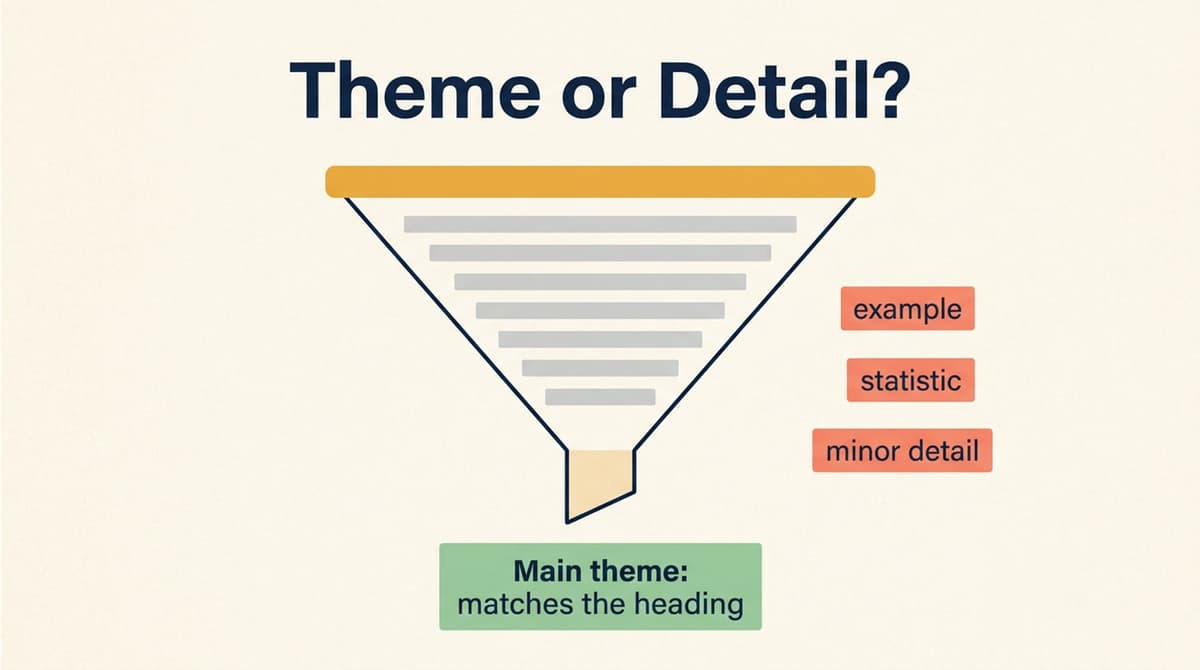
Framework
The Core Theme vs Supporting Detail Diagnostic Filter
- Identify the Topic Sentence (often, but not always, the first sentence): This sentence frequently introduces the paragraph's main subject.
- Scan for Controlling Ideas: What is the author's primary assertion or argument about this subject?
- Evaluate Supporting Evidence: Do the subsequent sentences provide examples, explanations, statistics, or further elaboration on the controlling idea? These are details.
- Synthesize the Gist: What single, concise statement best summarises the entire paragraph's purpose or message? This is the theme.
Band 9 Rule
A correct heading will be a generalisation or abstraction of the paragraph's core theme, not a specific detail or example mentioned within it. It must cover the entire scope of the paragraph's content.
The 3-Step Paragraph Core Synthesis Protocol
To consistently apply the 'Theme vs Detail' filter, I prescribe a rigorous, three-step protocol. This protocol forces you to engage with the text at a deeper level than mere keyword recognition.
Step 1: Read the Paragraph for Overall Understanding (The First Pass)
Do not look at the headings yet. Your initial read of each paragraph should be focused on comprehension, not matching. Read the entire paragraph, paying particular attention to:
- The first and last sentences: These often contain the topic sentence and concluding remarks, which frequently encapsulate the main idea.
- Transition words and phrases: Words like 'however,' 'therefore,' 'in contrast,' 'for example,' 'consequently' signal shifts in argument, introduction of evidence, or conclusions.
- Repeated ideas or concepts: What ideas does the author return to? What is the central focus?
Key Note
Resist the urge to highlight every noun or verb. Focus on understanding the flow of ideas. Ask yourself: "What is this paragraph primarily about?"
Step 2: Formulate Your Own Summary Sentence
After reading the paragraph, before looking at the provided headings, articulate a single, concise sentence that summarises its main idea. This is crucial. This forces active processing and prevents the provided headings from unduly influencing your interpretation.
Example Paragraph Excerpt:
"The advent of the internet profoundly reshaped global communication, enabling instantaneous information exchange across continents. However, this digital revolution also brought with it significant challenges, particularly concerning data privacy and the proliferation of misinformation. While early proponents envisioned a utopian global village, the reality has been a complex interplay of unprecedented connectivity and emergent societal vulnerabilities, demanding robust regulatory frameworks and enhanced digital literacy."
Your Summary Sentence (Internal Monologue): "The internet brought both benefits in communication and challenges like privacy and misinformation, creating a complex digital landscape."
Step 3: Match Your Summary to the Best Heading and Eliminate Distractors
Now, and only now, turn to the list of headings. Compare your self-generated summary sentence against each heading. This is where your understanding of distractor types becomes critical.
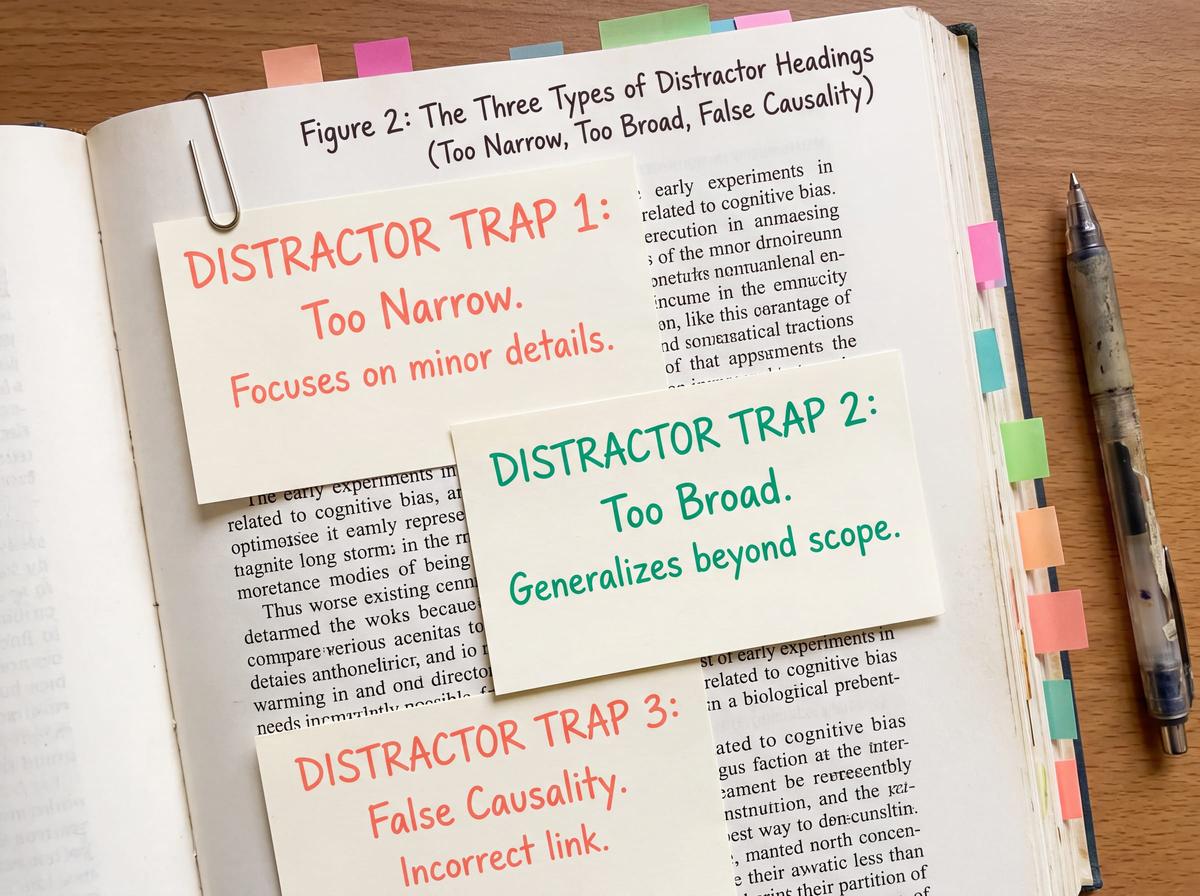
Framework
The Three Types of Distractor Headings
- Too Narrow: These headings focus on a specific detail, example, or a single sentence within the paragraph, rather than its overall theme. They often contain keywords from the paragraph but fail to capture its full scope.
- Too Broad: These headings are so general that they could apply to multiple paragraphs or even the entire passage. They lack the specificity to accurately represent the unique theme of a single paragraph.
- False Causality/Misinterpretation: These headings misrepresent the relationship between ideas in the paragraph, or introduce concepts not discussed. They might use similar vocabulary but convey a different meaning or implication.
Band 9 Rule
The correct heading will be the one that most accurately and comprehensively reflects your summary sentence, without being too specific (a detail) or too general (lacking focus).
Let's apply this to our example paragraph and some hypothetical headings:
Your Summary: "The internet brought both benefits in communication and challenges like privacy and misinformation, creating a complex digital landscape."
Hypothetical Headings:
- The Rise of Online Misinformation (Too Narrow – this is only one challenge, not the whole theme)
- Global Communication in the 21st Century (Too Broad – doesn't capture the 'challenges' aspect or the internet's specific role)
- The Dual Impact of Digital Connectivity (Correct – 'Dual Impact' covers both benefits and challenges, 'Digital Connectivity' accurately reflects the internet's role. This aligns perfectly with our summary.)
- Early Visions of the Internet (Too Narrow/Detail – refers only to 'early proponents' and their 'utopian global village' vision, which is a minor detail used to contrast with reality.)
Examiner Trap
Be wary of headings that use extreme language (e.g., 'always,' 'never,' 'only,' 'all') or make definitive claims if the paragraph presents a more nuanced or qualified argument. The correct heading will mirror the author's tone and scope.
The Strategic Advantage: Doing Headings First
Many candidates, in a misguided attempt to save time, leave Matching Headings until last. This is a critical error. I advocate for tackling Matching Headings first for any passage where they appear.
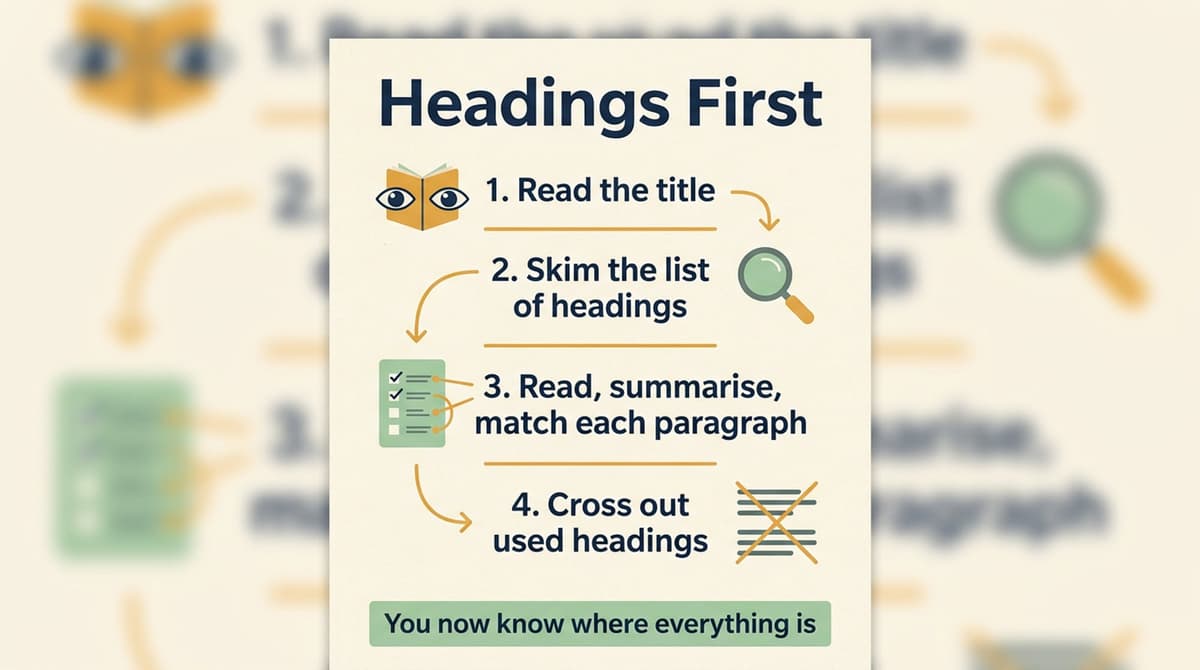
Framework
The First-Pass Protocol: Doing Headings First
- Read the Passage Title and Subtitle: Gain an initial understanding of the overall topic.
- Skim the Headings List: Get a general sense of the potential themes. Do NOT try to match yet.
- Apply the 3-Step Protocol to Each Paragraph: Read paragraph, summarise, match. As you match, cross out used headings.
- Benefit: Enhanced Passage Map: By the time you finish Matching Headings, you will have a detailed mental map of each paragraph's content and its contribution to the overall passage.
Band 9 Rule
Completing Matching Headings first provides a structural overview of the passage, making subsequent question types (e.g., True/False/Not Given, Summary Completion, Multiple Choice) significantly easier and faster to navigate. You will know exactly where to locate specific information.
This approach transforms a challenging question type into a powerful passage mapping tool. Instead of re-reading paragraphs for other questions, you will already have a clear understanding of where specific topics are discussed.
Advanced Strategies for Complex Texts
In Passages 2 and 3, paragraphs can be longer, more complex, and contain multiple sub-ideas. Here's how to adapt:
- Identify the 'Pivot': Look for conjunctions like 'however,' 'but,' 'although,' 'despite this.' These often signal a shift in focus or a counter-argument, which can be central to the paragraph's overall theme. The main idea might be presented after the pivot.
- Recognise Authorial Intent: Is the author primarily describing, arguing, comparing, contrasting, or problem-solving? The heading should reflect this intent.
- Beware of 'Red Herring' Sentences: Sometimes, a paragraph will start with a broad, attention-grabbing statement that is then immediately narrowed down. The true theme lies in the narrower focus.
Key Note
Practice with official complex historical and scientific research passages. These passages are designed to test your ability to navigate sophisticated academic discourse and are excellent training grounds for the 'Theme vs Detail' dichotomy.
Time Management for Matching Headings
While I advocate doing headings first, this does not mean spending an inordinate amount of time on them. Allocate approximately about a minute per paragraph for the 3-step protocol. If you are stuck between two headings, make your best educated guess, mark the paragraph, and move on. The mental map you build will often help you resolve ambiguities later when you tackle other questions.
Conclusion: From Keyword Scanning to Cognitive Synthesis
The journey from a Band 6.5 to a Band 9 in Matching Headings is a journey from superficial keyword recognition to deep cognitive synthesis. By internalising the 'Theme vs Detail' dichotomy, rigorously applying the 3-step Paragraph Core Synthesis protocol, and strategically tackling headings first, you will not only conquer this challenging question type but also gain a profound advantage across the entire Reading test.
Remember, the IELTS is a test of academic readiness. Your ability to quickly and accurately grasp the main ideas of complex texts is a hallmark of a proficient English user. Master this, and your Band 9 is within reach.

Check yourself
2 questions · about 2 minutes · every answer explained
Was this strategy guide helpful?
Tell us if it helped. It shapes what we write next.
Band 9 Team
Written by the team that builds Band 9.
Candidate Discussion (0)
Join the conversation
Sign in to ask our examiners questions and participate in strategy discussions.