The True / False / Not Given Mastery Blueprint
Why 80% of candidates confuse False with Not Given — and the 3-step examiner decision matrix that eliminates second-guessing on Academic & General Reading.


True/False/Not Given questions evaluate your ability to separate verified facts from plausible assumptions.
The Psychological Trap of Reading What Isn't There
If you ask a classroom of candidates why they missed Band 8.5 in Academic Reading, nearly three-quarters point to the exact same culprit: True / False / Not Given (or Yes / No / Not Given in opinion passages). Candidates rarely struggle to identify factual statements that clearly align with the text. The heartbreak occurs almost exclusively in the twilight zone between FALSE and NOT GIVEN.
The root cause is rarely vocabulary weakness; it is a cognitive bias called inferential projection. High-achieving students possess strong world knowledge, and when an IELTS statement feels logically reasonable or scientifically probable, the human brain automatically bridges the textual gap and assumes it must be true. But IELTS examiners do not grade your general knowledge. They grade your ability to verify textual commitment.
If the text does not supply direct, irrefutable evidence for a specific assertion, that assertion does not exist in the test universe. Never fill in the author's blanks with outside common sense.
The Three Definitions
Before looking at test passages, commit these three operational definitions to memory. These are the working definitions the question type is built on:
- TRUE Agrees completely with the text. Every single semantic element of the statement is explicitly confirmed or paraphrased by the author.
- FALSE Directly contradicts or opposes the text. The passage says the opposite, or demonstrates that the statement is mathematically or factually impossible according to the author.
- NOT GIVEN The passage neither confirms nor denies. The topic itself might be mentioned, but the specific relationship, comparison, consequence, or degree claimed in the statement is omitted.
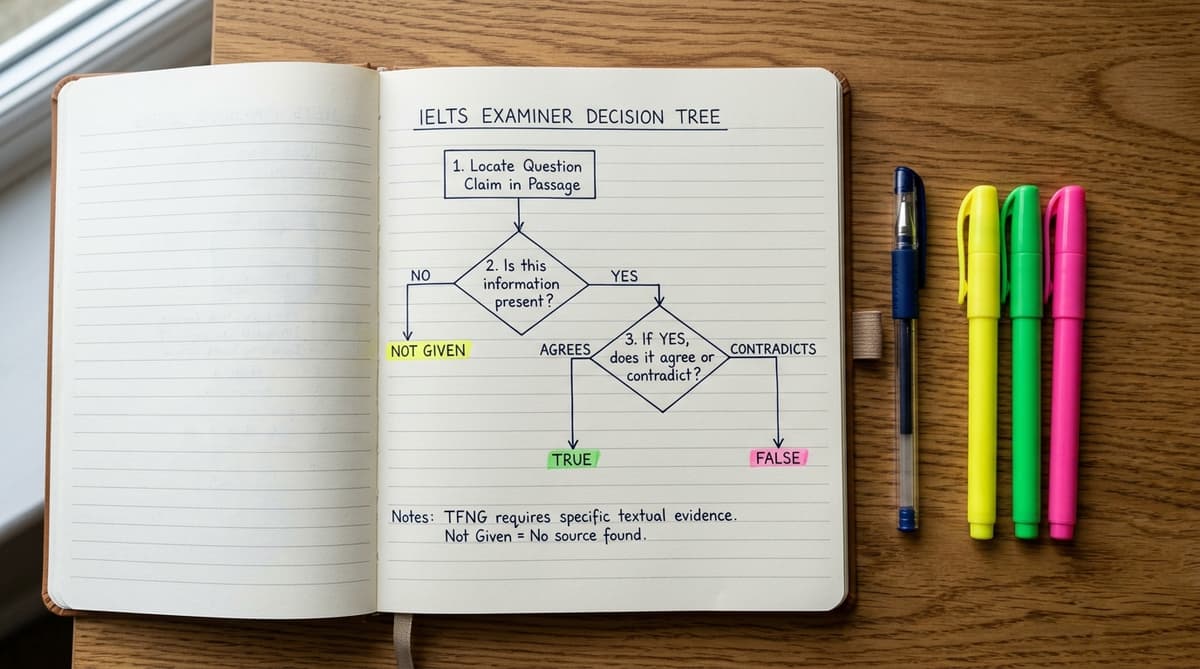
The 3-Step Decision Matrix
When you tackle any statement, follow this strict sequential path instead of guessing:
Locate the target sentence using non-paraphrasable terms (names, numbers, species).
Did the author make a claim about this exact relationship? If the author never took a stand, stop searching → NOT GIVEN.
If the author did state it: does it confirm (TRUE) or refute (FALSE)?
The Four Classic Examiner Traps & Annotated Corrections
In our examining sessions, we notice 90% of lost marks stem from four recurring structural traps. Here is how examiners construct them and how to counter them on exam day.
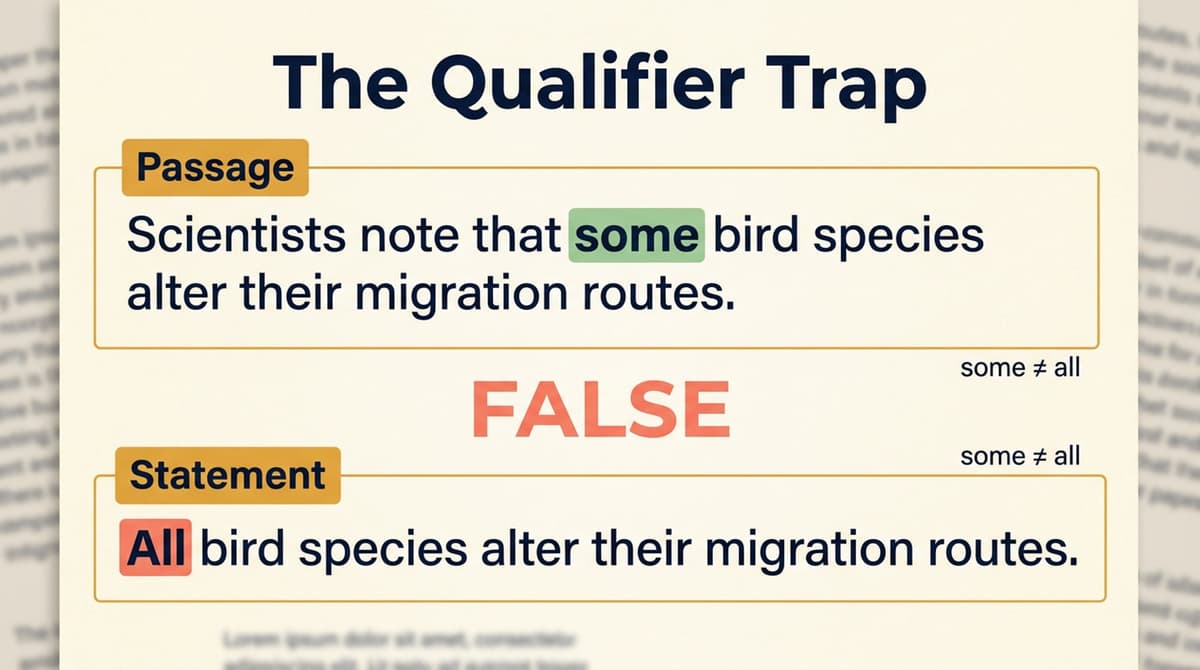
Absolute vs Nuanced Claims
Examiners take a cautious academic statement and turn it into an extreme or categorical proposition in the question.
"Scientists note that some bird species alter their migration routes during unseasonable warming."
"All bird species alter their routes due to climate change."
Trap 2: Causation vs Correlation (The Inference Mistake)
Another favourite distractor is taking two phenomena that occurred concurrently and inventing a causal link in the question statement. Candidates routinely fall for this because the causality sounds completely logical in real life.
Passage: "During the 19th-century railway expansion, adult literacy rates in provincial England rose by twelve percent."
Candidate thinks: "Well, railways brought books, trade, and newspapers into towns, so of course railways boosted literacy!" → Marks TRUE (Mistake!).
Statement: "The expansion of railways directly stimulated adult literacy in provincial England."
Examiner rubric: The author recorded two concurrent events, but never established a causal link. Without textual commitment, the answer must be NOT GIVEN.
The 20-Minute Chronological Guarantee
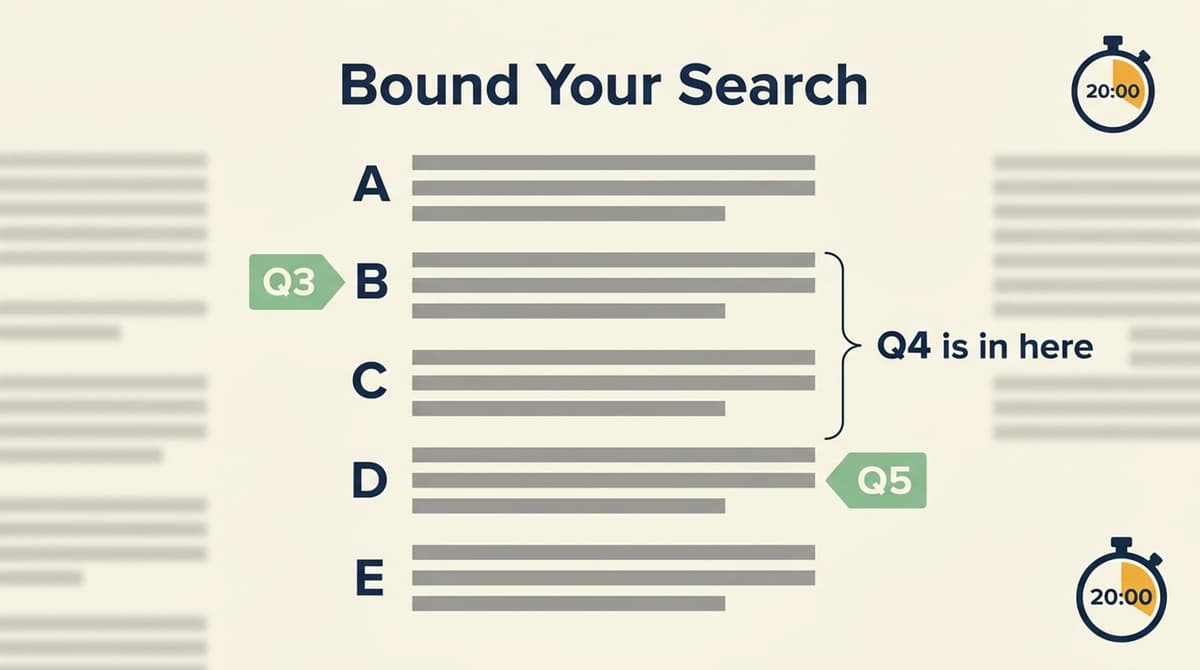
In real IELTS tests, True / False / Not Given questions are almost universally presented in chronological order within the passage. You can leverage this structural guarantee to pinpoint missing information without wasting precious minutes.
- If Question 3 is in Paragraph B, and Question 5 is in Paragraph D, the evidence for Question 4 is strictly bounded between them.
- If you read the intervening sentences and find zero mention of the controlling claim, that is your proof: it is NOT GIVEN.
- Never spend more than 90 seconds searching for a single question.

Check yourself
3 questions · about 2 minutes · every answer explained
Was this strategy guide helpful?
Tell us if it helped. It shapes what we write next.
Band 9 Team
Written by the team that builds Band 9.
Candidate Discussion (0)
Join the conversation
Sign in to ask our examiners questions and participate in strategy discussions.