The Concession & Counter-Argument Masterclass: How to Break Through the Band 6.5 Task Response Ceiling
Why listing three superficial points guarantees a Band 6.0 in Writing Task 2 — and the 4-tier concession framework examiners look for to award Band 8.0 and 9.0.

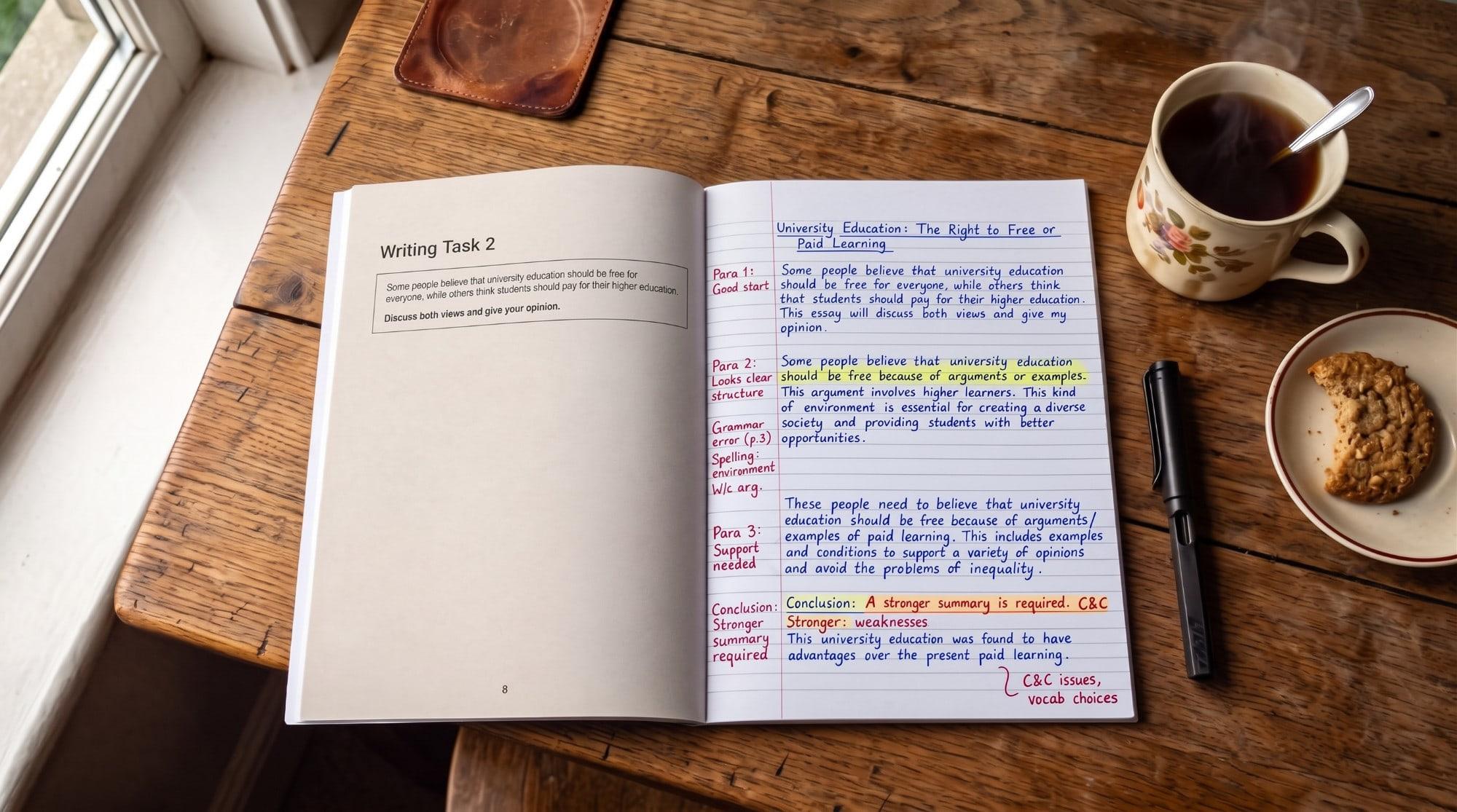
Band 8+ Task Response requires extended, well-supported ideas with clear counter-arguments.
On this page
- 01The 6.5 Ceiling: A Diagnostic of the 'Idea Listing' Trap
- 02Deconstructing Task Response: Beyond "Addressing All Parts"
- 03The Anatomy of a Band 9 Paragraph: Depth vs. Listing
- 04Strategic Integration: Where and When to Concede
- 05Lexical Resource for Concession & Rebuttal
- 06Grammatical Range & Accuracy: Crafting Complex Sentences
- 07The 40-Minute Examiner Protocol: Pacing for Perfection
- 08Conclusion: Elevating Your Argument to Examiner Expectations
Achieving a Band 8.0 or 9.0 in IELTS Writing Task 2 requires an operational understanding of how band descriptors are actually applied. The distinction between a Band 6.5 and a Band 8.5 script rarely comes down to grammar or spelling; it comes down to the analytical depth and logical extension of your arguments.
Today, we address a pervasive and insidious barrier that traps countless candidates at the 6.5 mark in Writing Task 2: the failure to adequately develop an argument through sophisticated concession and counter-argument. This is not merely about 'having good ideas'; it is about the strategic deployment of those ideas within a coherent, persuasive structure.
The IELTS Writing Task 2 is not a brainstorming session. It is a formal academic essay designed to assess your ability to construct a logical, well-supported argument. Superficiality is the enemy of high bands.
The 6.5 Ceiling: A Diagnostic of the 'Idea Listing' Trap
Many candidates approach Task 2 with a simple, yet fundamentally flawed, strategy: brainstorm three or four distinct points related to the prompt, and then dedicate a sentence or two to each in a body paragraph. This, I assure you, is a direct route to a Band 6.0 for Task Response.
Candidate Assumption / Mistake (Band 6.0)
"I need to show the examiner I have many ideas. If I list three different reasons in a paragraph, it proves I've thought deeply about the topic."
"My paragraph has a topic sentence, then three supporting sentences, each with a different example. This is 'development'."
Band 9 Examiner Reality
Examiner TrapThe examiner is not counting your ideas; they are assessing the depth and logical extension of your argument. Listing multiple points superficially demonstrates a lack of analytical depth, not intellectual breadth.
Band 9 RuleA single, well-developed idea, explored through explanation, concession, and rebuttal, is infinitely more valuable than three underdeveloped points. This is the core distinction between 'addressing all parts of the prompt' (Band 6) and 'presenting a fully developed position' (Band 8/9).
The Band 6 descriptor for Task Response states: "presents relevant main ideas but some may be inadequately developed/unclear." This 'inadequately developed' is precisely what 'idea listing' achieves. You touch upon points, but you do not delve into their implications, acknowledge their limitations, or robustly defend your primary stance against potential counter-arguments. This is the cognitive trap: mistaking quantity for quality.
Deconstructing Task Response: Beyond "Addressing All Parts"
For a Band 8 or 9 in Task Response, the descriptors demand: "presents a well-developed response to the question with relevant, extended and supported ideas" (Band 8) and "presents a fully developed position in answer to the question with relevant, fully extended and well-supported ideas" (Band 9). The keywords here are 'extended', 'supported', and 'fully developed position'.
This means your argument must evolve. It cannot be static. It must anticipate and address objections, demonstrating a nuanced understanding of the issue. This is where concession and counter-argument become indispensable tools.
Framework The 4-Tier Idea Extension Ladder: Your Band 9 Blueprint
To move beyond superficiality, you must adopt a structured approach to idea development. I call this the 4-Tier Idea Extension Ladder. It transforms a simple statement into a sophisticated, defensible argument.
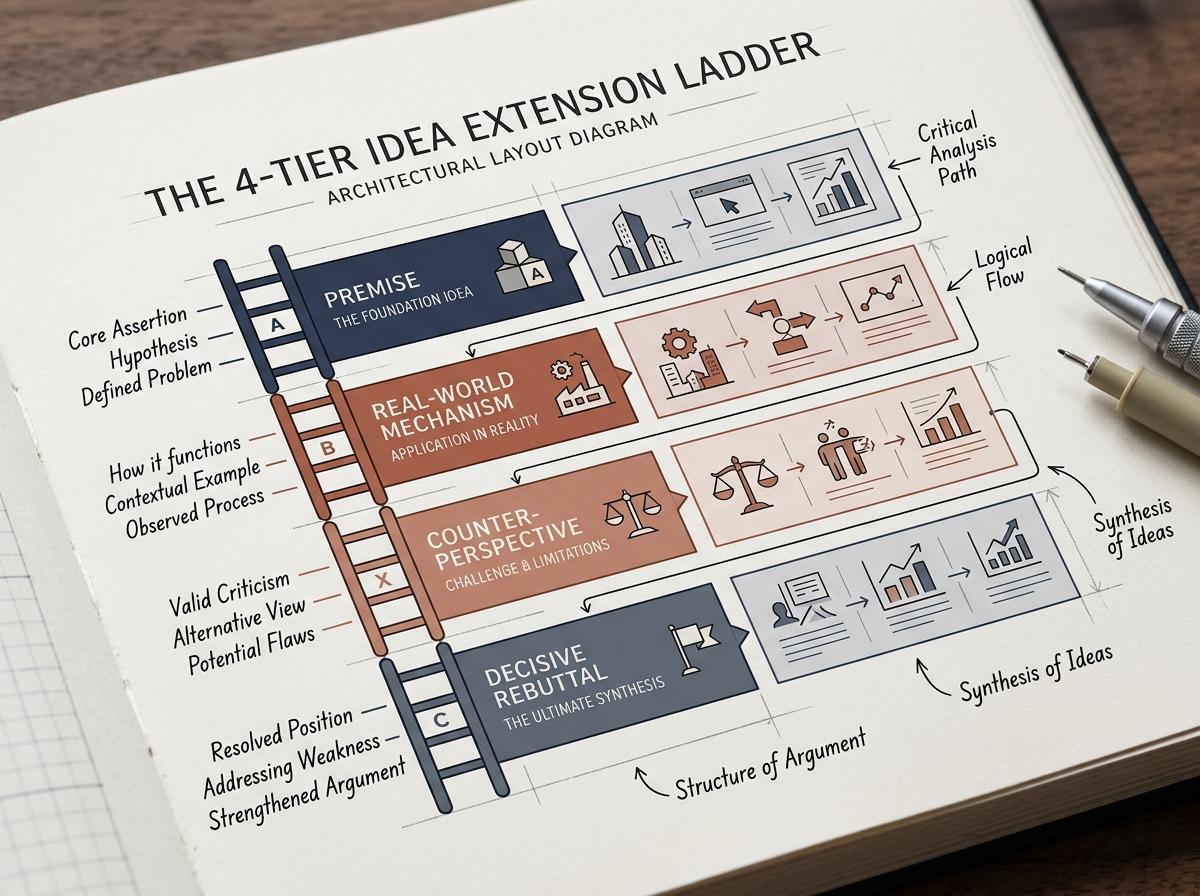
This framework ensures your ideas are not merely stated, but rigorously explored and defended. Each tier builds upon the last, creating a cohesive and compelling argument.
Tier 1: Premise / Main Argument (Topic Sentence)
This is your clear, concise statement of the main point of the paragraph. It directly supports your overall thesis. It should be unambiguous and assertive.Model Phrase: "One primary advantage of remote work is its potential to significantly enhance employee flexibility and autonomy."
Tier 2: Elaboration / Explanation / Example
Expand on your premise. Explain how or why it is true. Provide a logical explanation, a hypothetical scenario, or a general example to illustrate your point. This is where you demonstrate understanding.Model Phrase: "This increased flexibility, often manifested through adaptable working hours and location independence, empowers individuals to better manage personal commitments alongside professional responsibilities, leading to reduced stress and improved work-life balance."
Tier 3: Concession / Acknowledgment of Counter-Argument
This is the critical step. Acknowledge a valid, but secondary, counter-point or limitation to your premise. This demonstrates a nuanced understanding of the issue and intellectual maturity. It shows you've considered the other side.Model Phrase: "Admittedly, this model can present challenges, particularly in fostering team cohesion and spontaneous collaboration, which thrive in a shared physical environment."
Tier 4: Rebuttal / Reinforcement of Original Stance
Having acknowledged the counter-argument, you must now pivot back and reassert the primacy of your original premise. Explain why, despite the concession, your main point remains stronger or more significant. This is not about dismissing the counter-argument, but about contextualising it within your broader argument.Model Phrase: "Nevertheless, with the advent of sophisticated digital communication tools and structured virtual team-building activities, these collaborative hurdles are increasingly surmountable, allowing the core benefits of flexibility to remain paramount for individual well-being and productivity."
A concession without a rebuttal leaves your argument weakened and your stance unclear. Always return to reinforce your primary position. This is non-negotiable for high bands.
The Anatomy of a Band 9 Paragraph: Depth vs. Listing
Let's illustrate the stark difference between a Band 6.0 'idea listing' paragraph and a Band 9.0 'developed' paragraph using a common Task 2 prompt:
Prompt: Some people believe that governments should invest more in public transport, while others argue that individuals should be encouraged to use their own cars. Discuss both views and give your own opinion.
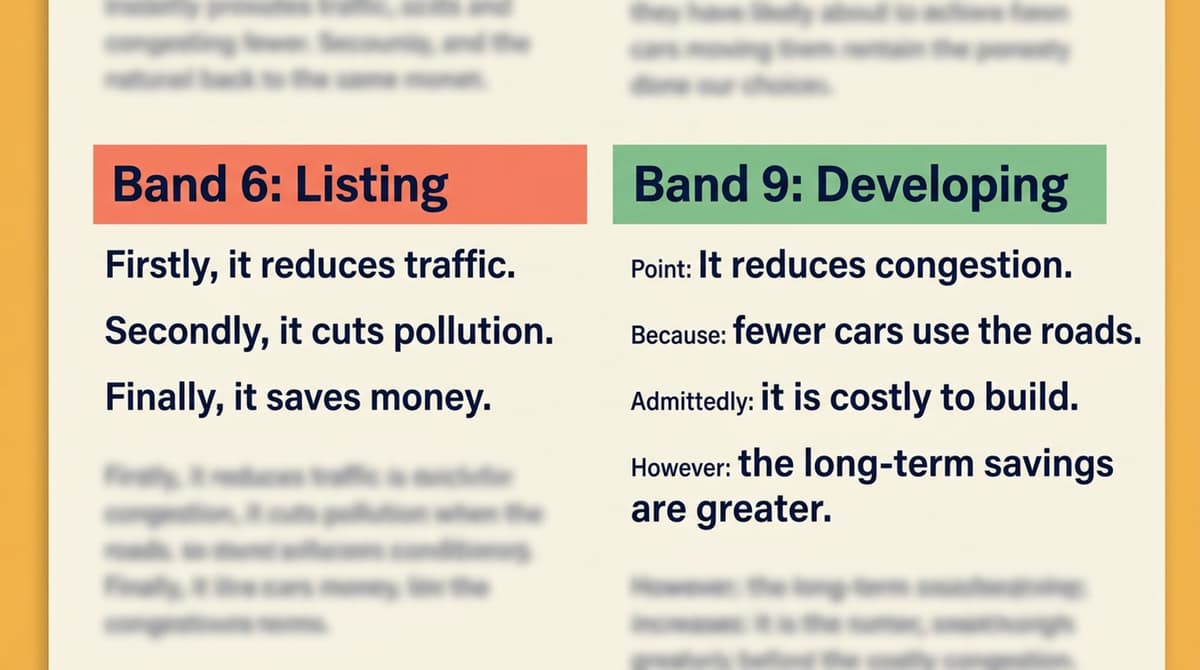
Band 6.0 'Idea Listing' Paragraph (Critique)
"Investing in public transport is good for many reasons. Firstly, it reduces traffic congestion in cities. Secondly, it is better for the environment because fewer cars mean less pollution. Finally, it can be cheaper for people than owning a car, saving them money. These are all important benefits for society."
Examiner's Critique:
- Task Response: Superficial. Lists three points without any genuine explanation, extension, or support. The 'reasons' are stated as facts rather than developed arguments. No concession or rebuttal.
- Coherence & Cohesion: Uses basic linking words ('firstly', 'secondly', 'finally') but the paragraph lacks logical progression beyond simple enumeration.
- Lexical Resource: Basic vocabulary ('good', 'many reasons', 'better', 'cheaper').
- Grammatical Range & Accuracy: Simple sentences, limited range.
Band 9.0 'Developed' Paragraph (Application of 4-Tier Framework)
"One compelling argument for increased governmental investment in public transport infrastructure is its profound capacity to alleviate urban congestion and enhance environmental sustainability. (Tier 1: Premise) This is primarily because a robust and efficient public transit network, comprising trains, buses, and trams, encourages a significant modal shift away from private vehicle use, thereby reducing the sheer volume of cars on the roads and, consequently, the emission of greenhouse gases and particulate matter. (Tier 2: Elaboration) Admittedly, the initial capital outlay for such extensive projects can be substantial, often requiring considerable public funding and potentially leading to temporary disruption during construction phases. (Tier 3: Concession) Nevertheless, the long-term societal benefits, including improved air quality, reduced commute times, and enhanced accessibility for all citizens, demonstrably outweigh these initial financial and logistical challenges, positioning public transport as a crucial component of modern, sustainable urban planning. (Tier 4: Rebuttal)"
Examiner's Assessment:
- Task Response: Fully developed position. The idea is extended with clear explanation, a relevant concession, and a strong rebuttal, demonstrating a nuanced understanding.
- Coherence & Cohesion: Seamless logical flow achieved through sophisticated cohesive devices ('primarily because', 'thereby', 'admittedly', 'nevertheless', 'positioning'). The argument progresses naturally.
- Lexical Resource: Wide range of sophisticated vocabulary used precisely ('compelling argument', 'profound capacity', 'alleviate urban congestion', 'environmental sustainability', 'modal shift', 'initial capital outlay', 'logistical challenges', 'paramount').
- Grammatical Range & Accuracy: Demonstrates a wide range of complex structures, including subordinate clauses, participial phrases, and precise punctuation, all with high accuracy.
Strategic Integration: Where and When to Concede
Concessions are not weaknesses; they are strategic strengths. They demonstrate that you have considered the complexity of an issue, which is a hallmark of advanced critical thinking. The most effective place for a concession and rebuttal is within your body paragraphs, as part of the development of your main points.
Some candidates attempt to dedicate an entire paragraph to 'the other side's view' without adequately linking it back to their own stance. This can lead to an 'unclear position' or an 'unbalanced argument' if not handled carefully. The 4-tier framework ensures the concession serves your argument, not detracts from it.
Think of it as a rhetorical dance: you present your strong point, acknowledge a potential counter-step, and then gracefully return to your original position, having shown greater understanding.
Lexical Resource for Concession & Rebuttal
To execute concessions and rebuttals effectively, you need a precise and varied vocabulary. Avoid repetitive phrases. Here are some high-level options:
- Concession Phrases:
- While it is true that...While it is true that online learning is flexible, it cannot fully replace classroom interaction.
- Admittedly,...Admittedly, building new motorways can ease congestion in the short term.
- Granted that...Granted that tourism creates jobs, its environmental cost cannot be ignored.
- It cannot be denied that...It cannot be denied that smartphones have made communication faster.
- Although there is some validity to the claim that...Although there is some validity to the claim that exams cause stress, they remain a fair way to compare students.
- One might argue that...One might argue that zoos protect endangered species.
- It is certainly the case that...It is certainly the case that renewable energy requires a large initial investment.
- To some extent, this perspective holds true...To some extent, this perspective holds true, as many young people do struggle to afford housing.
- Rebuttal Phrases:
- However, this perspective overlooks...However, this perspective overlooks the long-term savings that public transport brings.
- Nevertheless, the primary concern remains...Nevertheless, the primary concern remains the safety of patients.
- Despite this, the benefits of X significantly outweigh...Despite this, the benefits of a congestion charge significantly outweigh the inconvenience to drivers.
- Crucially, this does not negate the fact that...Crucially, this does not negate the fact that unpaid internships favour wealthier students.
- Yet, it is imperative to consider that...Yet, it is imperative to consider that not every family has reliable internet access.
- Nonetheless, the more compelling argument suggests...Nonetheless, the more compelling argument suggests that prevention is cheaper than cure.
- While acknowledging this point, it is vital to recognise...While acknowledging this point, it is vital to recognise that cultural heritage cannot be rebuilt once lost.
- Ultimately, the fundamental issue lies in...Ultimately, the fundamental issue lies in how fairly resources are distributed.
Key NoteThe precise choice of cohesive device (e.g., 'however', 'nevertheless', 'despite this') impacts the nuance of your argument. Practice using them accurately to convey the exact relationship between your ideas.
Grammatical Range & Accuracy: Crafting Complex Sentences
The 4-tier framework naturally lends itself to complex sentence structures, which are essential for high scores in Grammatical Range and Accuracy. Look for opportunities to embed clauses that express concession and contrast.
- Example Syntactic Pattern 1 (Concession + Main Clause):
"Although the initial investment in renewable energy sources is substantial, the long-term environmental and economic benefits are undeniable." - Example Syntactic Pattern 2 (Main Clause + Concession Clause):
"Governments should prioritise public health initiatives, even though such measures may sometimes infringe upon individual liberties." - Example Syntactic Pattern 3 (Adverbial Phrase of Concession):
"Despite the perceived drawbacks of automation, its potential to boost productivity and innovation is immense."
Mastering these structures allows you to articulate complex ideas with precision and sophistication, moving beyond simple compound sentences.
The 40-Minute Examiner Protocol: Pacing for Perfection
Understanding the theory is one thing; executing it under exam conditions is another. The 40-minute time limit for Task 2 is unforgiving. Effective planning is paramount.
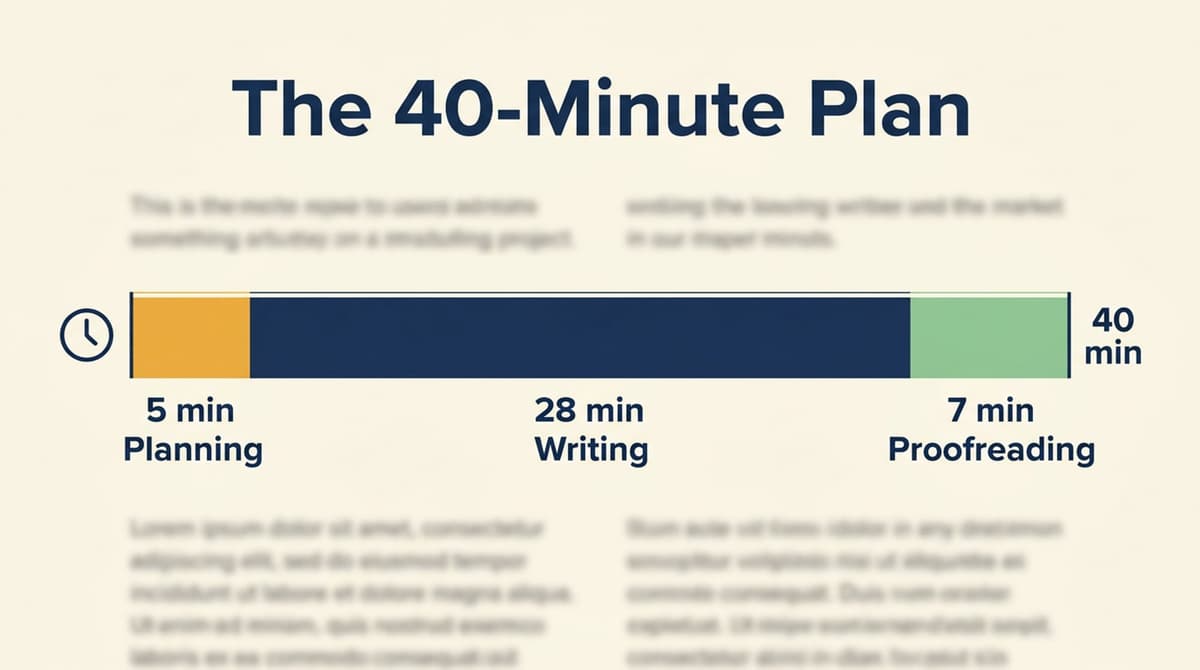
Your time allocation should reflect the cognitive demands of developing a Band 9 argument:
5 Minutes: Planning (The Blueprint)
This is where you outline your thesis, your main points for each body paragraph, and crucially, for each main point, you briefly jot down the concession and rebuttal. This ensures your 4-tier structure is pre-meditated, not improvised. For example:- BP1: Public Transport Benefits
- Premise: Reduces congestion/pollution
- Elaboration: Fewer cars, less emissions
- Concession: High initial cost/disruption
- Rebuttal: Long-term benefits outweigh short-term costs
Key NoteSkipping this step is a common error that leads to disorganised, underdeveloped essays. A well-structured plan is your roadmap to Band 9.
- BP1: Public Transport Benefits
28 Minutes: Synthesis & Writing (The Construction)
With your plan in hand, focus on crafting each paragraph, consciously applying the 4-tier framework. Pay attention to sentence structure, vocabulary, and cohesive devices. Do not rush; focus on precision and depth.7 Minutes: Proofreading & Refinement (The Quality Check)
This is not just for grammar and spelling. Review your essay for clarity of argument, logical flow, and whether your concessions and rebuttals are truly effective in strengthening your overall position. Ensure your stance is consistently clear.
The ability to integrate concession and rebuttal seamlessly is a key indicator of a candidate's capacity for sophisticated academic discourse. It demonstrates critical thinking, not just language proficiency.
Conclusion: Elevating Your Argument to Examiner Expectations
The journey from a Band 6.5 to a Band 8.0 or 9.0 in IELTS Writing Task 2 is not about writing more, but about writing smarter. It's about understanding that examiners seek depth, nuance, and a fully developed position, not a mere enumeration of points.
By internalising and consistently applying the 4-Tier Idea Extension Ladder — moving from premise to elaboration, then to a strategic concession, and finally to a robust rebuttal — you will transform your essays from superficial lists into compelling, sophisticated arguments. This framework, combined with precise lexical choices and varied grammatical structures, is your definitive pathway to breaking through the 6.5 ceiling and achieving the Band 9 you aspire to. Practice this diligently, and the results will speak for themselves.

Check yourself
3 questions · about 2 minutes · every answer explained
Was this strategy guide helpful?
Tell us if it helped. It shapes what we write next.
Band 9 Team
Written by the team that builds Band 9.
Candidate Discussion (0)
Join the conversation
Sign in to ask our examiners questions and participate in strategy discussions.
More Writing Strategies
The Process Diagram & Map Blueprint: Scoring Band 9.0 in Academic Task 1 Without Clichés
This masterclass deconstructs the common pitfalls in IELTS Academic Task 1 process diagrams and maps, revealing how to move beyond simplistic sequential descriptions to achieve a Band 9.0. Learn the examiner-approved 3-stage grouping protocol and the art of sophisticated passive voice transitions.
How to Write a Perfect Overview for Academic Task 1
Discover the two-sentence formula for crafting a Band 9 overview in IELTS Academic Task 1. Avoid common traps and learn to synthesise trends effectively for line graphs, bar charts, tables, and pie charts.