The Process Diagram & Map Blueprint: Scoring Band 9.0 in Academic Task 1 Without Clichés
Stop reciting raw steps sequentially. Master the 3-stage grouping protocol and precise passive voice transitions that examiners demand for non-data visuals.

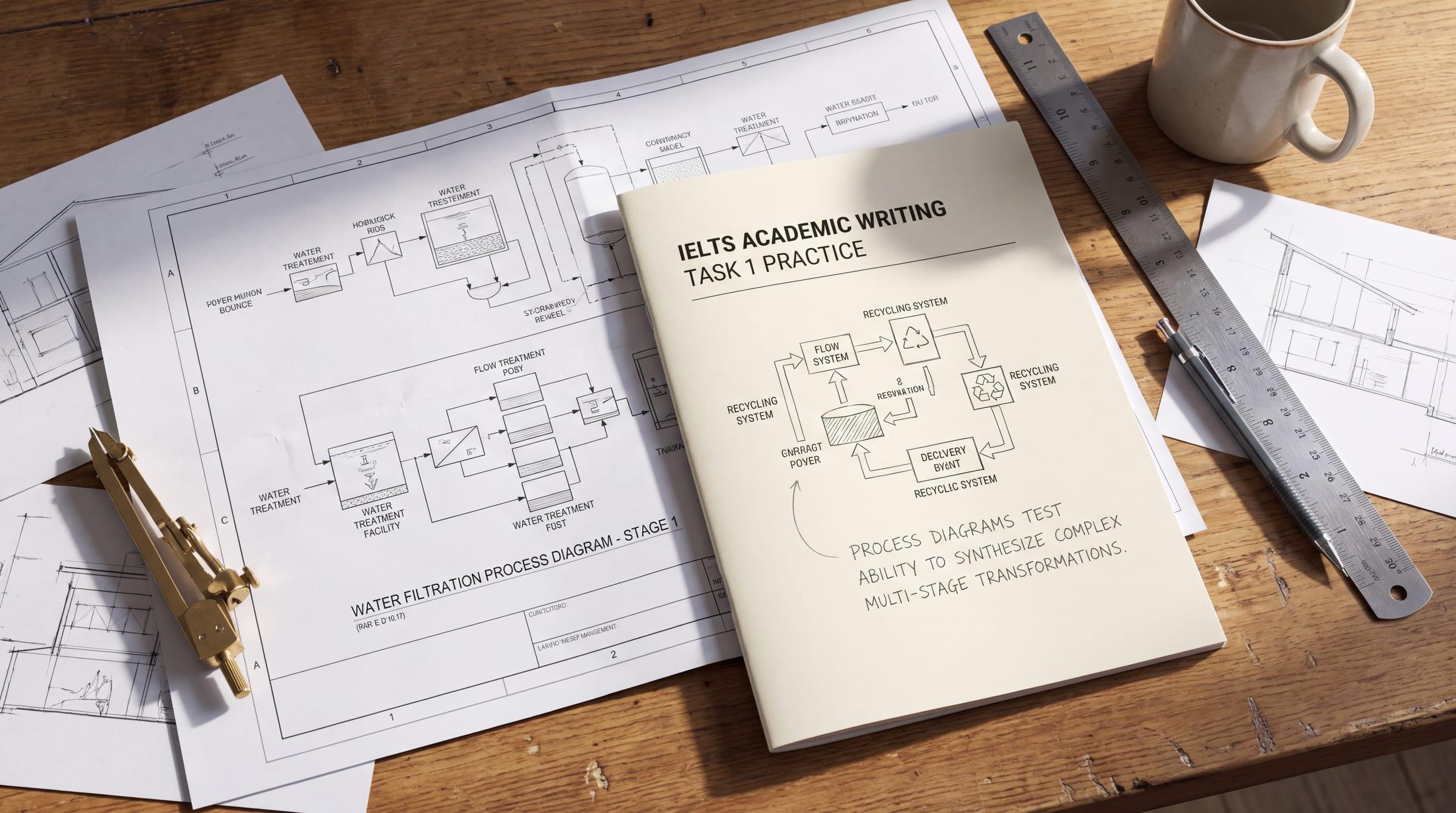
Process diagrams test your ability to synthesize complex multi-stage transformations.
On this page
- 01The Fundamental Flaw: The 'Recipe' Approach
- 02The Non-Negotiable Overview: Your Band 9 Gateway
- 03Coherence & Cohesion: Beyond Basic Linkers
- 04Lexical Resource: Precision and Variety
- 05Grammatical Range & Accuracy: Complex Structures
- 06The Map Description: A Tale of Transformation
- 07The 20-Minute Protocol: Time Management for Band 9
- 08Final Words
In Academic Task 1, non-data visuals—process diagrams and map descriptions—are among the most frequently mishandled tasks on the IELTS test. Today, the Band 9 editorial team deconstructs a persistent barrier: the misguided approach to process diagrams and map descriptions.
Far too many candidates treat these visual tasks as a mere exercise in sequential recitation, a mechanical listing of 'First, Then, Next.' This approach, while seemingly logical, fundamentally misunderstands the Band 9 expectation for Task Achievement and Coherence & Cohesion. It is a direct route to a Band 6.0, perhaps 6.5 if your grammar is impeccable, but never higher. Why? Because it lacks the analytical grouping, sophisticated summarisation, and natural flow that examiners are trained to identify.
Examiner Directive: Beyond the Obvious
Your primary goal in Academic Task 1 is not simply to describe what you see. It is to select, summarise, and report the main features in a way that is relevant, accurate, and coherent. For processes and maps, this means identifying stages, changes, and relationships, not just listing individual steps or features.
This masterclass will equip you with the precise blueprint to overcome this half-band barrier. We will deconstruct the examiner traps, reveal the Band 9 protocols, and provide you with the syntactic tools to articulate complex visual information with clarity and sophistication.
The Fundamental Flaw: The 'Recipe' Approach
Consider a typical process diagram, such as the brick manufacturing process found in published practice tests. A Band 6.0 candidate will invariably begin: "First, clay is dug up. Then, it is mixed with sand and water. Next, it is put into a mould..." While grammatically correct, this is a cognitive trap. It demonstrates a lack of higher-order thinking skills – specifically, the ability to group information logically and provide an overarching perspective.
Candidate Assumption (Band 6.0)
"I must describe every single step in the order it appears."
"Using 'First, Second, Then, Next' shows clear sequencing."
"The overview is just a quick sentence about the number of stages."
Band 9 Examiner Reality
"I must group related steps into logical stages and highlight the overall transformation."
"Sophisticated sequencing uses a variety of cohesive devices, including temporal clauses and natural passive voice transitions, not just basic adverbs."
"The overview is a crucial summary of the entire process, identifying the input, core transformation, and final output, or the most significant changes in a map."
The Band 9 candidate understands that the examiner is looking for evidence of analytical ability, not just descriptive capacity. This begins with the Overview.
The Non-Negotiable Overview: Your Band 9 Gateway
For both process diagrams and maps, the Overview paragraph is paramount. With no clear overview, the descriptors place Task Achievement at Band 5; a clear overview is what Band 7 asks for. For processes, your overview must encapsulate the entire journey, from raw input to final product, including the number of main stages and whether it is linear or cyclical.
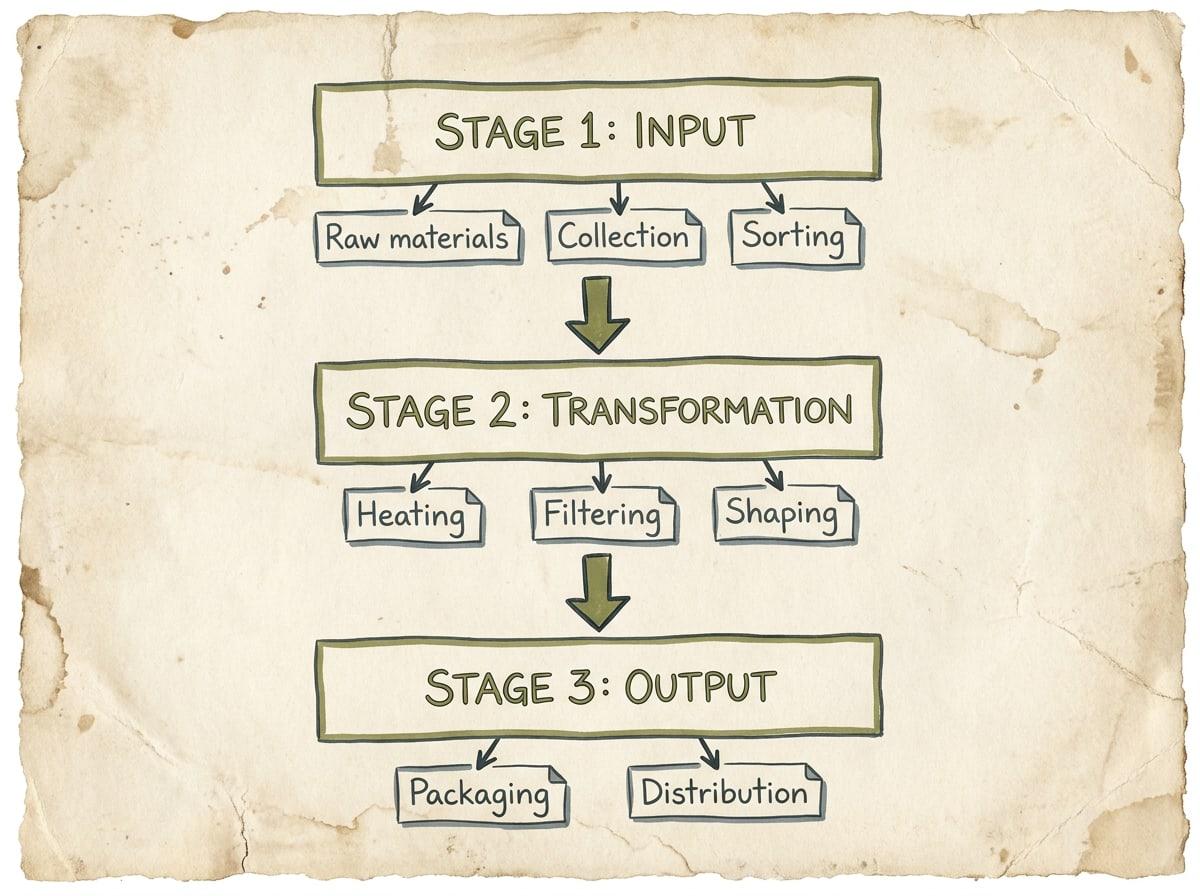
Framework: The 3-Tier Process Overview Matrix
To achieve a Band 9 overview for a process, adopt this three-tiered analytical framework:
- Tier 1: Raw Input Identification: What is the starting material or initial state? e.g., "The process begins with the extraction of raw clay..."
- Tier 2: Core Transformation Summary: What is the fundamental change or series of changes that occur? This is where you group stages. e.g., "...which then undergoes a series of manufacturing stages involving preparation, shaping, and firing..."
- Tier 3: Final Product/Outcome: What is the end result? e.g., "...culminating in the production of finished bricks ready for construction."
Key Note: This structure immediately signals to the examiner that you have grasped the macro-level understanding of the diagram, a key indicator of Band 7+ Task Achievement.
For maps, the overview must highlight the most significant changes or lack thereof between the given periods. Focus on major developments, demolitions, or additions, not minor details. e.g., "Overall, the town underwent significant modernisation and expansion over the period, with a clear shift from agricultural land to residential and commercial zones."
Coherence & Cohesion: Beyond Basic Linkers
This is where many candidates falter, relying on a limited repertoire of sequential adverbs. While 'First,' 'Then,' 'Next,' and 'Finally' have their place, their overuse indicates a lack of grammatical range and lexical sophistication. A Band 9 response employs a diverse array of cohesive devices, particularly temporal clauses, relative clauses, and sophisticated passive voice constructions.
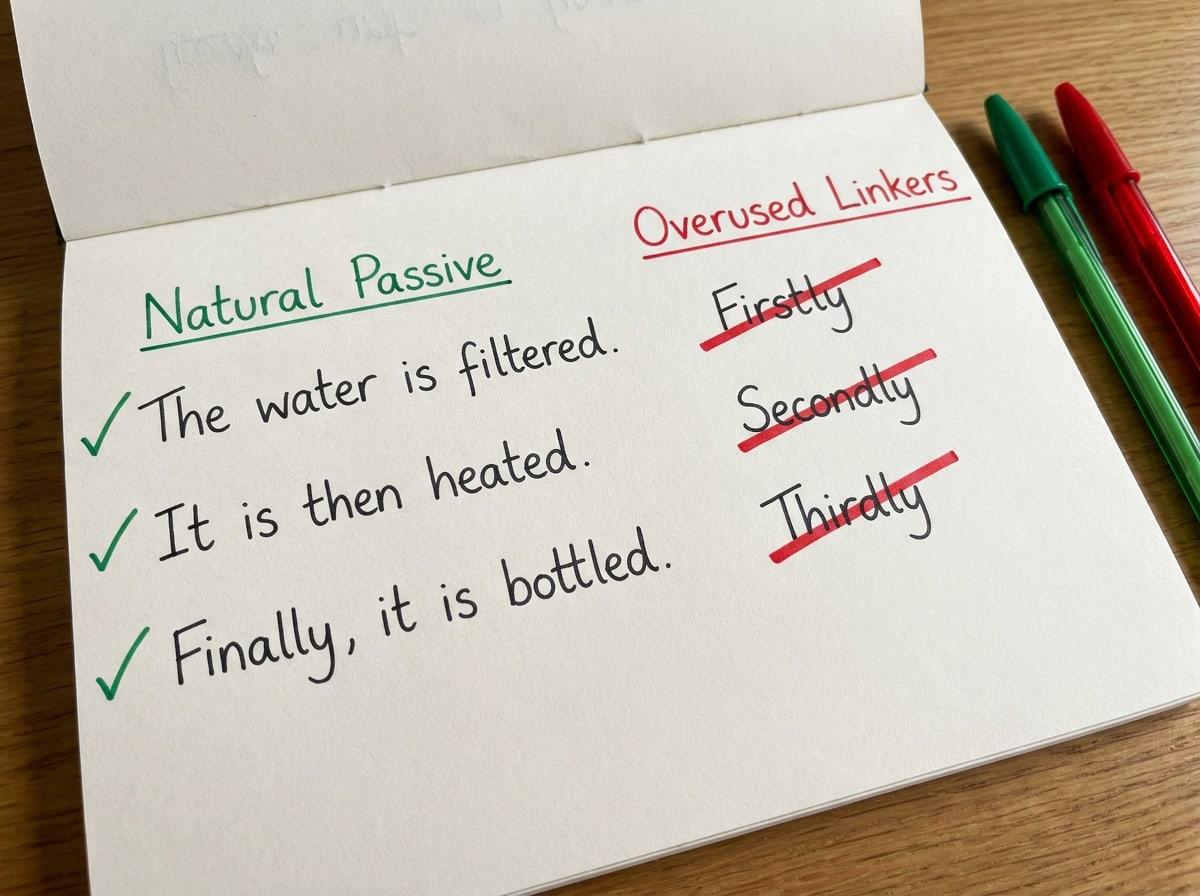
Band 9 Rule: Embrace the Natural Passive Voice
Process diagrams inherently describe actions performed on an object, making the passive voice the most natural and sophisticated grammatical choice. It allows for seamless transitions without clunky adverbs.
Band 6.0 Example: "First, workers dig up clay. Then, they put it into a crushing machine."
Band 9.0 Transformation: "Initially, raw clay is excavated from the ground, following which it is transported to a crushing machine."
Notice the seamless flow and the use of 'following which' as a more advanced temporal linker. Other excellent passive voice sequencers include:
- Once X has been completed, Y is then...Once the beans have been roasted, they are then ground into a fine powder.
- After X has undergone Y, it is subsequently...After the clay has undergone shaping, it is subsequently fired in a kiln.
- Upon completion of X, the material is moved to...Upon completion of the washing stage, the material is moved to a drying chamber.
- Prior to X, Y is carried out...Prior to packaging, a final quality check is carried out.
- The next stage involves X, where the material is...The next stage involves filtration, where the material is passed through a fine mesh.
Critical Cohesion Check: Reference Chains
Ensure your sentences are linked not just by temporal markers but also by pronoun reference (it, they, which) and lexical cohesion (synonyms, repetition of key terms). This creates a smooth, interconnected text, a hallmark of Band 8+ Coherence.
Lexical Resource: Precision and Variety
Avoid repetition of basic verbs like 'go,' 'make,' 'put.' Instead, use precise and varied vocabulary relevant to the process or map. For processes, think about verbs of transformation, movement, and creation. For maps, focus on verbs of development, demolition, and construction.
Process Vocabulary Examples:
- Instead of 'put in': inserted, placed, fed into, introduced toThe crushed grain is then fed into a large mixing tank.
- Instead of 'make': manufactured, produced, formed, constructed, fabricatedThe bricks are formed in rectangular moulds.
- Instead of 'move': transported, conveyed, transferred, directedThe finished bottles are conveyed along a belt to the packing area.
- Instead of 'clean': purified, filtered, refined, sterilisedThe water is filtered and then sterilised before it reaches homes.
- Instead of 'dry': dehydrated, air-dried, kiln-dried, evaporatedThe tea leaves are spread out and air-dried for two days.
Map Vocabulary Examples (Town Map Task):
- Development: modernised, expanded, urbanised, developed, converted into, replaced by, constructed, erectedThe fishing village was urbanised, and the old harbour was converted into a marina.
- Demolition: demolished, removed, cleared, knocked downThe factory was demolished and the site cleared for housing.
- Addition: added, built, established, introducedA new library was built beside the school, and a bus route was introduced.
- Location/Direction: to the north/south/east/west of, adjacent to, opposite, in the centre, on the outskirts, alongsideA car park was constructed to the north of the station, adjacent to the shopping centre.
Examiner Trap: Over-reliance on synonyms without understanding their precise connotations. A Band 9 candidate uses the most appropriate word, not just a different one.
Grammatical Range & Accuracy: Complex Structures
Beyond the passive voice, demonstrate a range of complex sentence structures. This includes:
- Relative clauses: "The clay, which is initially dug from the ground, is then crushed..."
- Participle clauses: "Having been crushed, the clay is then mixed..." or "The mixture, containing sand and water, is subsequently moulded..."
- Conditional clauses (less common for processes, but possible for hypothetical scenarios if the diagram implies options):
- Adverbial clauses of time: "Once the bricks have been fired, they are cooled..."
Key Note: Accuracy is paramount. A complex sentence with errors will score lower than a simpler, error-free sentence. Aim for controlled complexity.
The Map Description: A Tale of Transformation
Describing maps requires a similar analytical approach. Instead of a sequential 'first this, then that,' you must group changes thematically or geographically.
Key Map Strategies:
- Overall Change: Your overview must state the most significant transformation. e.g., "The town of X underwent substantial development over the 50-year period, transforming from a largely rural settlement into a modern urban centre."
- Directional Language: Use precise prepositions and adverbs of place. e.g., "To the north-east, the agricultural land was replaced by a new residential estate."
- Comparative Language: Highlight what remained the same or what was replaced. e.g., "While the river remained a prominent feature, the old port was redeveloped into a leisure complex."
- Thematic Grouping: Group changes by type (e.g., residential, commercial, infrastructure) or by area (e.g., northern section, central area).
Let's consider the classic town map redevelopment. Instead of listing every change chronologically, group them:
- Paragraph 1 (Overview): State the overall transformation (e.g., significant urbanisation, shift from rural to commercial/residential).
- Paragraph 2 (Major Changes - e.g., North/East): Describe the most prominent developments in one area, e.g., "In the northern part of the town, the previously undeveloped land was extensively built upon, with the construction of a new university campus and a shopping centre."
- Paragraph 3 (Major Changes - e.g., South/West/Centre): Detail changes in another area, e.g., "Concurrently, the central area witnessed the demolition of the old market, which was subsequently replaced by a modern multi-storey car park."
- Paragraph 4 (Minor Changes/Continuities): Mention less significant changes or features that remained, e.g., "Conversely, the residential area to the south-west remained largely unaltered, although a small park was established adjacent to it."
The 'No Conclusion' Rule
Academic Task 1 does not require a conclusion. Your overview serves this purpose. Writing a conclusion is a waste of valuable time and can sometimes lead to repetition, which detracts from your score.
The 20-Minute Protocol: Time Management for Band 9
Even with the right strategies, poor time management can derail your efforts. Academic Task 1 is worth one-third of your total Writing score, so allocate your time wisely.

Framework: The 20-Minute Protocol
Adhere strictly to this breakdown:
- 3 Minutes: Analysis & Planning
- Identify Task Type: Process or Map.
- Overview First: What is the overall transformation/number of stages? Input/Output? Major changes?
- Group Information: How will you logically group the stages/changes?
- Key Vocabulary: Brainstorm 3-5 precise verbs/nouns.
- 14 Minutes: Writing
- Paragraph 1: Introduction + Overview (2-3 sentences).
- Paragraphs 2-4: Body Paragraphs (3-4 sentences each). Focus on logical grouping and sophisticated linking.
- Maintain Word Count: Aim for 160-180 words.
- 3 Minutes: Review & Calibration
- Task Achievement: Is the overview clear? Have all main features been covered?
- Coherence & Cohesion: Are paragraphs logically organised? Are linking words varied and appropriate?
- Lexical Resource: Is vocabulary precise and varied? Any repetition?
- Grammatical Range & Accuracy: Any obvious errors? Sentence structure variety?
Examiner Trap: Spending too long on the introduction or getting bogged down in minor details. Remember, selection and summarisation are key.
Final Words
Achieving a Band 9 in Academic Task 1 for process diagrams and maps is not about memorising templates or listing every detail. It is about demonstrating analytical prowess, sophisticated linguistic control, and a clear understanding of the task's demands.
By mastering the 3-tier overview matrix, embracing the natural passive voice for seamless transitions, and adhering to the 20-minute protocol, you will move beyond the common pitfalls and present a response that truly reflects Band 9 proficiency. Practice these techniques diligently, and the half-band barrier will cease to be an obstacle.

Check yourself
3 questions · about 2 minutes · every answer explained
Was this strategy guide helpful?
Tell us if it helped. It shapes what we write next.
Band 9 Team
Written by the team that builds Band 9.
Candidate Discussion (0)
Join the conversation
Sign in to ask our examiners questions and participate in strategy discussions.
More Writing Strategies
How to Write a Perfect Overview for Academic Task 1
Discover the two-sentence formula for crafting a Band 9 overview in IELTS Academic Task 1. Avoid common traps and learn to synthesise trends effectively for line graphs, bar charts, tables, and pie charts.
The Concession & Counter-Argument Masterclass: How to Break Through the Band 6.5 Task Response Ceiling
Many IELTS candidates find themselves perpetually stuck at Band 6.0 or 6.5 in Writing Task 2, despite having decent grammar and vocabulary. The culprit? A fundamental misunderstanding of 'development' and 'depth' in Task Response. This masterclass exposes the 'Idea Listing' trap and introduces the indispensable 4-tier concession framework that elevates your argument from superficial to sophisticated, unlocking Band 8.0 and 9.0.