Speed Reading vs. Scanning: When to Use Which Skill
Stop running out of time in Reading Passage 3. Master the strategic distinction between gist skimming, keyword scanning, and micro-dissection.

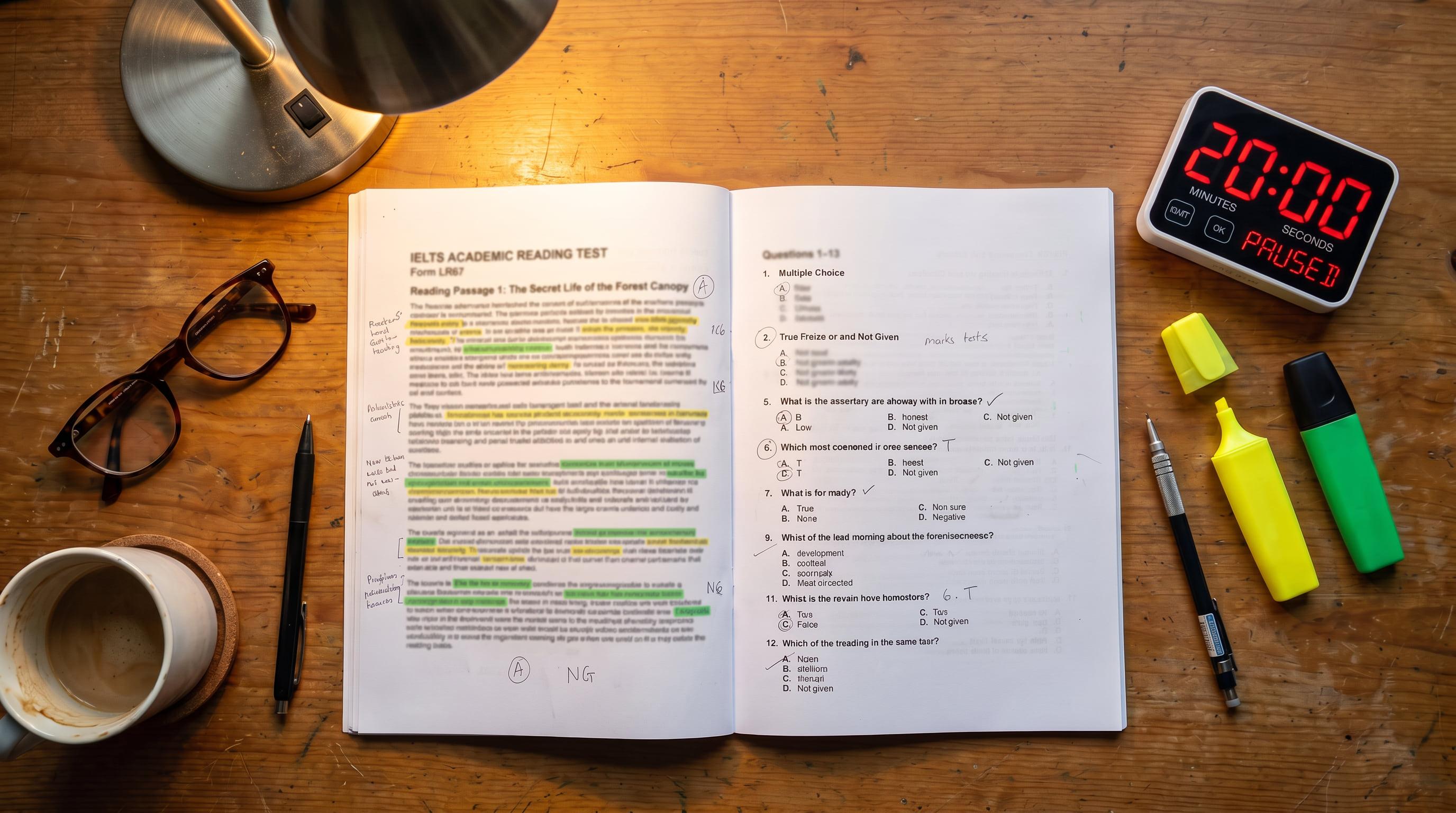
High band scores depend on deploying skimming, scanning, and deep reading at the right moments.
The 60-Minute Challenge: Why Time Runs Out
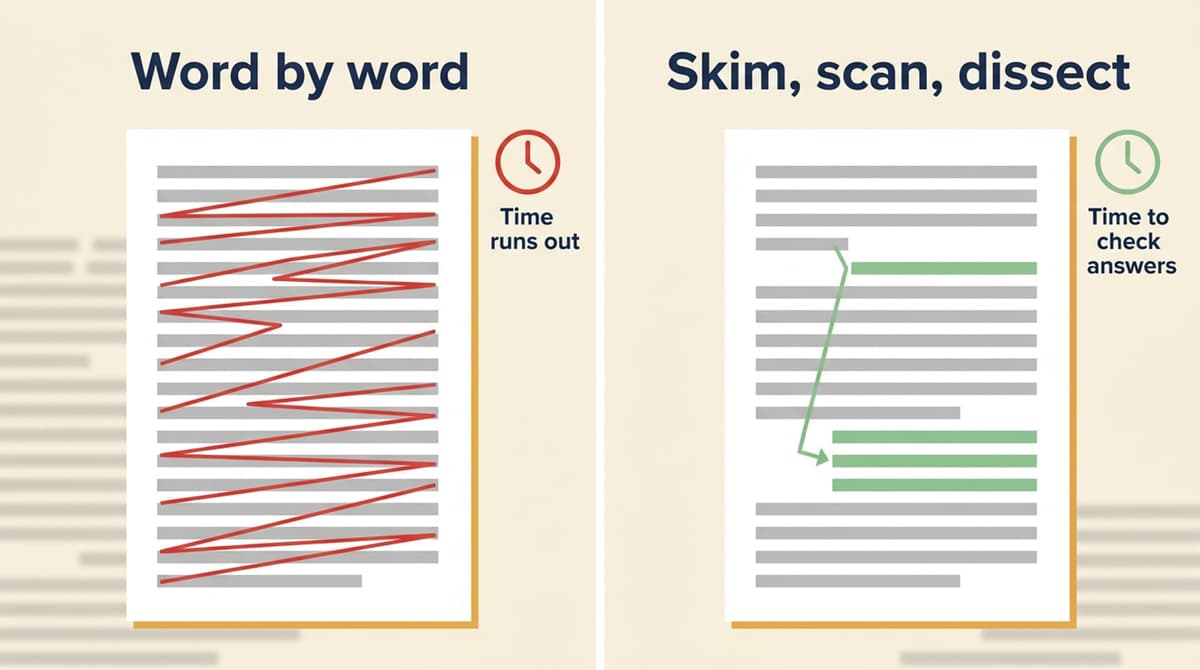
The IELTS Reading test gives you 60 minutes to answer 40 questions across three passages. This means you have, on average, just 15 minutes per passage, including time to transfer your answers. Many candidates find themselves rushing through the final passage, or worse, not even finishing it. This often happens because of a common misconception: that every word in the passage must be read and understood.
This approach, while thorough, is a trap. Reading every word from start to finish for every question will inevitably lead to a time deficit, especially in the more complex Passages 2 and 3. The Band 9 Team knows that successful candidates do not read everything. Instead, they employ a strategic, multi-tiered approach to reading, matching their reading technique to the specific task at hand.
Reading every word of the passage from beginning to end for every question is a common mistake. This linear approach consumes too much time, leaving insufficient minutes for the more challenging questions and passages, particularly Passage 3.
The Three-Tier Reading Funnel
Imagine your reading process as a funnel, narrowing down from a broad overview to precise detail. This 'Three-Tier Reading Funnel' helps you manage your time and focus your effort where it's most needed.
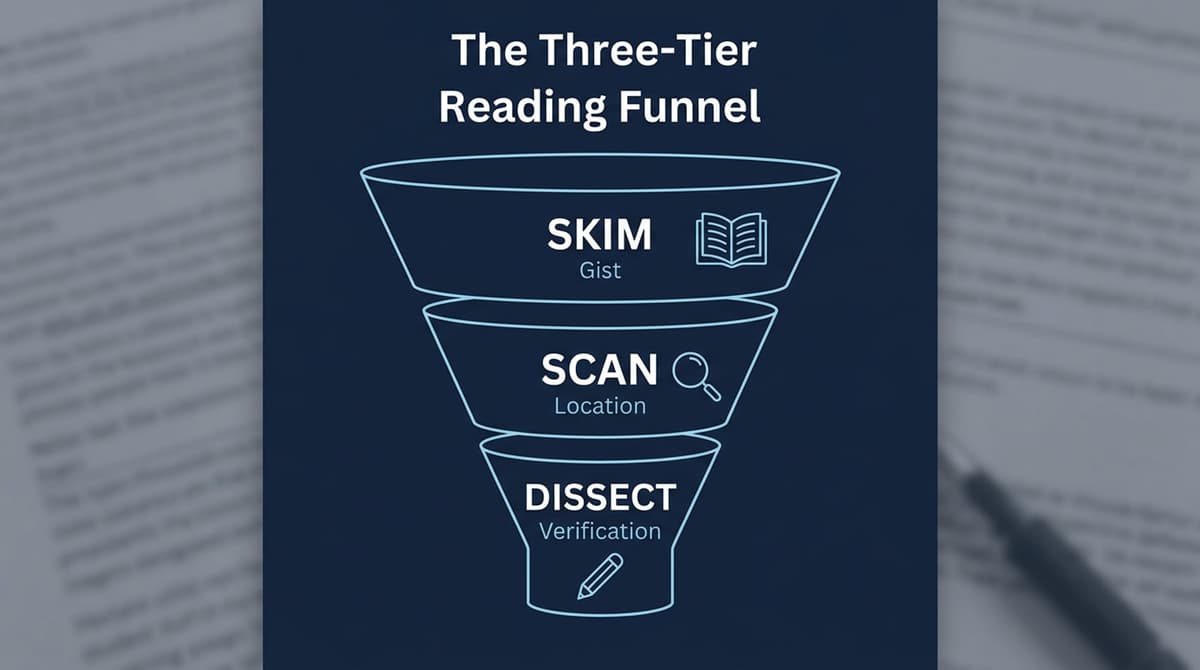
Tier 1: Skimming for Gist
Skimming is your first pass through a passage. Its purpose is to get a general understanding of the main topic, the overall structure, and the author's purpose. You are not looking for specific answers yet. Instead, you are building a mental map of the text.
- How to Skim: Read the title, headings, subheadings, and any introductory or concluding paragraphs. Read the first and last sentence of each body paragraph. Don't read every word; let your eyes glide over the text, picking out keywords and phrases.
- When to Skim: Always do this at the beginning of each new passage. It helps you understand the context for the questions that follow.
Tier 2: Scanning for Location
Once you have a general idea of the passage, you move to scanning. This is where you look for specific keywords or phrases from the questions within the text. You are not reading for understanding; you are searching for a particular piece of information, much like looking up a word in a dictionary.
- How to Scan: Identify keywords in the question (names, dates, numbers, unique nouns). Then, quickly move your eyes across the passage, looking specifically for these keywords or their synonyms. Do not read the surrounding text until you find your keyword.
- When to Scan: Use this technique when questions ask for specific details, such as names, dates, figures, or when you need to locate the paragraph where a particular idea is discussed. This is crucial for question types like Matching Headings, Sentence Completion, or Short Answer questions.
Tier 3: Dissecting for Verification
After skimming to understand the gist and scanning to locate potential answers, the final tier is dissection. This involves reading the specific sentence or paragraph where your keyword was found, carefully and thoroughly, to verify the answer. This is the only time you should be reading slowly and meticulously.
- How to Dissect: Once you've located a potential answer using scanning, read the sentence or two surrounding that keyword very carefully. Pay attention to the exact wording, grammar, and any qualifying phrases. Ensure the information directly answers the question and matches any word limits.
- When to Dissect: This is essential for all question types once you have narrowed down the location of the answer. It's particularly important for True/False/Not Given questions, where subtle differences in wording can change the answer.
Never assume a keyword match is the answer. Always dissect the surrounding text to verify that the meaning aligns with the question. Many distractors use keywords but alter the meaning.
Strategic Time Management: The 60-Minute Protocol
Effective time management is critical for the Reading test. The Band 9 Team recommends a flexible time budget that accounts for the increasing difficulty of the passages.
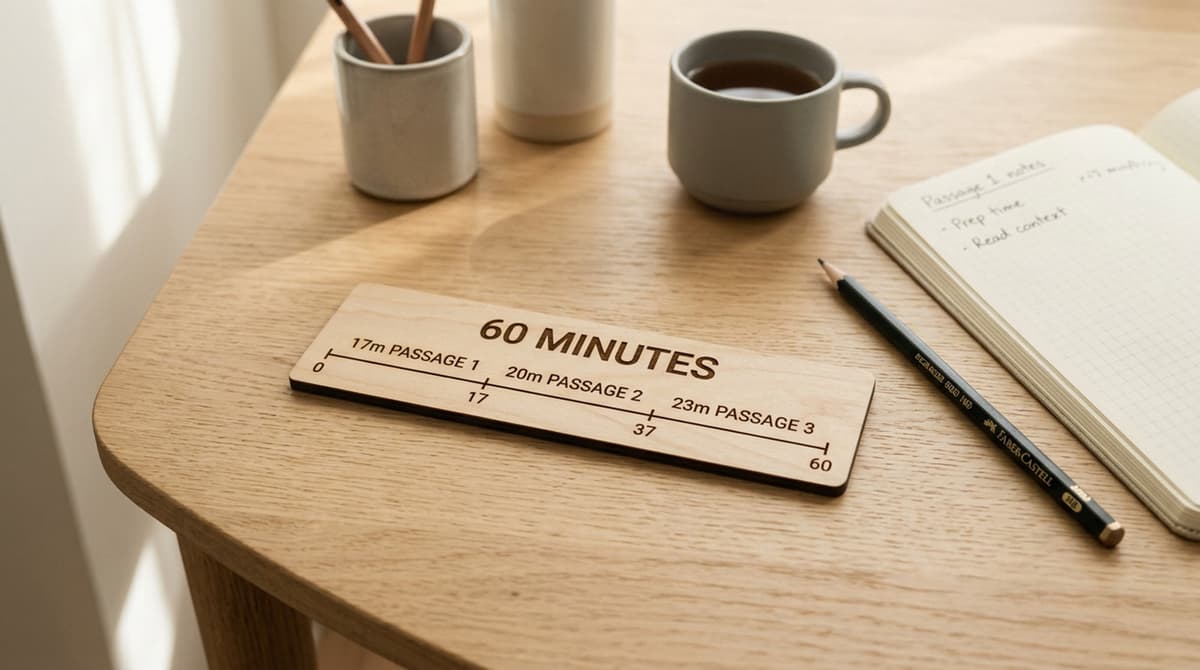
While you have 60 minutes in total, it's not simply 20 minutes per passage. Passage 1 is generally the easiest, and Passage 3 the most challenging. Allocate your time accordingly:
- Passage 1: Aim for 15-17 minutes. This passage often contains more straightforward questions and vocabulary.
- Passage 2: Allocate 18-20 minutes. The complexity increases, and you might encounter more analytical questions.
- Passage 3: Dedicate 20-23 minutes. This passage is typically the most difficult, with complex arguments and vocabulary. You will need more time for careful dissection here.
Remember, these are guidelines. Practice will help you refine your own pacing. The key is to be aware of the clock and adjust your strategy if you find yourself spending too long on any single question or passage.
Candidate Assumption (Band 6.0)
I must read every word of the passage to understand it fully before attempting any questions.
I will spend equal time on each passage, approximately 20 minutes per passage.
If I find a keyword from the question in the passage, that's the answer.
Band 9 Reality
I will use the Three-Tier Reading Funnel: Skim for gist, Scan for location, and Dissect for verification, matching the technique to the task.
I will allocate more time to Passage 3 (20-23 minutes) than to Passage 1 (15-17 minutes) due to increasing complexity.
I will always verify keyword matches by carefully reading the surrounding text to ensure the meaning aligns with the question.
Applying the Funnel: A Practical Example
Let's consider a typical IELTS Reading scenario:
- You receive the Reading paper. Before looking at any questions, quickly skim Passage 1. Read the title, introduction, and topic sentences of paragraphs. Get a general idea of what it's about. (Tier 1: Skim)
- Move to the first set of questions. Identify keywords in the questions. For example, if it's a 'Matching Information' question, look for specific concepts or names. (Tier 2: Scan)
- Scan the passage for those keywords. Your eyes are moving quickly, not reading for meaning, but for visual recognition of the words.
- Once you find a keyword, stop. Now, read the sentence or two around that keyword very carefully. Does it answer the question? Does it fit the word limit? (Tier 3: Dissect)
- Repeat for all questions. As you progress through the passages, be mindful of your time. If a question is taking too long, make an educated guess and move on. You can always return to it if time permits.
Remember that answers must be copied exactly from the passage. Do not change the form of a word. If a word from the passage does not fit grammatically into the answer blank, it is likely the wrong word, and you need to keep looking.
Checklist for Reading Success
- Skim first: Always get the gist of a passage before tackling questions.
- Scan for keywords: Use question keywords to locate potential answers quickly.
- Dissect to verify: Read carefully around the keyword to confirm the answer and check for distractors.
- Manage your time: Allocate more time to Passages 2 and 3.
- Practice makes perfect: Regularly practice with timed passages to improve your speed and accuracy in applying these techniques.
- Spelling matters: Ensure all copied answers are spelled correctly.

Check yourself
4 questions · about 3 minutes · every answer explained
Was this strategy guide helpful?
Tell us if it helped. It shapes what we write next.
Band 9 Team
Written by the team that builds Band 9.
Candidate Discussion (0)
Join the conversation
Sign in to ask our examiners questions and participate in strategy discussions.
More Reading Strategies
Matching Headings in Academic Reading: Why Scanning for Keywords Guarantees a Band 6.5
Matching Headings is arguably the most challenging question type in IELTS Academic Reading. This masterclass, authored by the Band 9 editorial team, exposes why keyword scanning is a fatal flaw and introduces a robust 'Theme vs Detail' framework and a 3-step Paragraph Core Synthesis protocol to consistently achieve Band 9.
The True / False / Not Given Mastery Blueprint
Why 80% of candidates confuse False with Not Given — and the 3-step examiner decision matrix that eliminates second-guessing on Academic & General Reading.