The Tone Consistency Formula for General Training Task 1: Band 9 Register Calibration
How a single misplaced formal word in a letter to a friend, or a colloquial phrase to a landlord, can hold Task Achievement at Band 6.


In GT Task 1, tone consistency directly dictates your Task Achievement score.
Greetings, future Band 9 candidates. Countless promising candidates falter not due to a lack of vocabulary or grammatical prowess, but due to a fundamental misunderstanding of register and tone consistency in General Training Writing Task 1. This is not a trivial oversight; it is a critical half-band barrier that can hold an otherwise excellent script at Band 6 for Task Achievement.
The public IELTS Band Descriptors for Task Achievement ask, at Band 7, for 'the tone consistent and appropriate'. At Band 6, 'there may be inconsistencies in tone'. At Band 5, 'the tone may be variable and sometimes inappropriate'. What many candidates fail to grasp is the absolute criticality of consistency. It is not enough to merely *start* with an appropriate tone; you must maintain it meticulously throughout the entire letter. A single misstep, a solitary formal phrase in a letter to a close friend, or an overly casual idiom in a complaint to a landlord, is exactly the 'inconsistency in tone' the Band 6 descriptor describes.
The IELTS General Training Writing Task 1 is fundamentally a test of your ability to communicate effectively in real-world scenarios. In such contexts, register is paramount. Imagine writing a formal complaint to an airline using slang; it would be dismissed. Conversely, writing a highly formal letter to a friend inviting them to a casual dinner would be perceived as awkward and unnatural. The examiner is assessing your sociolinguistic competence – your awareness of how language adapts to context, audience, and purpose.
This masterclass will deconstruct the precise mechanisms by which examiners assess tone and register, provide a Band 9 formula for calibration, and expose the common psychological traps that lead to these costly errors. We will move beyond generic advice and delve into the syntactic and lexical markers that define appropriate register, ensuring your Task 1 letter is not just grammatically correct, but also perfectly calibrated for its intended audience.
"I need to show off my wide vocabulary, so I'll use some complex words even if the letter is to a friend. The examiner will be impressed."
Using overly formal or complex vocabulary in an informal letter is a direct register slip. It demonstrates a lack of awareness of audience and purpose, leading to a lower Task Achievement score. Lexical Resource is assessed on appropriacy, not just breadth.
The Register Calibration Framework: Three Pillars of Tone Consistency
Achieving Band 9 in Task Achievement for GT Writing Task 1 requires a systematic approach to register. I propose a Three-Pillar Register Calibration Framework:
- Audience Analysis: Who are you writing to? This is the foundational question.
- Purpose Definition: Why are you writing? What do you want to achieve?
- Contextual Lexis & Syntax: What specific language choices align with Pillars 1 and 2?
Let's examine how these pillars translate into actionable strategies.
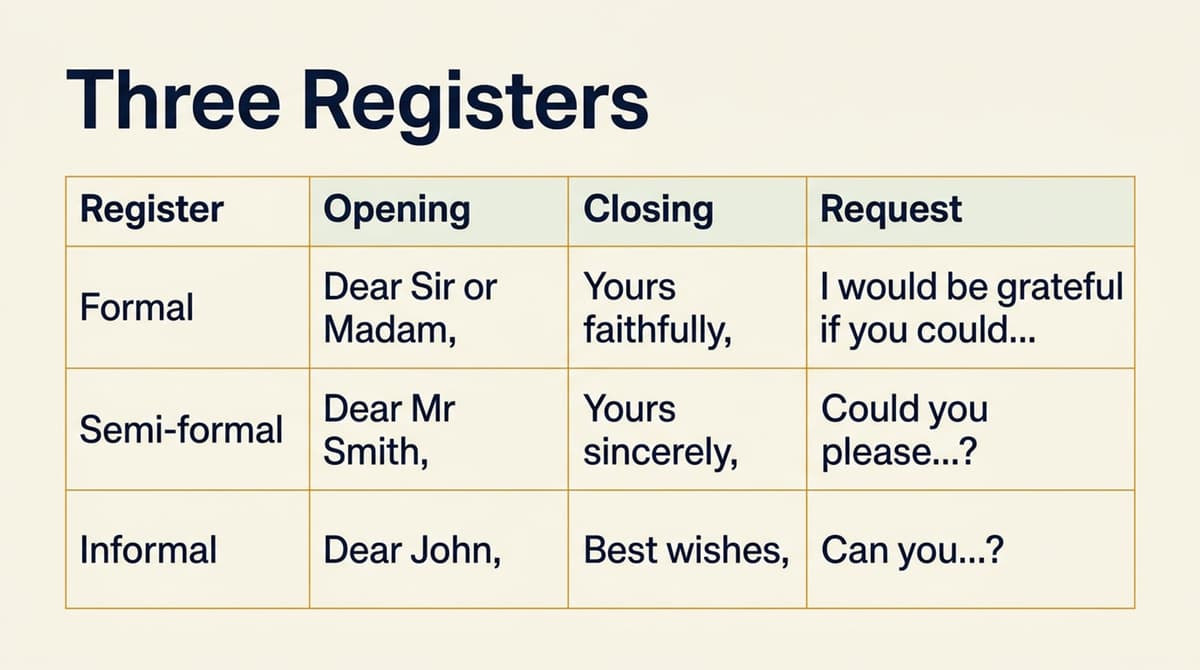
Pillar 1 & 2: Audience and Purpose — The Foundation
Before you write a single word, dedicate 60 seconds to a precise Audience and Purpose Analysis. This is non-negotiable. The prompt will always provide this information explicitly.
- Informal: (e.g., a friend, family member, close colleague). Purpose: Social interaction, sharing news, making casual arrangements.
- Semi-Formal: (e.g., a landlord, neighbour, local business manager, university tutor). Purpose: Requesting information, making a complaint, offering suggestions, applying for something.
- Formal: (e.g., a company CEO, government official, newspaper editor, HR department). Purpose: Formal complaint, official application, expressing strong opinion, providing detailed information.
Band 9 Rule: Your salutation and sign-off are the most immediate and visible indicators of your chosen register. Get these wrong, and the examiner's perception of your tone consistency is immediately compromised.
Salutation Examples:
- Informal: "Dear John," "Hi Sarah," "Hello Mark,"
- Semi-Formal: "Dear Mr. Smith," "Dear Ms. Jones," "Dear Sir/Madam," (if name unknown)
- Formal: "Dear Sir/Madam," "To Whom It May Concern," (use sparingly, only when no specific recipient is implied)
Sign-off Examples:
- Informal: "Best wishes," "Cheers," "Talk soon," "See you soon,"
- Semi-Formal: "Yours sincerely," (if name known) "Yours faithfully," (if name unknown) "Regards," "Kind regards,"
- Formal: "Yours sincerely," "Yours faithfully,"
Examiner Trap: Using "Dear Sir/Madam" and then signing off with "Best wishes" is a classic register clash that will cost you dearly. It signals a lack of control over tone.
Pillar 3: Contextual Lexis & Syntax — The Language of Tone
This is where the majority of candidates falter. Tone is not just about a few opening and closing phrases; it permeates every lexical and syntactic choice you make. Examiners are trained to spot tonal contamination – instances where language from one register bleeds into another.
Think of register as a linguistic ecosystem. Each ecosystem (informal, semi-formal, formal) has its own flora and fauna (vocabulary, grammar, sentence structures). Introducing species from one ecosystem into another can disrupt the balance and lead to a breakdown in coherence and appropriateness.
Let's break down the specific linguistic features for each register:
Informal Register Markers:
- Contractions: "I'm," "you've," "it's," "don't." (Crucial for sounding natural).
- Phrasal Verbs: "pick up," "drop off," "look forward to."Could you pick me up from the station on Friday evening?
- Idiomatic Expressions/Slang: "catch up," "hang out," "a piece of cake." (Use with caution; ensure they are universally understood and not overly niche).It would be great to catch up over coffee next week.
- Direct Questions: "How are you?" "What do you think?"
- Exclamations: "Great news!" "I'm so excited!"
- Simpler Sentence Structures: More coordination (using 'and', 'but', 'so') rather than complex subordination.
- Personal Pronouns: Frequent use of "I," "you," "we."
- Colloquial vocabulary: "stuff," "loads of," "a bit."I've got loads of news to tell you, and I'm a bit nervous about my new job.
Examiner Trap: Writing "I am writing to inform you that I will be unable to attend your party" to a friend is a severe register mismatch. The formal phrasing is jarring and unnatural.
Semi-Formal Register Markers:
- Avoidance of Contractions: Generally, write "I am," "you have," "it is."
- Standard Phrasing for Requests/Complaints: "I would be grateful if you could..." "I am writing to express my dissatisfaction with..." "Could you please...?"I would be grateful if you could send me a copy of the new timetable.
- Polite Modals: "would," "could," "may."Could you let me know whether the room is still available?
- Clear and Concise Language: Avoid slang and overly complex academic vocabulary.
- Objective but Polite Tone: Focus on facts, but maintain respect.
- Standard Connectors: "However," "Therefore," "In addition," "Furthermore."The heating has failed twice this month. Furthermore, nobody has replied to my emails.
Band 9 Rule: The semi-formal register is often the most challenging because it requires a delicate balance. It's not informal, but it's not bureaucratic either. Err on the side of politeness and clarity.
Formal Register Markers:
- No Contractions: Absolutely none.
- Complex Sentence Structures: Frequent use of subordination, passive voice (where appropriate), and nominalisation.
- Formal Vocabulary: "commence" instead of "start," "endeavour" instead of "try," "subsequently" instead of "later."The renovation work will commence on 1 March and will subsequently move to the second floor.
- Impersonal Language: Often avoids "I" and "you" where possible, focusing on the issue.
- Standard Formal Openings/Closings: "I am writing to request/enquire/complain about..." "I look forward to your prompt response."I am writing to enquire about the evening courses advertised on your website.
- Precise and Objective Language: Avoid emotional language or personal opinions unless explicitly requested.
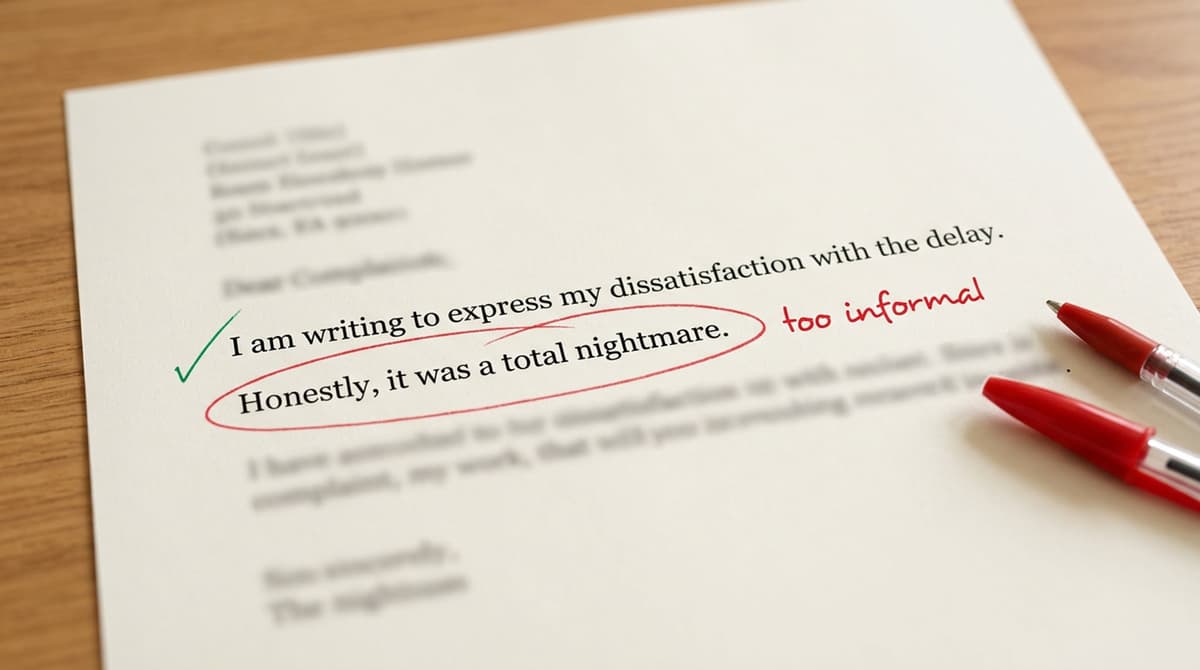
The 'Tonal Contamination' Error
This is the silent killer of Task Achievement scores. It occurs when a candidate, perhaps under pressure or attempting to showcase a broad vocabulary, inadvertently mixes lexical or syntactic features from different registers within the same letter.
Consider this example from a candidate writing a complaint letter to an airline (formal context):
"I am writing to express my profound dissatisfaction with the recent debacle regarding my lost luggage. Honestly, it was a total nightmare, and your customer service reps were completely useless. I demand a full refund ASAP."
Let's dissect the contamination:
- "I am writing to express my profound dissatisfaction with the recent debacle regarding my lost luggage." - Formal and appropriate.
- "Honestly, it was a total nightmare, and your customer service reps were completely useless." - Highly informal, emotional, and accusatory language. "Honestly," "total nightmare," "useless" are all register slips.
- "I demand a full refund ASAP." - "ASAP" is an informal abbreviation. While "I demand" is strong, the informal abbreviation undermines the formal tone. A more appropriate formal phrasing would be: "I expect a full refund without delay."
Examiner Trap: The examiner does not average out your tone. Inconsistent tone is a Band 6 feature in the Task Achievement descriptors, so a clear instance of tonal contamination can cost you the 7 the rest of the letter earned.
Strategic Bullet Point Development and Word Count Management
Beyond tone, Task Achievement also assesses whether you have 'covered all parts of the task' and 'presented a clear purpose'. These are inextricably linked to your register choices and word count allocation.
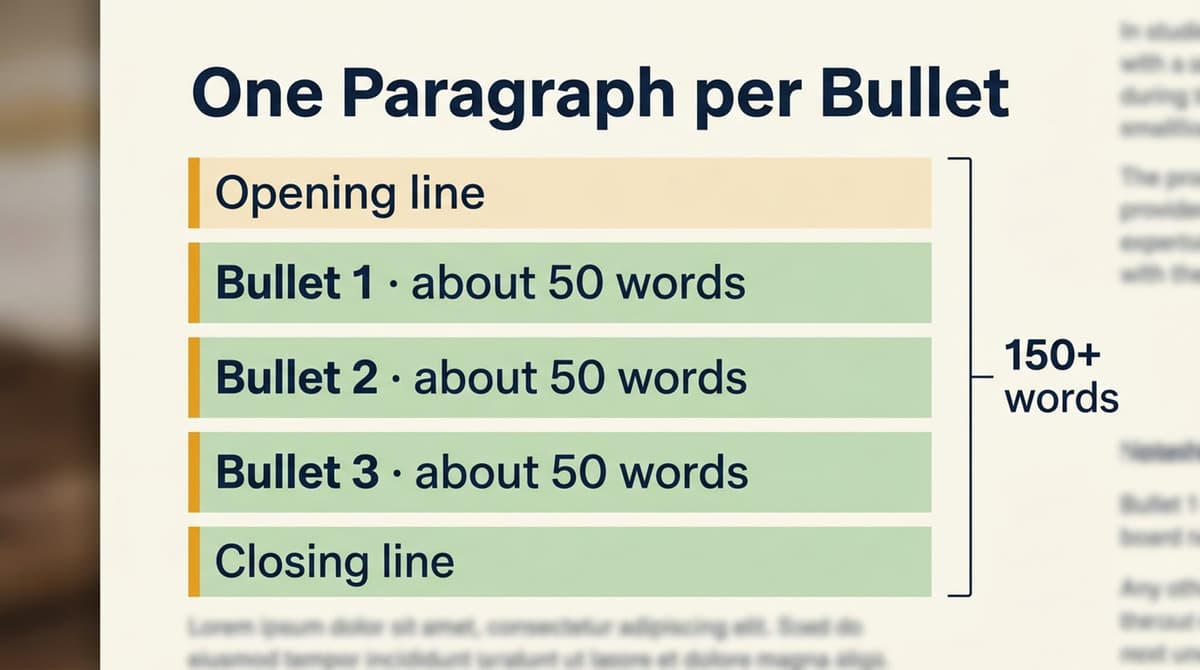
For a Band 9, aim for approximately 50-70 words per bullet point in the prompt. This ensures sufficient development without over-elaboration, allowing you to maintain a consistent tone and stay within the optimal word count (180-220 words for GT Task 1).
Each bullet point requires specific information and, crucially, must be expressed in the chosen register. For instance, if you are writing to a friend about a party:
- Bullet 1: Explain why you are writing. (e.g., "I'm writing to invite you to my birthday bash!") - Informal
- Bullet 2: Give details about the party. (e.g., "It's going to be on Saturday, the 15th, at my place, starting around 7 pm. We'll have loads of food and some cool tunes.") - Informal
- Bullet 3: Ask your friend to bring something. (e.g., "Could you possibly bring some of your famous brownies? They're always a hit!") - Informal, polite request.
Notice the consistent use of contractions, phrasal verbs, and casual vocabulary. Now, imagine if Bullet 3 was: "I would be most grateful if you could furnish a quantity of your confectionery items." This is a clear tonal contamination.
The Psychological Trap: Over-Correction
Many candidates, aware of the need for a good vocabulary, fall into the trap of over-correction. They assume that 'good vocabulary' always means 'complex vocabulary'. This is a profound misunderstanding of the Lexical Resource criterion.
Band 9 Rule: For Lexical Resource, the descriptor states 'uses a wide range of vocabulary with very natural and sophisticated control of lexical features; rare minor errors occur only as 'slips''. The key terms here are 'natural' and 'sophisticated control'. Sophisticated control means knowing *when* to use certain words, not just *that* you know them. Naturalness is directly linked to appropriate register.
If you are writing an informal letter, using natural, common phrasal verbs and idioms demonstrates sophisticated control of informal lexical features. Conversely, using formal academic vocabulary in an informal context is unnatural and inappropriate, leading to a lower score for Lexical Resource AND Task Achievement.
Self-Correction Mechanism:
- Initial Draft: Write your letter focusing primarily on addressing the bullet points.
- Register Check (First Pass): Read through, specifically looking for salutation, sign-off, and any obvious lexical mismatches (e.g., formal words in an informal letter, or slang in a formal letter).
- Consistency Check (Second Pass): Scrutinise every sentence. Ask yourself: "Would a native speaker use this exact phrasing in this specific context to this specific person?" If the answer is no, rephrase.
Key Note: This two-pass review is critical. It forces you to actively engage with the concept of register, moving beyond passive awareness to active calibration.
Common Scenarios and Band 9 Solutions
Scenario 1: Informal Letter (e.g., inviting a friend)
"Dear Mr. Smith, I am writing to formally invite you to a social gathering at my residence. I would be most grateful if you could confirm your attendance at your earliest convenience. Yours faithfully, John."
"Hi John, Hope you're doing well! I'm writing to invite you to a get-together at my place next Saturday. It would be great if you could make it. Let me know if you can come. Cheers, Mark."
Analysis: Consistent informal salutation, contractions, phrasal verbs ("get-together," "make it"), direct questions, and informal sign-off. Natural and appropriate.
Scenario 2: Semi-Formal Letter (e.g., complaining to a landlord)
"Yo Mr. Johnson, The heating's totally busted, and it's freezing! Sort it out ASAP, mate. I'm proper annoyed. See ya, Sarah."
"Dear Mr. Johnson, I am writing to inform you of a significant issue with the heating system in my apartment, which appears to be malfunctioning. The temperature has dropped considerably, causing discomfort. I would be grateful if you could arrange for a technician to inspect and repair it at your earliest convenience. Yours sincerely, Sarah Jones."
Analysis: Appropriate semi-formal salutation and sign-off. Formal, polite language ("significant issue," "malfunctioning," "causing discomfort"), avoidance of contractions, and a clear, polite request. No slang or overly emotional language.
Scenario 3: Formal Letter (e.g., applying for a job)
"Dear Sir/Madam, I'm writing to apply for the marketing gig you advertised. I reckon I'm a good fit 'cause I've got loads of experience. Hope to hear from you soon. Best, Alex."
"Dear Sir/Madam, I am writing to formally apply for the Marketing Assistant position, as advertised on your company website. My extensive experience in digital marketing, coupled with my proven track record in campaign management, aligns precisely with the requirements outlined in the job description. I am confident that my qualifications and skills would be a valuable asset to your organisation. I look forward to the opportunity to discuss my application further. Yours faithfully, Alex Chen."
Analysis: Formal salutation and sign-off. No contractions. Formal vocabulary ("formally apply," "extensive experience," "proven track record," "aligns precisely," "valuable asset"). Complex sentence structures. Professional and objective tone.
Final Examiner Advice: The Non-Negotiables
- Read the Prompt TWICE: Identify the audience and purpose without fail. This is your compass.
- Pre-Plan Your Register: Before writing, mentally (or physically) list 3-5 key lexical items and 1-2 syntactic structures appropriate for your chosen register.
- Salutation & Sign-off First: Write these down immediately. They set the tone and act as a constant reminder.
- Self-Correction is Key: Allocate 2-3 minutes at the end specifically for a 'register audit'. Scan for any words or phrases that feel out of place.
- Prioritise Appropriacy over Complexity: A simple, appropriate word will always score higher than a complex, inappropriate one.
Mastering tone consistency is not about memorising lists; it's about developing a deep linguistic sensitivity to context. By applying the Register Calibration Framework and diligently auditing your language choices, you will eliminate this common half-band barrier and confidently stride towards your Band 9 in General Training Writing Task 1.

Check yourself
3 questions · about 2 minutes · every answer explained
Was this strategy guide helpful?
Tell us if it helped. It shapes what we write next.
Band 9 Team
Written by the team that builds Band 9.
Candidate Discussion (0)
Join the conversation
Sign in to ask our examiners questions and participate in strategy discussions.
More Writing Strategies
The Process Diagram & Map Blueprint: Scoring Band 9.0 in Academic Task 1 Without Clichés
This masterclass deconstructs the common pitfalls in IELTS Academic Task 1 process diagrams and maps, revealing how to move beyond simplistic sequential descriptions to achieve a Band 9.0. Learn the examiner-approved 3-stage grouping protocol and the art of sophisticated passive voice transitions.
How to Write a Perfect Overview for Academic Task 1
Discover the two-sentence formula for crafting a Band 9 overview in IELTS Academic Task 1. Avoid common traps and learn to synthesise trends effectively for line graphs, bar charts, tables, and pie charts.